
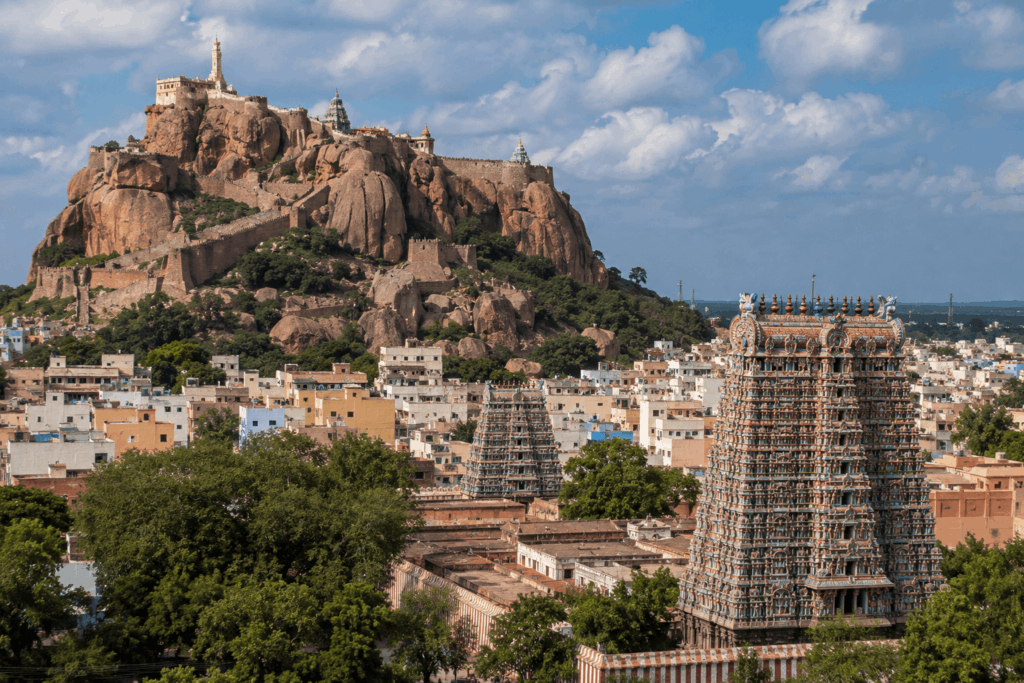
Tiruchirappalli, popularly known as Trichy , is one of the oldest continuously inhabited cities in South India. Located on the fertile banks of the Cauvery River in Tamil Nadu, the city has played a vital role in the political, cultural, religious, and economic history of the region for over two thousand years. With its iconic Rock Fort , the sacred island of Srirangam , and centuries-old temples, Tiruchirappalli stands as a living museum of Tamil civilization.
Throughout history, the city has been ruled by several powerful dynasties, including the Early Cholas, Pallavas, Pandyas, Vijayanagara rulers, Madurai Nayaks, the Carnatic Nawabs, and the British. Each dynasty left behind monuments, inscriptions, temples, irrigation systems, and administrative practices that continue to shape the city’s identity today.
Tiruchirappalli has also been a strategic military centre because of its location between northern and southern Tamil Nadu. The towering Rock Fort, built upon one of the world’s oldest rock formations, served as a natural fortress for successive rulers and became the focal point of many important battles during the Carnatic Wars.
Today, Tiruchirappalli is not only an important pilgrimage destination but also a leading educational, industrial, and tourism hub. For history enthusiasts, students, researchers, and competitive exam aspirants, the city offers valuable insights into the evolution of South Indian kingdoms, temple architecture, and colonial history.
This article explores the fascinating history of Tiruchirappalli—from its ancient origins and Sangam Age prominence to its transformation into one of Tamil Nadu’s most important modern cities.
The Origin of Tiruchirappalli
The origin of Tiruchirappalli is closely associated with local legends, ancient inscriptions, and religious traditions.
One widely accepted explanation is that the city’s name evolved from “Tiru-Chira-Palli, referring to a sacred settlement associated with a Jain monk named Chira. Over centuries, the name gradually became Tiruchirappalli.
Another tradition links the city’s history with the ancient Rock Fort hill, which has served as a place of worship and defence since early historical times.
Today, although commonly known as **Trichy**, the city’s official name remains Tiruchirappalli
Early Settlements
Archaeological discoveries indicate that the region surrounding Tiruchirappalli has been inhabited since prehistoric times.
Excavations have revealed:* Stone tools
Pottery fragments
Iron implements
Burial sites
Early inscriptions
The fertile lands nourished by the Cauvery River encouraged agriculture and permanent settlements long before organized kingdoms emerged.
Its strategic location also connected inland regions with coastal trading centres.
Tiruchirappalli During the Sangam Age
During the Sangam Age (approximately 300 BCE–300 CE), Tiruchirappalli formed part of the expanding Tamil cultural landscape.
The fertile Cauvery basin supported prosperous farming communities while nearby trade routes connected merchants with major ports on the east coast.
Sangam literature frequently praises the richness of the Cauvery region, describing:
Productive agriculture
Prosperous villages
Skilled craftsmen
Active trade
Powerful rulers
Although Madurai served as the principal literary centre, Tiruchirappalli benefited from the broader economic and cultural growth of the Sangam period.
Importance of the Cauvery River
The Cauvery River has been the lifeline of Tiruchirappalli throughout history.
Its waters sustained:
Agriculture
Drinking water
Trade
Irrigation
Religious activities
Ancient rulers built canals, tanks, and irrigation channels that transformed the surrounding plains into one of South India’s most productive agricultural regions.
The fertile delta produced:
Rice
Sugarcane
Cotton
Pulses
Vegetables
Agricultural prosperity strengthened the city’s economy and attracted merchants, artisans, and scholars.
The Early Cholas
The Cholas were among the earliest dynasties to influence the Tiruchirappalli region.
The fertile Cauvery basin became one of their political and economic strongholds.
Under Chola administration:
Agriculture expanded
Irrigation improved
Temples flourished
Trade increased
Villages became more organized
Stone inscriptions from the Chola period provide valuable information about taxation, village assemblies, land grants, and temple management.
Pallava Influence
During different periods, the Pallavas also exercised influence over parts of the region.
The Pallavas were renowned for:
Temple architecture
Rock-cut monuments
Administrative reforms
Promotion of religion
Their artistic traditions influenced later temple construction across Tamil Nadu.
Although Tiruchirappalli was not their principal capital, Pallava architectural ideas contributed to the development of sacred sites in the surrounding region.
Rise of the Medieval Cholas
The city gained greater importance during the Imperial Chola period.
Powerful rulers such as **Rajaraja Chola I** and **Rajendra Chola I** expanded the empire across South India and Southeast Asia.
The Tiruchirappalli region benefited through:
Improved irrigation
Temple construction
Agricultural development
Better administration
Trade expansion
Many villages around the city became prosperous because of efficient water management and fertile agricultural lands.
The Rock Fort
The Rock Fort is undoubtedly Tiruchirappalli’s most iconic historical monument.
Built upon a massive rock estimated to be more than **3 billion years old**, it is considered one of the oldest exposed rock formations on Earth.
The hill’s natural height made it an ideal defensive location.
Successive rulers strengthened the fort by adding:
Stone walls
Defensive gateways
Bastions
Watchtowers
Temples
Its commanding position allowed armies to monitor movement across the surrounding plains.
Over the centuries, the Rock Fort became one of South India’s most strategically important military strongholds.
Religious Importance
Tiruchirappalli has long been an important religious centre.
Several faiths flourished in different periods, including:
Hinduism
Jainism
Buddhism
Ancient temples became centres of:
Education
Music
Dance
Charity
Literature
The nearby island of **Srirangam**, home to the famous Ranganathaswamy Temple, eventually developed into one of the most sacred pilgrimage destinations in India.
Growth of Trade
Trade played an essential role in Tiruchirappalli’s development.
Merchants transported agricultural products, textiles, metals, and handicrafts across South India.
Roads connected the city with:
Thanjavur
Madurai
Karur
Kanchipuram
Coastal ports
Commercial prosperity encouraged urban growth and supported temple construction.
Education and Culture
Ancient Tiruchirappalli became known for its learning traditions.
Temples supported scholars engaged in:
Tamil literature
Sanskrit studies
Philosophy
Mathematics
Astronomy
Cultural activities such as music and dance flourished under royal patronage, helping preserve South India’s artistic heritage.
Why Tiruchirappalli Became Important
Several factors contributed to the city’s historical prominence:
Strategic location
Fertile Cauvery basin
Strong agricultural economy
Military significance
Religious importance
Active trade routes
Efficient irrigation
Political stability under major dynasties
These advantages ensured that successive rulers regarded Tiruchirappalli as a valuable administrative and military centre.
Legacy of Ancient Tiruchirappalli
Modern Tiruchirappalli continues to preserve its ancient heritage through:
Rock Fort
Temple inscriptions
Historic streets
Ancient irrigation systems
Cultural festivals
Traditional arts
The city’s remarkable continuity makes it one of the finest examples of a living historical city in India.