
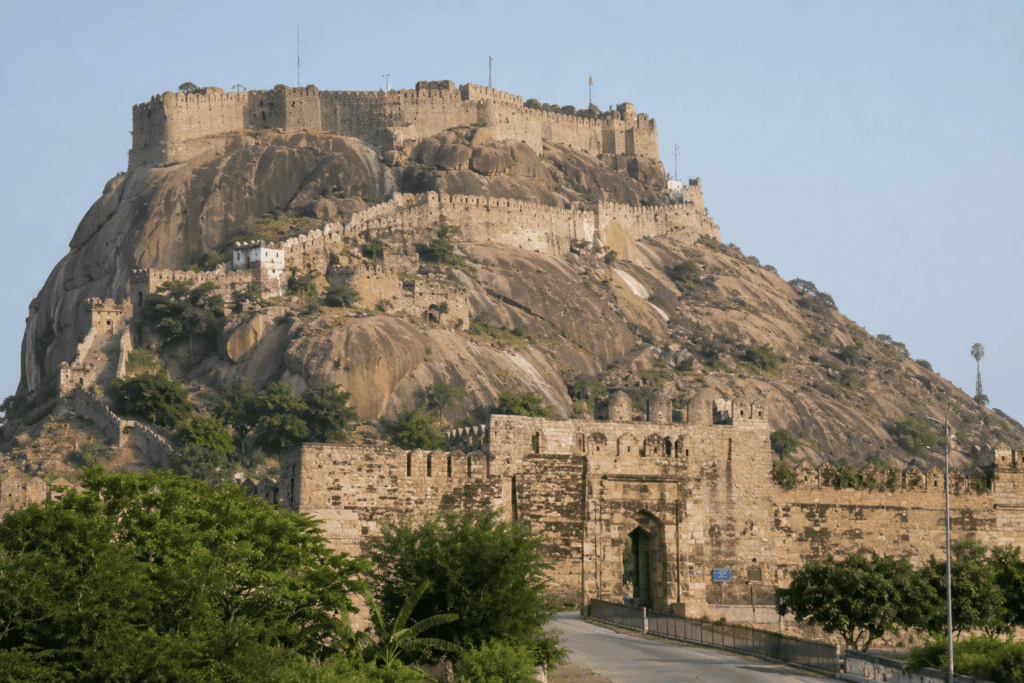
Standing proudly atop a massive rocky hill in the heart of Dindigul, Tamil Nadu, Dindigul Fort is one of South India’s most impressive hill forts. Rising approximately 280 feet (85 metres) above the surrounding plains, the fort has served as a military stronghold, administrative center, and strategic defense post for more than four centuries. Its commanding location, strong granite walls, ingenious water storage systems, and rich historical legacy have made it one of Tamil Nadu’s most significant heritage monuments.
Built during the reign of the Madurai Nayaks in the 17th century, Dindigul Fort later came under the control of the Mysore Kingdom, where it was strengthened by Hyder Ali and Tipu Sultan. Eventually, it became an important military station under the British East India Company after the Anglo-Mysore Wars.
Today, Dindigul Fort is protected by the Archaeological Survey of India (ASI) and attracts thousands of tourists, history enthusiasts, architecture lovers, students, researchers, and photographers every year. Visitors come not only to admire its remarkable engineering but also to enjoy panoramic views of the surrounding landscape.
Whether you are exploring Tamil Nadu’s rich heritage, preparing for competitive examinations, or simply fascinated by India’s military history, Dindigul Fort offers an unforgettable journey into the past.
Where Is Dindigul Fort Located?
Dindigul Fort is located in Dindigul city, Tamil Nadu.
Approximate distances:
- Madurai – 65 km
- Karur – 80 km
- Tiruchirappalli – 100 km
- Coimbatore – 150 km
- Chennai – 420 km
The fort dominates the city’s skyline and is visible from almost every part of Dindigul.
Origin of Dindigul Fort
The rocky hill itself has existed for millions of years, but the present fort was constructed during the 17th century.
Historians generally credit Muthu Krishnappa Nayak, a ruler of the Madurai Nayak Kingdom, with building the original stone fort around 1605 CE.
Its elevated position made it an ideal location for defending the surrounding region.
Why Was Dindigul Fort Built?
The Madurai Nayaks needed a powerful military fortress to protect their territories from invading armies.
The fort served several important functions:
- Military defense
- Administrative headquarters
- Storage of weapons
- Protection of trade routes
- Observation of enemy movements
- Safe refuge during wars
Its natural rocky foundation greatly strengthened its defenses.
Rule Under the Madurai Nayaks
The Nayaks developed Dindigul into one of the strongest military centers in southern Tamil Nadu.
They constructed:
- Thick granite walls
- Defensive gateways
- Bastions
- Watchtowers
- Barracks
- Water reservoirs
- Temples
The fort became a crucial part of the Nayak defense system.
Hyder Ali and the Mysore Kingdom
In the 18th century, Hyder Ali captured Dindigul Fort and recognized its strategic importance.
He transformed the fort into a major military headquarters.
Important developments included:
- Strengthening defensive walls
- Expanding military facilities
- Improving water storage
- Stationing large numbers of soldiers
For several years, Dindigul served as one of Hyder Ali’s principal military bases in Tamil Nadu.
Tipu Sultan’s Rule
Following Hyder Ali’s death, Tipu Sultan inherited control of Dindigul Fort.
He continued strengthening the fort and used it to defend Mysore’s southern territories against British expansion.
Tipu Sultan’s administration also improved:
- Military infrastructure
- Supply systems
- Strategic communication routes
British East India Company
After the Third Anglo-Mysore War (1792), the British East India Company gained control of Dindigul Fort.
The British used the fort for:
- Military administration
- Arms storage
- Barracks
- Regional governance
Although advances in artillery reduced the military importance of hill forts, Dindigul Fort remained an important administrative center.
Architecture of Dindigul Fort
Dindigul Fort is considered one of the finest examples of military architecture in South India.
Granite Hill
The fort stands atop a massive granite rock.
The steep natural slopes created a powerful defensive barrier that made direct attacks extremely difficult.
Fortification Walls
Massive granite walls surround the summit.
These walls include:
- Defensive bastions
- Observation points
- Guard towers
- Stone parapets
Many sections remain remarkably well preserved.
Defensive Gateways
The entrance gates were designed with narrow approaches that slowed enemy movement.
Heavy wooden doors reinforced with iron spikes protected against attacks.
Cannon Platforms
Several elevated platforms were built for mounting cannons.
These allowed defenders to fire upon approaching armies from advantageous positions.
Water Management System
One of Dindigul Fort’s greatest engineering achievements is its sophisticated water management.
The builders constructed:
- Rainwater harvesting tanks
- Stone reservoirs
- Wells
- Drainage channels
These systems ensured reliable water supplies during prolonged sieges.
Secret Passages
Local traditions mention hidden tunnels that may have connected different parts of the fort.
Although many have collapsed or remain inaccessible, they illustrate the advanced military planning of the period.
Temples Inside the Fort
Several small temples are located within the fort complex.
These shrines served soldiers and local residents during times of peace and conflict.
They also reflect the close relationship between religion and governance in medieval South India.
Daily Life Within the Fort
Dindigul Fort functioned as a self-sufficient military settlement.
Facilities included:
- Soldiers’ quarters
- Granaries
- Administrative buildings
- Weapon storage
- Water tanks
- Temples
- Guard rooms
During wartime, the fort could accommodate a substantial military force.
Military Engineering
The builders carefully combined natural geography with advanced defensive planning.
Key features include:
- Steep rocky slopes
- Thick granite walls
- Elevated watchtowers
- Bastions
- Cannon platforms
- Water reservoirs
- Narrow access routes
These elements made the fort extremely difficult to capture.
Strategic Importance
Dindigul occupied an important location connecting:
- Madurai
- Tiruchirappalli
- Coimbatore
- Palani
- Western Ghats
Control of the fort meant control over major trade and military routes.
Dindigul Fort Today
Today, Dindigul Fort is maintained by the Archaeological Survey of India.
Visitors can explore:
- Ancient gateways
- Bastions
- Water tanks
- Cannon platforms
- Stone stairways
- Watchtowers
- Scenic viewpoints
The panoramic view from the summit is one of the fort’s greatest attractions.
Best Time to Visit
The ideal months are:
- October
- November
- December
- January
- February
Morning and evening visits provide pleasant weather and excellent photography opportunities.
Travel Tips
If you plan to visit:
- Wear comfortable trekking shoes.
- Carry drinking water.
- Wear a hat or cap.
- Start early in the morning.
- Allocate at least two hours for exploration.
- Follow ASI guidelines.
- Avoid littering.
Importance for Competitive Exams
Dindigul Fort frequently appears in UPSC, TNPSC, SSC, Railways, and university examinations.
Important facts:
- Located in Dindigul district.
- Built by Muthu Krishnappa Nayak.
- Strengthened by Hyder Ali.
- Controlled by Tipu Sultan.
- Captured by the British after the Anglo-Mysore Wars.
- Protected by the Archaeological Survey of India.
- Famous for its military engineering and water management.
Lesser-Known Facts
- The granite hill resembles a pillow, which is believed to have inspired the name “Dindigul” from the Tamil words meaning “pillow rock.”
- Hyder Ali used the fort as one of his principal military headquarters in southern India.
- The rainwater harvesting system within the fort continues to demonstrate the engineering expertise of medieval builders.
- Several original cannons and cannon platforms remain visible today.
- The fort offers panoramic views of the Sirumalai Hills and the surrounding countryside.
Why Dindigul Fort Matters Today
Dindigul Fort is not just a historical monument—it is a symbol of Tamil Nadu’s military heritage and architectural excellence. It reflects the ingenuity of the Madurai Nayaks, the strategic vision of Hyder Ali and Tipu Sultan, and the changing political landscape of South India during the colonial era.
For students and researchers, the fort provides valuable insights into medieval warfare, fort construction, and regional history. For travelers, it offers a blend of adventure, history, and breathtaking natural beauty.