
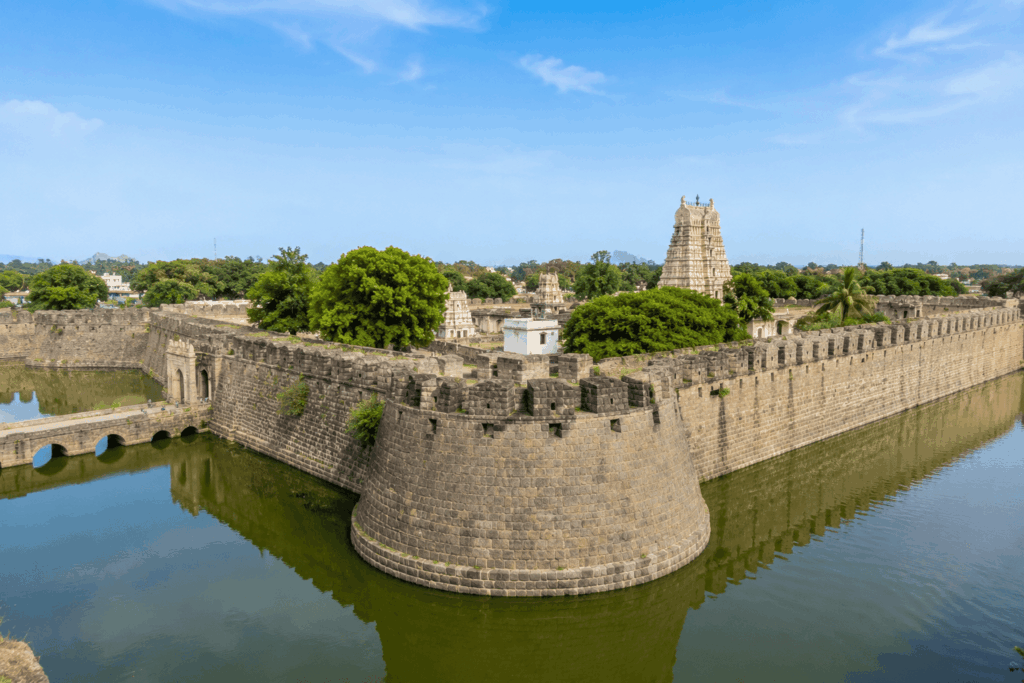
Standing proudly in the heart of **Vellore, Tamil Nadu**, Vellore Fort is one of India’s finest examples of medieval military architecture. Surrounded by a massive moat, towering granite walls, and powerful bastions, the fort has witnessed over four centuries of South Indian history. From the rule of the Vijayanagara Empire and the Bijapur Sultans to the Marathas, the Mughal Empire, the Nawabs of Arcot, and finally the British East India Company, Vellore Fort has remained a silent witness to political change, warfare, and the early struggle for India’s independence.
One of the fort’s most significant historical events was the **Vellore Mutiny of 1806 regarded by many historians as one of the earliest organized military rebellions against British colonial rule. Decades before the Revolt of 1857, Indian soldiers stationed at Vellore challenged British authority, making the fort an important symbol in India’s freedom movement.
Today, Vellore Fort is a protected monument under the Archaeological Survey of India (ASI)**. It attracts thousands of visitors every year, including history enthusiasts, students, researchers, photographers, and tourists eager to explore its remarkable architecture and rich historical legacy.
Whether you are preparing for competitive examinations, planning a heritage tour of Tamil Nadu, or simply fascinated by India’s past, Vellore Fort offers an unforgettable journey through centuries of history.
Where Is Vellore Fort Located?
Vellore Fort is situated in the city of **Vellore**, approximately:
140 km from Chennai
65 km from Ranipet
130 km from Tiruvannamalai
210 km from Bengaluru
Its strategic location on important trade and military routes made it one of South India’s most valuable fortresses.
Construction of Vellore Fort
Vellore Fort was built during the 16th century, around 1566 CE by Chinna Bommi Nayak and Thimma Reddy Nayak, who were regional chieftains under the Vijayanagara Empire.
The builders selected granite as the primary construction material because of its exceptional strength and durability. Even after more than 450 years, much of the original structure remains intact, reflecting the advanced engineering skills of its builders.
Why Was Vellore Fort Built?
The Vijayanagara rulers needed a powerful military stronghold to protect their territories in northern Tamil Nadu.
The fort served several purposes:
Military defense
Administrative headquarters
Protection of trade routes
Storage of weapons and supplies
Royal residence
Refuge during invasions
Its strong defensive design made it one of the most secure forts in South India.
Rule Under the Vijayanagara Empire
During the Vijayanagara period, Vellore Fort flourished as an important military and administrative center.
The empire invested heavily in strengthening the fort by constructing:
Massive granite walls
Watchtowers
Bastions
Defensive gateways
Water systems
Storage facilities
The fort’s architecture reflects the military expertise of the Vijayanagara rulers.
Control by the Bijapur Sultanate
Following the decline of the Vijayanagara Empire after the Battle of Talikota (1565) Vellore Fort came under the control of the Bijapur Sultanate
Although the rulers changed, the fort retained its strategic importance because of its location and strong defenses.
Maratha Occupation
During the late 17th century, the Marathas captured Vellore Fort under the leadership of **Chhatrapati Shivaji Maharaj’s** successors.
The Marathas recognized the fort as a valuable military base and used it to strengthen their influence in South India.
Mughal Rule
In the early 18th century, the Mughal Empire expanded into South India.
Under **Emperor Aurangzeb**, Mughal forces captured Vellore Fort, making it part of their southern territories.
The fort later came under the administration of the **Nawabs of Arcot**, who ruled much of the Carnatic region.
British East India Company
The British East India Company gradually gained control over Vellore Fort during the late 18th century.
Recognizing its military value, they transformed the fort into an important military garrison.
British troops and Indian sepoys were stationed within its walls, setting the stage for one of India’s earliest military uprisings.
The Vellore Mutiny of 1806
The most famous event associated with Vellore Fort is undoubtedly the **Vellore Mutiny**, which took place on **10 July 1806**.
What Caused the Mutiny?
The British introduced new military regulations that offended the religious beliefs and cultural traditions of Indian soldiers.
These included:
Restrictions on wearing religious symbols
Changes in dress regulations
Growing dissatisfaction with British policies
The resentment among Indian soldiers eventually erupted into rebellion.
The Revolt
On the night of10 July 1806 Indian sepoys attacked the British garrison inside Vellore Fort.
The rebels:
Captured sections of the fort
Killed several British officers
Raised the flag associated with the Mysore royal family
However, British reinforcements from Arcot quickly suppressed the uprising.
Although the rebellion lasted only a short time, it became one of the earliest organized armed revolts against British rule in India.
Historical Importance
The Vellore Mutiny demonstrated that Indian soldiers could unite against colonial authority.
Many historians consider it a precursor to the **Revolt of 1857**, often referred to as India’s First War of Independence.
Today, the mutiny is remembered as an important milestone in India’s freedom struggle.
Architecture of Vellore Fort
Vellore Fort is regarded as one of the finest examples of military engineering in India.
Granite Walls
The fort is surrounded by thick granite walls designed to withstand enemy attacks.
The walls feature:
Defensive bastions
Guard towers
Strategic firing positions
Massive Moat
One of the fort’s most striking features is its broad moat.
Historically, the moat contained water and was said to have housed crocodiles, providing additional protection against invading armies.
Fort Gates
The entrance gates were carefully designed to slow advancing enemies.
Heavy wooden doors reinforced with iron spikes protected the fort from elephant attacks.
Jalakandeswarar Temple
Located inside the fort, the **Jalakandeswarar Temple** is one of Tamil Nadu’s finest examples of Vijayanagara architecture.
Highlights include:
Intricate stone carvings
Beautiful mandapas
Ornate pillars
Rich sculptural details
Dravidian-style gopuram
The temple remains an active place of worship and is one of the fort’s main attractions.
St. John’s Church
The British constructed **St. John’s Church** within the fort during the 19th century.
Its presence reflects the colonial history of the fort and the coexistence of different architectural traditions.
Government Museum
The Government Museum inside Vellore Fort displays:
Ancient sculptures
Coins
Weapons
Archaeological artifacts
Historical documents
The museum provides visitors with valuable insights into the fort’s long history.
Military Engineering
The fort’s defensive system demonstrates remarkable planning.
Key features include:
Double fortification
Granite ramparts
Bastions
Watchtowers
Water-filled moat
Secret passages
Strong gateways
These elements made the fort extremely difficult to capture.
Cultural Importance
Vellore Fort reflects the diverse cultural influences of successive rulers.
Within the fort complex, visitors can find:
Hindu temple
Christian church
Nearby mosque
Colonial buildings
Traditional South Indian architecture
This diversity symbolizes the region’s rich historical heritage.
Conservation
Today, Vellore Fort is protected by the Archaeological Survey of India.
Conservation work focuses on:
Structural repairs
Cleaning stone walls
Protecting sculptures
Visitor facilities
Archaeological research
These efforts help preserve the monument for future generations.
Visiting Vellore Fort
The fort is open throughout the year and is one of the most popular tourist destinations in northern Tamil Nadu.
Visitors should:
Wear comfortable footwear.
Carry drinking water.
Visit during the cooler months (October–February).
Allocate 2–3 hours to explore the complex.
Visit the museum and Jalakandeswarar Temple.
Importance for Competitive Exams
Vellore Fort is frequently covered in UPSC, TNPSC, SSC, Railways, and university examinations.
Important facts include:
Built around 1566 CE.
Constructed by Chinna Bommi Nayak and Thimma Reddy Nayak.
Built under the Vijayanagara Empire.
Famous for the Vellore Mutiny of 1806.
Protected by the Archaeological Survey of India.
Houses the Jalakandeswarar Temple.
Features one of India’s best-preserved granite fortifications.
Lesser-Known Facts
The granite used in the fort’s construction was sourced locally and carefully shaped without modern machinery.
The fort’s moat is among the widest in South India.
Members of the Mysore royal family, including relatives of Tipu Sultan, were once imprisoned within the fort.
Several scenes from Indian films have been shot at Vellore Fort due to its impressive architecture.
The fort continues to host cultural and heritage events that promote awareness of Tamil Nadu’s rich history.