
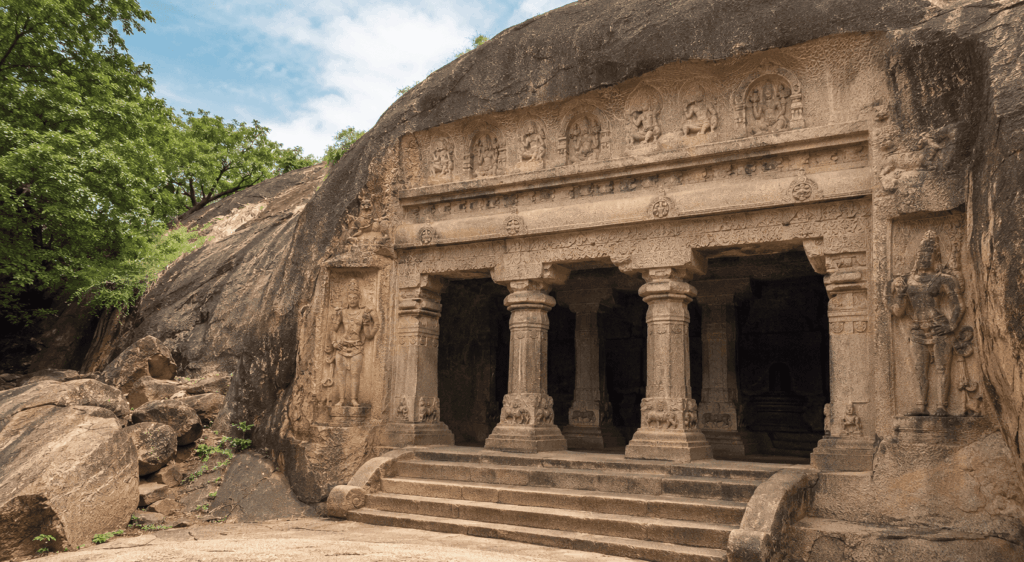
Tamil Nadu is often celebrated for its towering temple gopurams, magnificent Chola architecture, and centuries-old spiritual traditions. However, long before the construction of massive structural temples, ancient craftsmen created extraordinary places of worship by carving directly into living rock. These remarkable monuments, known as rock-cut temples , represent some of the earliest surviving examples of temple architecture in South India.
Unlike conventional temples built with bricks or stone blocks, rock-cut temples were sculpted from a single rock face or hillside. Every pillar, shrine, sculpture, ceiling, and wall was painstakingly carved by hand using simple iron tools and remarkable engineering skills. These monuments stand as lasting evidence of the artistic excellence, religious devotion, and technological advancement of ancient Tamil civilization.
Today, Tamil Nadu is home to dozens of rock-cut temples built mainly during the **Pallava** and Pandya periods. Many of these temples are more than 1,300 years old and continue to attract historians, archaeologists, architects, pilgrims, photographers, and tourists from around the world.
In this article, we explore the fascinating history, architecture, cultural significance, and famous rock-cut temples of Tamil Nadu.
What Are Rock-Cut Temples?
Rock-cut temples are monuments carved directly into natural rock formations rather than constructed using separate building materials. Instead of assembling stones one by one, ancient sculptors removed unwanted portions of solid rock to create temples complete with halls, pillars, sanctums, sculptures, and decorative carvings.
This method required extraordinary precision because any mistake during carving could permanently damage the monument. Since the entire structure was created from a single rock mass, there was no possibility of replacing damaged sections.
Rock-cut architecture represents one of the earliest forms of temple construction in India and laid the foundation for later structural temples.
The Origins of Rock-Cut Architecture in India
India’s tradition of rock-cut architecture dates back to the **3rd century BCE**, during the reign of Emperor Ashoka of the Maurya Empire. Early examples include the **Barabar Caves** in Bihar, which were carved for Ajivika monks.
Over the following centuries, Buddhist monks expanded the rock-cut tradition by creating magnificent cave monasteries and prayer halls at places such as Ajanta, Ellora, Karla, Bhaja, and Kanheri.
Inspired by these earlier works, Hindu rulers in South India adapted the technique to create temples dedicated to Shiva, Vishnu, Durga, and other deities. Tamil Nadu soon became one of the most important centers of Hindu rock-cut architecture.
The Beginning of Rock-Cut Temples in Tamil Nadu
The history of rock-cut temples in Tamil Nadu begins with the **Pallava Dynasty**, which ruled large parts of northern Tamil Nadu between the 4th and 9th centuries CE.
Although earlier shrines may have existed in wood and brick, many of them have disappeared due to the effects of time and climate. The Pallavas chose stone because of its durability and permanence.
Their experiments in carving temples directly into hills and rocky outcrops revolutionized South Indian temple architecture.
Historians consider these monuments the stepping stones that eventually led to the construction of grand structural temples such as the Brihadeeswarar Temple at Thanjavur and the Kailasanathar Temple at Kanchipuram.
The Pallava Dynasty: Pioneers of Rock-Cut Architecture
No discussion of Tamil Nadu’s rock-cut temples is complete without mentioning the Pallavas.
The Pallava kings were not only skilled administrators and military leaders but also great patrons of art, architecture, literature, and religion. Their reign transformed Kanchipuram into one of South India’s greatest cultural capitals.
Among all Pallava rulers, **Mahendravarman I (c. 600–630 CE)** played the most important role in the development of rock-cut architecture.
Mahendravarman I: The Visionary Temple Builder
Mahendravarman I is widely regarded as the father of South Indian rock-cut temple architecture.
Before his reign, temples were mostly constructed using timber, brick, and other perishable materials. Mahendravarman introduced the revolutionary idea of carving temples directly into stone.
His inscriptions proudly state that some temples were built without the use of bricks, timber, metal, or mortar , emphasizing the durability of stone architecture.
Several cave temples across Tamil Nadu bear inscriptions referring to him, making it easier for historians to trace the evolution of Pallava architecture.
Why Did Ancient Kings Build Rock-Cut Temples?
Several factors influenced the construction of rock-cut temples:
Religious Devotion
The temples served as sacred spaces where devotees could worship Shiva, Vishnu, and other deities.
Durability
Stone monuments could survive natural disasters, fire, and weather far better than wooden or brick structures.
Royal Prestige
Temple construction showcased the wealth, power, and artistic vision of the ruling dynasty.
Cultural Identity
These monuments promoted Hindu traditions while strengthening the kingdom’s cultural influence.
Artistic Innovation
Rock-cut temples allowed sculptors to experiment with new forms of architecture and sculpture that later evolved into freestanding temples.
How Were Rock-Cut Temples Carved?
One of the most fascinating aspects of these temples is the engineering behind them.
Ancient craftsmen began by selecting a suitable rocky hill or cliff. Instead of building upwards, they carved inward from the rock surface.
The process involved:
Marking the temple layout
Removing unwanted rock
Carving pillars first
Creating the hall (mandapa)
Sculpting the sanctum (garbhagriha)
Adding decorative carvings
Polishing the surfaces
Engraving inscriptions
Iron chisels, hammers, and simple measuring tools were the primary instruments used.
Considering the limited technology available during the 7th century, the precision achieved by these artisans remains astonishing.
Architectural Features of Tamil Nadu’s Rock-Cut Temples
Although each temple has unique characteristics, most share several common architectural elements.
Pillared Halls
Visitors first enter an open hall supported by beautifully carved pillars. Early Pallava pillars are relatively simple but elegant, while later examples become increasingly elaborate.
Sanctum (Garbhagriha)
At the rear of the cave lies the sanctum, where the principal deity is installed.
Most early temples are dedicated to Lord Shiva, although Vishnu and other deities also appear.
Dvarapalas (Guardian Deities)
Almost every rock-cut temple features impressive guardian figures standing at the entrance of the sanctum.
These powerful sculptures symbolize divine protection and display remarkable artistic detail.
Relief Sculptures
Temple walls often depict scenes from Hindu mythology, including:
Shiva as Nataraja
Shiva with Parvati
Vishnu in various incarnations
Durga slaying Mahishasura
Ganesha
Kartikeya
Linga worship
These carvings served both religious and educational purposes.
Famous Rock-Cut Temples of Tamil Nadu
1. Mandagapattu Cave Temple
Located near Villupuram, the Mandagapattu Cave Temple is considered the first known rock-cut Hindu temple in Tamil Nadu
It was commissioned by Mahendravarman I during the early 7th century CE.
The temple is historically significant because its inscription proudly declares that it was constructed without bricks, timber, metal, or mortar .
Dedicated to the Hindu Trinity—Brahma, Vishnu, and Shiva—the temple marks the beginning of Pallava stone architecture.
Although modest in appearance, its historical value is immense.
2. Mamandur Cave Temples
Situated near Kanchipuram, the Mamandur cave complex consists of four rock-cut caves carved during the Pallava period.
The temples include:
Large pillared halls
Incomplete excavation sites
Shiva shrines
Ancient inscriptions
These caves provide valuable insights into the experimental phase of Pallava architecture.
Some caves appear unfinished, allowing archaeologists to understand the carving techniques used by ancient craftsmen.
3. Mahendravadi Cave Temple
The Mahendravadi temple is another masterpiece attributed to Mahendravarman I.
Located in present-day Ranipet district, this cave temple is dedicated to Lord Vishnu.
Its elegant façade, symmetrical pillars, and well-proportioned shrine reflect the growing confidence of Pallava architects.
The temple also contains inscriptions that help historians date the monument accurately.
4. Dalavanur Cave Temple
The Dalavanur Cave Temple showcases early Pallava artistic excellence.
Its notable features include:
Gracefully carved pillars
Shiva shrine
Intricate sculptures
Well-preserved inscriptions
The temple demonstrates how Pallava architects gradually refined their architectural techniques.
5. Siyamangalam Rock-Cut Temple
Located in Tiruvannamalai district, the Siyamangalam temple is among the finest examples of Pallava cave architecture.
Dedicated to Lord Shiva, the temple is famous for:
Massive dvarapalas
Beautiful lion-based pillars
Elegant façade
Ancient inscriptions
Many historians believe this temple reflects the transition from simple cave architecture to more sophisticated structural temples.
6. Tiruchirappalli Rock Fort Cave Temple
The famous Rock Fort at Tiruchirappalli contains one of Tamil Nadu’s oldest cave temples.
Built during the Pallava period and later expanded by subsequent dynasties, the cave features:
Rock-cut sanctum
Shiva shrine
Ancient inscriptions
Sculptures depicting Gangadhara Shiva
The temple combines natural geological beauty with exceptional craftsmanship.
Religious Importance of Rock-Cut Temples
These temples were far more than architectural achievements.
They functioned as:
Centers of worship
Educational institutions
Cultural gathering places
Artistic workshops
Pilgrimage destinations
Royal symbols of patronage
Many continue to host daily rituals and annual festivals, preserving traditions that have endured for over a millennium.
The Legacy of Pallava Architecture
The innovations introduced in Tamil Nadu’s rock-cut temples influenced later dynasties, especially the Cholas and Vijayanagara rulers.
Architectural features first tested in cave temples—such as pillared halls, sanctums, lion-based columns, and sculptural programs—were later adapted into monumental stone temples across South India.
The legacy of these early cave shrines can still be seen in many of Tamil Nadu’s most famous temples today.