
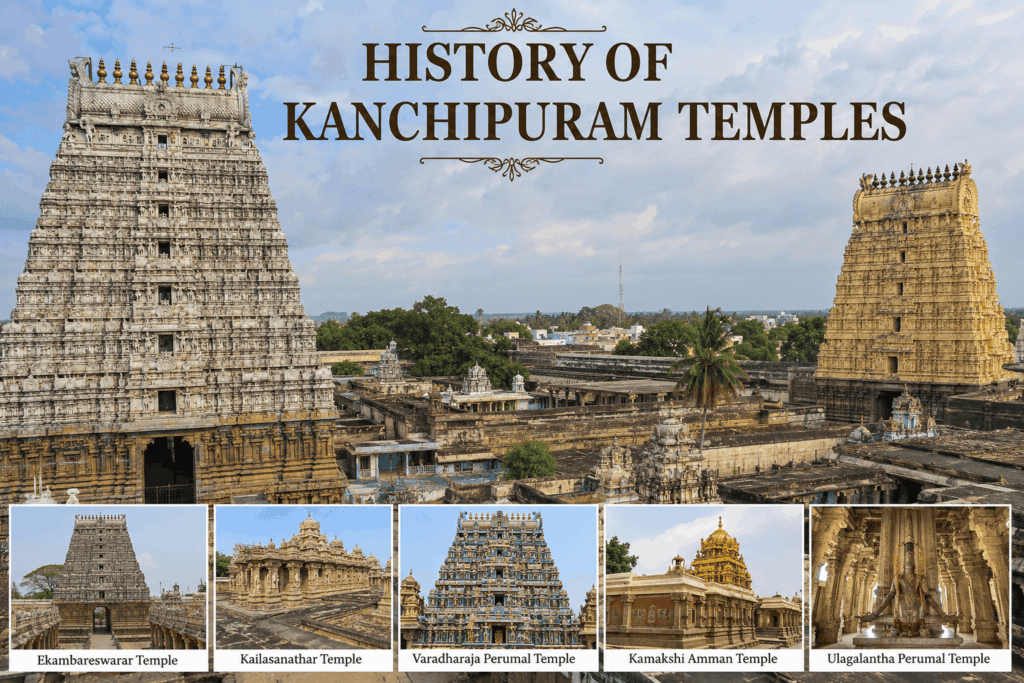
Kanchipuram, often called the City of a Thousand Temples is one of India’s oldest and most sacred cities. Located in the Tamil Nadu state, about 75 kilometers southwest of Chennai, Kanchipuram has been a major center of religion, education, architecture, and culture for more than 2,000 years. It is regarded as one of the seven sacred cities (Sapta Puri) in Hinduism, where attaining salvation (moksha) is believed to be possible.
For centuries, kings, saints, scholars, and devotees have contributed to the city’s remarkable spiritual heritage. The temples of Kanchipuram are not merely places of worship—they are masterpieces of Dravidian architecture, centers of classical learning, and living museums that preserve South India’s rich history.
Today, Kanchipuram attracts millions of pilgrims, history enthusiasts, architects, researchers, students, and tourists from India and around the world. Every temple in the city tells a fascinating story of devotion, artistic excellence, royal patronage, and timeless traditions.
Why is Kanchipuram Famous?
Kanchipuram is renowned for several reasons:
Ancient Hindu temples
Rich Dravidian architecture
Silk saree weaving industry
Religious importance
Historical monuments
Cultural festivals
Classical education during ancient times
The city is equally important for both Shaivism (worship of Lord Shiva) and Vaishnavism (worship of Lord Vishnu). It is one of the few places where magnificent temples dedicated to both deities exist side by side.
Apart from Hinduism, Kanchipuram also played a significant role in Buddhism and Jainism during different periods of history.
The Ancient History of Kanchipuram
The history of Kanchipuram dates back more than two millennia. Historical records, inscriptions, Sangam literature, and archaeological evidence indicate that Kanchipuram flourished as an important urban center even before the Common Era.
The city finds mention in ancient Tamil Sangam literature, Sanskrit texts, and the travel accounts of Chinese Buddhist monk Xuanzang (Hiuen Tsang), who visited India during the 7th century CE.
According to historical accounts, Xuanzang described Kanchipuram as:
A prosperous city
A center of education
Home to numerous temples
A place where Hinduism and Buddhism coexisted peacefully
His writings remain valuable historical evidence about the city’s significance during the Pallava period.
Kanchipuram During the Pallava Dynasty
The golden age of Kanchipuram began under the Pallava rulers between the 4th and 9th centuries CE.
The Pallavas transformed Kanchipuram into one of South India’s greatest capitals. They encouraged:
Temple construction
Sculpture
Literature
Sanskrit education
Tamil culture
Religious tolerance
Many of today’s famous temples were either built or significantly expanded by Pallava kings.
Some notable Pallava rulers include:
Mahendravarman
Mahendravarman I was one of the earliest temple builders of South India.
His contributions include:
Rock-cut temples
Cave architecture
Promotion of arts
Sanskrit literature
He laid the foundation for later temple architecture.
Narasimhavarman I (Mamalla)
Narasimhavarman I defeated the Chalukyas and expanded the Pallava kingdom.
He is famous for:
Strengthening Kanchipuram
Patronizing temple architecture
Building monuments
Supporting scholars
His reign witnessed remarkable artistic achievements.
Narasimhavarman II (Rajasimha)
Perhaps the greatest temple builder among the Pallavas.
He commissioned one of India’s earliest structural stone temples:
Kailasanathar Temple
This temple became a model for later Dravidian architecture across South India.
Kanchipuram Under the Cholas
After the Pallavas, the mighty Chola dynasty took control of Kanchipuram.
The Cholas:
Expanded temples
Added towering gopurams
Built mandapams
Installed bronze idols
Improved irrigation
Encouraged temple administration
The Cholas viewed temples not only as religious centers but also as economic institutions.
Many temples received:
Agricultural lands
Donations
Gold
Jewels
Villages
Temple inscriptions reveal valuable information about administration, taxation, trade, education, and social life.
Vijayanagara Empire’s Contributions
Between the 14th and 16th centuries, the Vijayanagara rulers renovated several temples.
Their contributions include:
Tall entrance towers (Rajagopurams)
Large marriage halls
Temple corridors
Stone pillars
Sculptures depicting mythology
Many of the grand features visitors admire today belong to the Vijayanagara period.
Kanchipuram – A Religious Capital
Kanchipuram has long been regarded as a spiritual capital of South India.
The city is divided into two traditional sections:
Shiva Kanchi
Dedicated primarily to Lord Shiva.
Famous temples include:
Ekambareswarar Temple
Kailasanathar Temple
Vishnu Kanchi
Dedicated mainly to Lord Vishnu.
Famous temples include:
Varadharaja Perumal Temple
Ulagalantha Perumal Temple
Yathothkari Perumal Temple
This coexistence reflects the city’s inclusive religious heritage.
The Famous Kanchipuram Temples
1. Ekambareswarar Temple
The Ekambareswarar Temple is among the largest Shiva temples in India.
Historical Importance
The temple’s origins date back over 1,500 years.
The Pallavas initiated construction.
Later expansions were made by:
Cholas
Vijayanagara kings
Nayaks
Unique Features
Massive Rajagopuram (about 59 meters)
Ancient mango tree believed to be over 3,000 years old
Thousand-pillared hall
Large temple tank
Beautiful sculptures
Religious Belief
The temple represents the **Earth Element (Prithvi)** among the Pancha Bhoota Sthalams.
Devotees believe Goddess Parvati worshipped Lord Shiva here using a sand lingam under the sacred mango tree.
2. Kailasanathar Temple
The Kailasanathar Temple is one of the oldest structural stone temples in Tamil Nadu.
Built by:
King Narasimhavarman II (Rajasimha)
Construction Period:
Around the early 8th century CE.
Architectural Significance
This temple marks the beginning of mature Dravidian temple architecture.
Highlights include:
Sandstone carvings
Miniature shrines
Intricate sculptures
Shiva in numerous forms
Lion pillars
Ancient fresco remnants
Unlike later temples, Kailasanathar maintains a compact yet elegant design.
Historians consider it an architectural laboratory that inspired later South Indian temples.
3. Varadharaja Perumal Temple
Dedicated to Lord Vishnu.
One of the 108 Divya Desams.
Historical Background
Originally built by the Cholas.
Expanded by Vijayanagara rulers.
Famous Attractions
Hundred-pillared hall
Stone chains
Intricate carvings
Golden and silver lizards mounted on the ceiling
Temple tank
Thousands of devotees visit annually seeking blessings.
4. Kamakshi Amman Temple
One of India’s most important Shakti temples.
Dedicated to Goddess Kamakshi.
According to tradition:
The goddess performed penance here to marry Lord Shiva.
Architectural Beauty
Golden Vimana
Beautiful sanctum
Ancient sculptures
Elegant mandapams
The temple remains an important center of Shakti worship.
5. Ulagalantha Perumal Temple
Dedicated to Lord Vishnu’s Vamana incarnation.
The deity is depicted in his gigantic Trivikrama form.
This temple features:
Massive idol
Beautiful carvings
Ancient inscriptions
Religious significance
It is among the Divya Desam temples praised by the Alvars.
Dravidian Temple Architecture in Kanchipuram
The temples of Kanchipuram are celebrated for their remarkable Dravidian architecture.
Common architectural features include:
Towering Gopurams
The gateway towers dominate the skyline.
They contain hundreds of colorful sculptures depicting:
Gods
Goddesses
Celestial beings
Mythological stories
Animals
Mandapams
Large pillared halls were used for:
Religious gatherings
Dance performances
Musical concerts
Temple festivals
Every pillar showcases extraordinary craftsmanship.
Stone Sculptures
Visitors can admire sculptures portraying:
Shiva’s cosmic dance
Vishnu’s incarnations
Episodes from the Ramayana
Mahabharata scenes
Floral motifs
Mythical creatures
Many sculptures remain remarkably preserved despite centuries of weathering.
Temple Tanks
Nearly every major temple includes a sacred water tank.
These tanks serve both ritual and practical purposes.
Devotees perform purification rituals before entering the temples.
Sacred Mango Tree at Ekambareswarar
One of Kanchipuram’s most famous living symbols is the ancient mango tree.
According to legend:
The tree bears four different varieties of mangoes representing the four Vedas.
Though its exact age remains debated, it continues to attract pilgrims from across India.
Education and Learning in Ancient Kanchipuram
Kanchipuram was not only a religious city but also one of India’s greatest educational centers.
Students studied:
Sanskrit
Tamil literature
Philosophy
Mathematics
Astronomy
Grammar
Logic
Medicine
Scholars from different regions visited Kanchipuram to learn from renowned teachers.
The city earned a reputation similar to ancient universities due to its vibrant intellectual environment.