
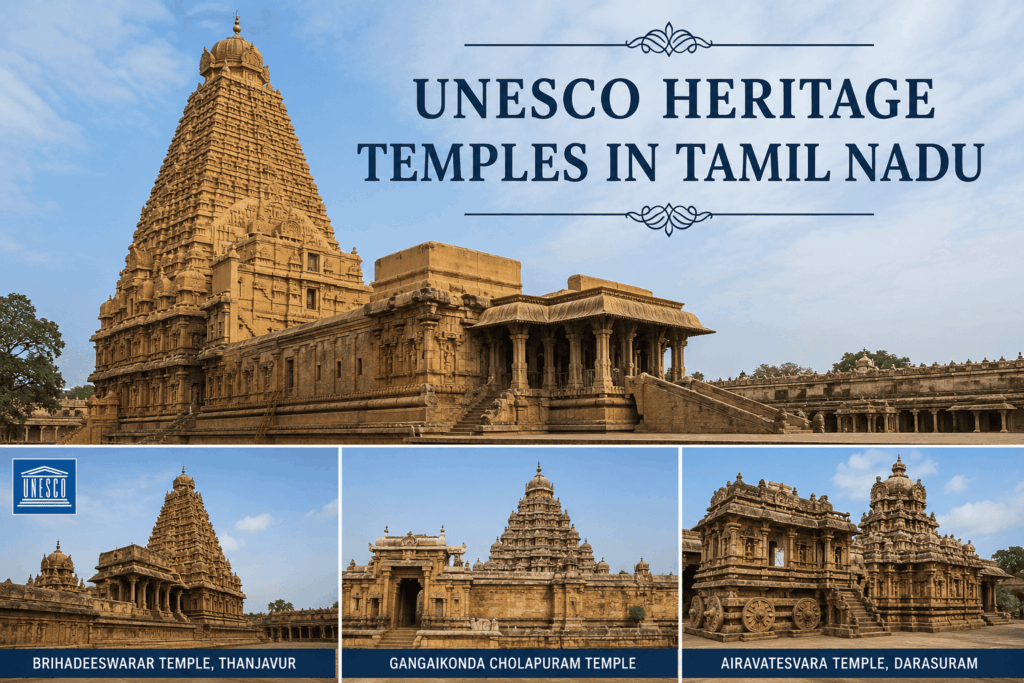
Tamil Nadu is often referred to as the Land of Temples, a title earned through centuries of architectural brilliance, spiritual devotion, and cultural richness. Across the state, thousands of temples stand as living monuments to India’s glorious past. Among them, a select group has received global recognition from the United Nations Educational, Scientific and Cultural Organization (UNESCO) for their outstanding universal value.
These temples are more than ancient structures built of stone. They are living centers of worship, repositories of art and literature, engineering marvels, and symbols of the remarkable achievements of the Chola dynasty. Every sculpture, inscription, pillar, and towering vimana tells a story of innovation, faith, and royal patronage that has endured for over a thousand years.
The UNESCO-recognized temples of Tamil Nadu, collectively known as the Great Living Chola Temples , continue to host daily rituals and annual festivals while attracting millions of pilgrims, tourists, historians, architects, researchers, photographers, and students from around the world.
In this article, we explore the history, architecture, cultural significance, and global importance of Tamil Nadu’s UNESCO World Heritage temples.
What is UNESCO World Heritage?
The United Nations Educational, Scientific and Cultural Organization (UNESCO) identifies and protects places that possess exceptional cultural, historical, scientific, or natural importance to humanity.
A site included on the UNESCO World Heritage List is considered to have Outstanding Universal Value (OUV) . Such places represent humanity’s shared heritage and deserve protection for future generations.
To receive UNESCO recognition, a monument must satisfy strict criteria related to:
Historical significance
Architectural excellence
Cultural value
Authenticity
Integrity
Conservation
Tamil Nadu’s Chola temples meet these criteria because of their remarkable architecture, engineering achievements, artistic masterpieces, and continuous religious traditions.
UNESCO World Heritage Temples in Tamil Nadu
Tamil Nadu currently has one UNESCO-listed temple group:
The Great Living Chola Temples
This UNESCO World Heritage Site consists of three magnificent temples:
Brihadeeswarar Temple, Thanjavur
Gangaikonda Cholapuram Temple
Airavatesvara Temple, Darasuram
These temples were built between the 11th and 12th centuries during the reign of the mighty Chola Empire.
UNESCO first inscribed Brihadeeswarar Temple on the World Heritage List in 1987.
In 2004, the listing was expanded to include Gangaikonda Cholapuram and Airavatesvara Temple and the group was officially named the Great Living Chola Temples .
The word “Living” is significant because all three temples continue to function as active places of worship even after nearly a thousand years.
The Chola Dynasty: Builders of Timeless Monuments
The Chola Empire ruled large parts of South India between the 9th and 13th centuries CE.
At its peak, the empire extended across:
Tamil Nadu
Kerala
Karnataka
Andhra Pradesh
Sri Lanka
Maldives
Southeast Asia
The Cholas were known for:
Strong administration
Naval supremacy
International trade
Temple construction
Bronze sculpture
Tamil literature
Irrigation engineering
Temple construction became one of the defining features of Chola civilization.
Rather than serving solely as religious centers, temples also functioned as:
Educational institutions
Economic hubs
Cultural centers
Libraries
Land administration offices
Music and dance academies
Brihadeeswarar Temple, Thanjavur
The Crown Jewel of Chola Architecture
Among all Chola monuments, the Brihadeeswarar Temple is undoubtedly the most famous.
Built by Emperor Rajaraja Chola I , the temple was completed around 1010 CE , making it more than a thousand years old.
Dedicated to Lord Shiva, the temple remains one of India’s greatest architectural achievements.
Why Was the Temple Built?
Rajaraja Chola I commissioned the temple to:
Celebrate military victories
Express devotion to Lord Shiva
Demonstrate the strength of the Chola Empire
Promote Tamil culture
Leave an everlasting legacy
The temple soon became the spiritual and political symbol of the empire.
Architectural Marvel
The Brihadeeswarar Temple astonishes visitors with its scale and precision.
Important features include:
Massive Vimana
The temple’s vimana rises to approximately **66 meters (216 feet)**, making it one of the tallest temple towers in India.
Unlike later South Indian temples where the entrance gopuram dominates, the Brihadeeswarar Temple’s towering vimana is the architectural centerpiece.
Monolithic Capstone
One of the temple’s greatest mysteries is its enormous granite capstone weighing approximately 80 tons .
Historians believe ancient engineers transported it to the summit using a long earthen ramp stretching several kilometers.
Even today, this feat remains an extraordinary example of medieval engineering.
Nandi Mandapa
Facing the sanctum stands one of India’s largest monolithic Nandi statues.
Carved from a single block of granite, the majestic sculpture measures:
Around 6 meters long
About 3.7 meters high
The polished stone continues to impress visitors
Temple Walls and Inscriptions
Hundreds of inscriptions carved into the temple walls provide valuable information about:
Chola administration
Taxation
Donations
Temple staff
Musicians
Dancers
Land grants
Religious rituals
These inscriptions are among the most important historical records from medieval South India.
Engineering Excellence Beyond Its Time
One of the most remarkable aspects of the temple is the extensive use of granite.
Interestingly, granite is not naturally available near Thanjavur.
Historians believe thousands of workers transported massive stone blocks from distant quarries.
The precise alignment, symmetrical proportions, and structural stability of the temple continue to amaze engineers even today.
After more than one thousand years, the monument remains structurally sound.
Gangaikonda Cholapuram Temple
Following Rajaraja Chola I, his son Rajendra Chola I expanded the empire to northern India.
To commemorate his victorious expedition to the Ganges River, he established a new capital called Gangaikonda Cholapuram meaning “The City of the Chola Who Brought the Ganges.”
At its heart, he built another magnificent Shiva temple.
Architectural Elegance
Although inspired by Brihadeeswarar Temple, Gangaikonda Cholapuram possesses its own distinct character.
The temple features:
Softer architectural lines
Graceful proportions
Delicate sculptures
Elaborate carvings
Spacious courtyards
Many art historians consider its sculptures even more refined than those of Thanjavur.
Sculptural Highlights
Visitors can admire beautifully carved images of:
Shiva
Vishnu
Durga
Chandikeswara
Saraswati
Ganesha
The temple also contains remarkable depictions of mythical creatures and celestial beings.
Historical Importance
Gangaikonda Cholapuram symbolizes the height of Chola political power.
The temple demonstrates how architecture evolved within only a few decades while preserving the essential principles established at Thanjavur.
Airavatesvara Temple, Darasuram
The third UNESCO monument among the Great Living Chola Temples is the Airavatesvara Temple at Darasuram.
It was constructed during the reign of **Rajaraja Chola II** in the 12th century.
Although smaller than the other two temples, it is celebrated for its artistic perfection.
Why is it Famous?
The temple is dedicated to Lord Shiva.
According to Hindu tradition, Airavata , the white elephant of Lord Indra, worshipped Shiva here.
Hence, the temple came to be known as Airavatesvara Temple.
Architectural Beauty
The temple resembles a stone jewel box.
Its highlights include:
Chariot-shaped mandapa
Miniature sculptures
Musical steps
Intricate pillars
Decorative ceilings
Fine stone carvings
Almost every surface contains exquisite sculptural detail.
Musical Stone Steps
One of the temple’s most fascinating attractions is its musical staircase.
Certain stone steps are believed to produce different musical notes when gently tapped.
Although access is now restricted to protect the monument, this feature demonstrates the remarkable scientific knowledge of Chola craftsmen.
Artistic Excellence of Chola Temples
The UNESCO temples are masterpieces of Dravidian architecture.
Common features include:
Towering vimanas
Symmetrical layouts
Granite construction
Sculptured pillars
Mandapas
Circumambulatory paths
Ornamental carvings
Every sculpture tells stories from:
Mahabharata
Shiva Purana
Hindu mythology
These carvings served as visual education for devotees during medieval times.
Why UNESCO Recognized These Temples
UNESCO recognizes the Great Living Chola Temples because they represent:
Outstanding Dravidian architecture
Exceptional engineering
Advanced stone construction techniques
Rich historical documentation through inscriptions
Living religious traditions
Artistic excellence
Influence on later South Indian temple architecture
Even after a thousand years, the temples continue to function as active centers of worship while preserving their historical authenticity.