
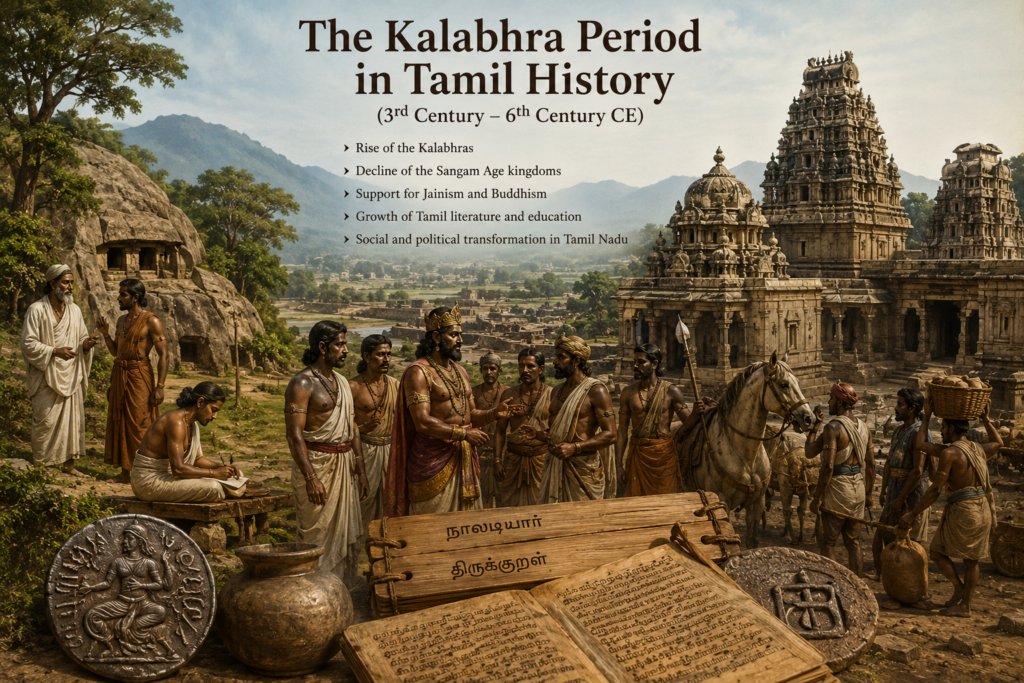
The history of Tamil Nadu is filled with the achievements of powerful dynasties such as the Cheras, Cholas, and Pandyas. However, between the decline of the Sangam Age kingdoms and the rise of the Pallavas and the later Pandyas, Tamil Nadu witnessed a lesser-known yet historically significant phase called the Kalabhra Period. This era, generally dated from the 3rd century CE to the 6th century CE, remains one of the most debated chapters in South Indian history.
Unlike the Cholas or Pandyas, the Kalabhras left behind very few inscriptions, monuments, or royal records. As a result, much of what historians know about them comes from later inscriptions, literary references, archaeological findings, and religious texts. Because of the scarcity of direct evidence, this period was once described as the “Kalabhra Interregnum” or even the “Dark Age of Tamil History.” However, many modern historians argue that this description is misleading. Instead of being an age of decline, the Kalabhra Period may have been a time of political transition, social change, and the growth of new religious and literary traditions.
During this period, the traditional rule of the Cheras, Cholas, and Pandyas weakened. The Kalabhras established control over much of Tamil Nadu, introducing changes that influenced administration, land ownership, education, and religion. Jainism and Buddhism received royal support, while Tamil literary activity continued in different forms.
Although many questions about the Kalabhras remain unanswered, their role in shaping the history of Tamil Nadu cannot be ignored. Understanding this period helps us connect the Sangam Age with the emergence of the Pallavas, the medieval Cholas, and the later Pandya Empire.
This article explores the rise, rule, administration, religion, literature, economy, decline, and historical significance of the Kalabhra Period, providing valuable insights for students, history enthusiasts, researchers, tourists, and competitive exam aspirants.
What Was the Kalabhra Period?
The Kalabhra Period refers to a phase in Tamil history when the traditional Tamil dynasties temporarily lost political control, and the Kalabhras emerged as the dominant rulers across much of present-day Tamil Nadu.
Most historians place this period between:
- Beginning: Around the 3rd century CE
- End: Around the 6th century CE
This era falls between:
- The end of the Sangam Age
- The rise of the Pallava and Pandya kingdoms
Because of limited historical records, the Kalabhra Period remains one of the least understood eras in South Indian history.
Who Were the Kalabhras?
One of the greatest mysteries in Indian history is the identity of the Kalabhras.
Unlike the Cholas or Pandyas, the Kalabhras did not leave extensive inscriptions or monumental architecture. Historians have therefore proposed several theories regarding their origin.
Theory 1: Local Tribal Chiefs
Some scholars believe the Kalabhras were local chiefs or warrior groups from the hill regions of Tamil Nadu who gradually expanded their political influence.
Theory 2: Karnataka Connection
Another theory suggests that the Kalabhras may have had links with regions that are now part of Karnataka and later moved into Tamil territory.
Theory 3: Independent Tamil Rulers
Some historians argue that they were indigenous rulers who rose to power during a period of political instability after the decline of the Sangam kingdoms.
Although no single theory has been universally accepted, it is clear that the Kalabhras established authority over a large part of Tamil Nadu for several centuries.
Why Is It Called the “Kalabhra Interregnum”?
The term “Kalabhra Interregnum” was introduced by historians to describe the interruption in the rule of the three traditional Tamil dynasties:
- Cheras
- Cholas
- Pandyas
Since later royal inscriptions from these dynasties often portrayed the Kalabhras as rulers who had displaced established kingdoms, early historians considered this period an interruption in Tamil political history.
However, modern historians increasingly question this interpretation. Rather than viewing it as a “dark age,” many now describe the Kalabhra Period as a time of transformation, when new political structures, religious ideas, and social groups gained prominence.
Political Situation Before the Kalabhras
To understand the rise of the Kalabhras, it is important to examine the political landscape after the Sangam Age.
By the end of the Sangam period:
- The Chera kingdom had weakened.
- The Cholas had lost much of their political influence.
- The Pandyas faced internal struggles.
- Regional chiefs gained greater autonomy.
- Trade patterns were changing.
This political fragmentation created opportunities for new powers to emerge, allowing the Kalabhras to establish their authority over large parts of Tamil Nadu.
Rise of the Kalabhras
Although precise details remain uncertain, historians believe the Kalabhras gradually expanded their influence by defeating local rulers and taking control of strategic regions.
Their success may have been supported by:
- Strong military organization.
- Alliances with local communities.
- Weakening of traditional kingdoms.
- Administrative reforms.
By the 4th century CE, they had become one of the dominant political forces in the Tamil region.
Administration During the Kalabhra Rule
Because few official records survive, our understanding of Kalabhra administration comes mainly from later inscriptions and indirect evidence.
Historians believe they maintained an organized system of governance that included:
Regional Administration
Tamil Nadu appears to have been divided into administrative regions governed by local officials loyal to the ruling authority.
Revenue Collection
Agriculture remained the primary source of revenue, with taxes collected from farming communities and trade activities.
Local Governance
Village institutions likely continued to function, ensuring that everyday administration remained stable despite political changes.
This suggests that the Kalabhras governed through existing local structures rather than replacing them entirely.
Society During the Kalabhra Period
The Kalabhra Period witnessed important social developments.
Some historians believe the rulers challenged the dominance of traditional elite groups by supporting broader sections of society.
Possible social changes included:
- Increased opportunities for local communities.
- Expansion of educational institutions.
- Greater religious diversity.
- Support for scholars and monks.
Although evidence is limited, these developments indicate that society continued to evolve rather than stagnate.
Religion Under the Kalabhras
One of the defining features of the Kalabhra Period was the growth of Jainism and Buddhism.
Unlike earlier rulers who primarily supported Vedic traditions, the Kalabhras appear to have extended patronage to these religions.
Growth of Jainism
Jain monks established learning centers across Tamil Nadu.
They contributed to:
- Literature.
- Education.
- Philosophy.
- Ethics.
Several important Tamil works associated with Jain scholars were composed during or shortly after this period.
Influence of Buddhism
Buddhist monasteries also flourished in parts of Tamil Nadu.
Buddhist scholars promoted:
- Education.
- Moral teachings.
- Literary traditions.
- Cultural exchange.
The coexistence of Hinduism, Jainism, and Buddhism reflects the religious diversity of ancient Tamil society.
Tamil Literature During the Kalabhra Period
Contrary to the older belief that literature declined, several important Tamil works are associated with this era.
Among them are:
Thirukkural
Although scholars continue to debate its exact date, many associate the spread and influence of Thirukkural with the broader cultural environment of the Kalabhra Period.
Naladiyar
This classic collection of moral verses reflects strong Jain philosophical influences and remains one of Tamil literature’s greatest works.
Other Didactic Texts
The period saw the growth of ethical and philosophical literature focusing on:
- Virtue.
- Justice.
- Education.
- Good governance.
- Moral conduct.
These works continue to shape Tamil culture today.
Why the Kalabhra Period Is Important
Although historical records are limited, the Kalabhra Period serves as a crucial bridge between the ancient Sangam Age and the medieval kingdoms of South India.
Its significance includes:
- Political transformation after the Sangam Age.
- Promotion of Jainism and Buddhism.
- Continuation of Tamil literary traditions.
- Social and administrative changes.
- Preparation for the rise of the Pallavas and later Pandyas.
Modern historians increasingly recognize that this era was not a period of decline but one of transition and cultural evolution.