
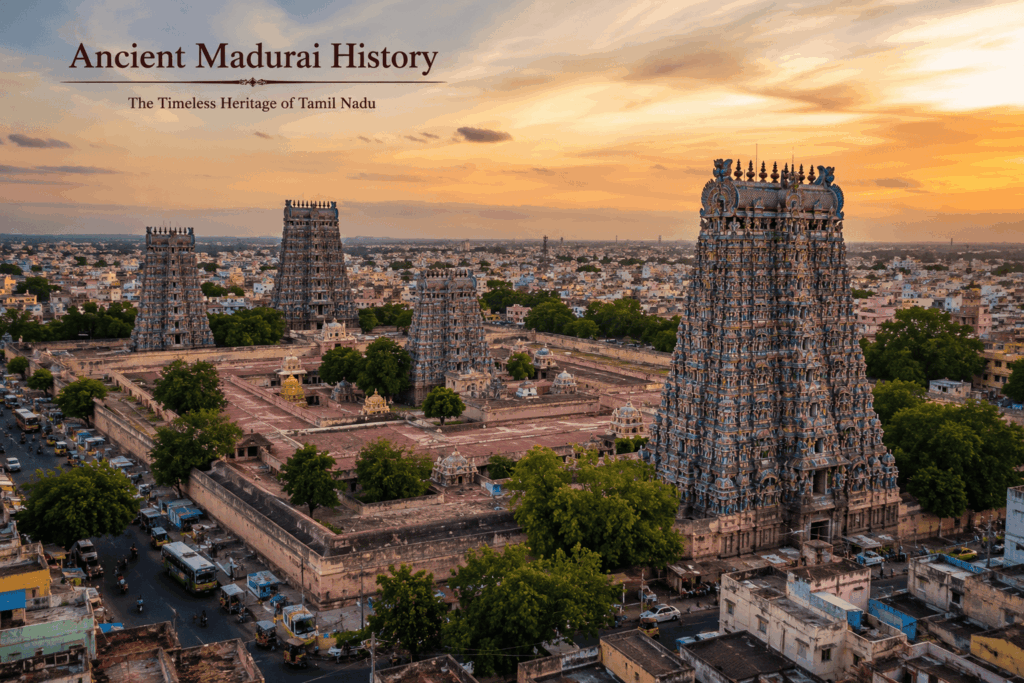
Madurai is one of the oldest continuously inhabited cities in India and a symbol of Tamil civilization, culture, literature, and spirituality. Often referred to as the **”Athens of the East,”** Madurai has been an important political, cultural, and commercial center for more than two thousand years. Situated on the banks of the Vaigai River in southern Tamil Nadu, the city has witnessed the rise and fall of powerful dynasties, the flourishing of Sangam literature, international trade with Rome, magnificent temple architecture, and the evolution of Tamil society.
The history of Madurai is deeply intertwined with the **Pandya dynasty**, one of the three great Tamil kingdoms alongside the Cholas and Cheras. For centuries, Madurai served as the capital of the Pandyas and became renowned as the center of Tamil learning and literary excellence. Ancient Tamil poets gathered here during the legendary Sangams producing literary masterpieces that continue to shape Tamil culture today.
Madurai’s importance extended far beyond literature. The city became a thriving commercial hub connected to ancient ports such as Korkai and Kaveripoompattinam (Poompuhar), allowing merchants to trade pearls, spices, cotton textiles, precious stones, and ivory with traders from Rome, Greece, Egypt, Arabia, Sri Lanka, and Southeast Asia.
Today, Madurai remains one of India’s most visited heritage destinations. The magnificent **Meenakshi Amman Temple**, bustling traditional markets, historic monuments, and vibrant festivals continue to attract millions of pilgrims and tourists every year. Archaeological discoveries and historical records further confirm Madurai’s role as one of South Asia’s oldest urban settlements.
This article explores the fascinating history of ancient Madurai, tracing its origins, political significance, cultural achievements, economic prosperity, religious importance, and lasting contribution to Indian civilization.
Where Is Madurai Located?
Madurai is situated in the southern part of Tamil Nadu on the fertile plains surrounding the **Vaigai River**.
Its geographical location offered several advantages:
Reliable water supply from the Vaigai River.
Fertile agricultural lands.
Easy access to inland trade routes.
Proximity to the Gulf of Mannar through the ancient port of Korkai.
Natural connections with neighboring Tamil kingdoms.
These factors enabled Madurai to grow into one of the most prosperous cities in ancient India.
Origin of the Name Madurai
Several traditions explain the origin of Madurai’s name.
According to Hindu mythology, Lord Shiva blessed the city with divine nectar (“Madhu”), which fell upon the land and made it sacred. Because of this event, the city came to be known as Madurai , meaning”the place of nectar
Ancient Tamil literature also refers to Madurai by several names, including:
Koodal
Thenmadurai (Southern Madurai)
Aalavai
Naanmada Koodal
These names reflect the city’s religious and historical importance.
Madurai During the Sangam Age
The Sangam Age (approximately 300 BCE–300 CE) represents one of the most celebrated periods in Tamil history.
During this era, Madurai became the cultural and intellectual capital of the Tamil-speaking world.
It served as the center of:
Literature
Education
Poetry
Philosophy
Music
Political administration
Ancient Tamil poems describe Madurai as a magnificent city with:
Wide streets.
Royal palaces.
Busy marketplaces.
Temple complexes.
Public squares.
Beautiful gardens.
Prosperous merchants.
The city attracted scholars, poets, merchants, artists, and travelers from across South India.
The Legendary Tamil Sangams
Madurai is traditionally associated with the famous **Tamil Sangams**, literary academies believed to have been patronized by the Pandya kings.
Although historians continue to debate aspects of the Sangam tradition, Tamil literature credits these academies with preserving and promoting classical Tamil language and poetry.
Many celebrated works, including poems found in the **Ettuthokai** (Eight Anthologies) and **Pattuppaattu** (Ten Idylls), are linked to the Sangam period.
These literary collections provide valuable insights into:
Ancient Tamil society.
Warfare.
Trade.
Agriculture.
Religion.
Family life.
Governance.
For students and researchers, Sangam literature remains one of the most important sources for understanding ancient South India.
Madurai: Capital of the Pandya Kingdom
The greatest political significance of Madurai lies in its role as the capital of the **Pandya dynasty**.
The Pandyas ruled large parts of southern Tamil Nadu for centuries and established Madurai as their administrative headquarters.
From this historic city, the Pandya kings:
Governed their kingdom.
Collected taxes.
Promoted literature.
Encouraged overseas trade.
Built temples.
Supported education and the arts.
Madurai became synonymous with Pandya power and prosperity.
Famous Pandya Kings
Several notable rulers contributed to Madurai’s development.
Nedunjeliyan
Known for his military victories and patronage of Tamil literature.
Mudukudumi Peruvazhuthi
Remembered for supporting scholars and performing numerous Vedic sacrifices.
Maravarman Sundara Pandyan
Strengthened the Pandya kingdom during the medieval period and expanded its influence across South India.
These rulers helped transform Madurai into one of India’s most influential cities.
Madurai’s Economy in Ancient Times
Ancient Madurai enjoyed a vibrant and diversified economy.
Its prosperity depended upon:
Agriculture.
Textile production.
Pearl trade.
Spice commerce.
Handicrafts.
Metalworking.
Inland and overseas trade.
The fertile lands surrounding the Vaigai River produced abundant crops such as rice, sugarcane, cotton, and pulses.
Agricultural prosperity supported urban growth and commercial expansion.
Trade with the Roman Empire
One of the most fascinating aspects of Madurai’s history is its trade relationship with the Roman Empire.
Goods produced in and around Madurai reached Roman markets through nearby ports, particularly **Korkai**.
Major exports included:
Pearls.
Pepper.
Cotton textiles.
Ivory.
Precious stones.
Aromatic woods.
In return, Roman merchants brought:
Gold coins.
Wine.
Glassware.
Coral.
Luxury pottery.
Archaeological discoveries of Roman coins across Tamil Nadu confirm these international commercial links.
The wealth generated through overseas trade contributed significantly to the prosperity of Madurai.
madurai in Sangam Literature
Classical Tamil works provide vivid descriptions of the city.
Poets praised Madurai for:
Prosperous markets.
Skilled artisans.
Generous kings.
Religious festivals.
Cultural celebrations.
Beautiful architecture.
The famous work **Madurai Kanchi**, written by Mangudi Maruthanar, offers one of the most detailed descriptions of the city’s urban life.
It portrays Madurai as a thriving metropolis with organized streets, thriving commerce, and an active cultural scene.
Religion in Ancient Madurai
Religion played an important role in shaping Madurai’s identity.
The city became a major center for:
Shaivism.
Vaishnavism.
Jainism.
Buddhism.
Temples, monasteries, and educational institutions flourished under royal patronage.
Religious festivals strengthened community life while attracting pilgrims from across South India.
The Meenakshi Amman Temple
No discussion of Madurai’s history is complete without mentioning the **Meenakshi Amman Temple**.
Although the present structure mainly reflects the contributions of the Nayak rulers, the temple’s origins trace back to ancient times.
According to tradition:
Goddess Meenakshi ruled Madurai.
She married Lord Sundareswarar (Lord Shiva).
Their divine marriage remains one of Tamil Nadu’s most celebrated religious festivals.
The temple became the spiritual heart of Madurai and continues to symbolize the city’s rich cultural heritage.