
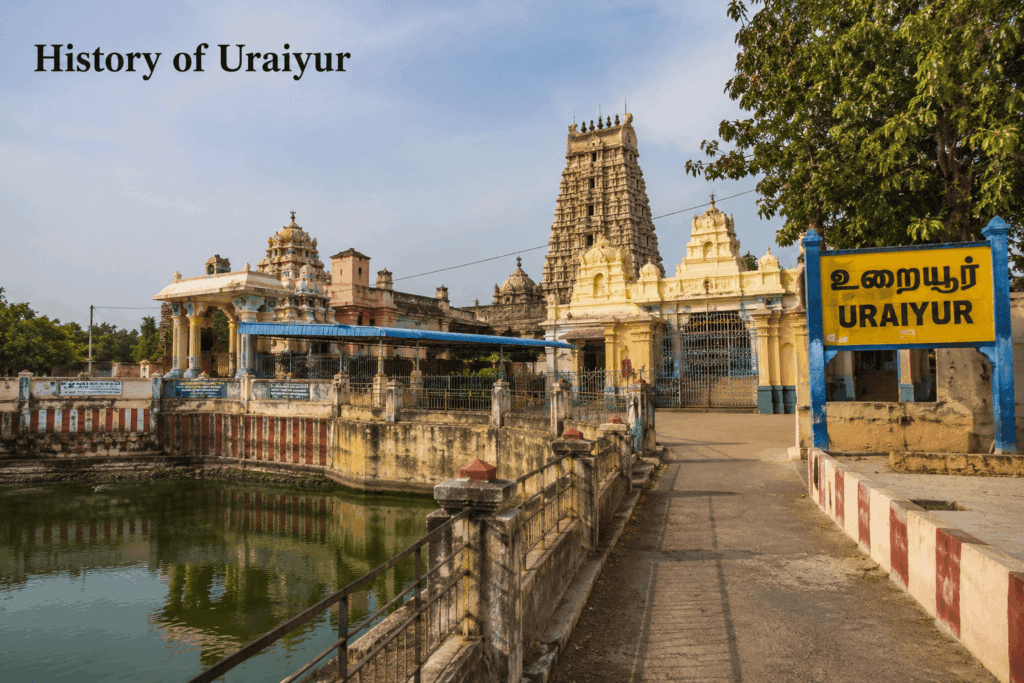
Tamil Nadu is home to several ancient cities that have played a significant role in shaping India’s history, culture, and civilization. Among these historic cities, Uraiyur holds a unique place as one of the oldest continuously inhabited urban settlements in South India. Situated in present-day Tiruchirappalli (Trichy), Uraiyur was once the glorious capital of the early Chola dynasty and served as a major center of administration, trade, literature, and culture for centuries.
Long before the magnificent temples of Thanjavur were built and before the Cholas became a maritime superpower under Rajaraja Chola I and Rajendra Chola I, Uraiyur stood as the political heart of the Chola kingdom. The city is frequently mentioned in Sangam literature, one of the oldest collections of Tamil literary works, where it is described as a prosperous city with busy markets, fertile agricultural lands, skilled artisans, and wealthy merchants.
Uraiyur was strategically located on the banks of the River Kaveri, one of South India’s most important rivers. This advantageous location supported agriculture, inland trade, and communication with other parts of the Tamil region. Over time, the city developed into an important cultural and economic center, attracting poets, scholars, traders, and royal patronage.
Today, although Uraiyur has become a part of modern Tiruchirappalli, its historical significance continues to attract historians, archaeologists, tourists, students, and researchers. Archaeological discoveries, temple inscriptions, literary references, and historical records provide valuable insights into the city’s glorious past.
This article explores the fascinating history of Uraiyur, from its legendary origins and Sangam Age prominence to its role as the capital of the early Cholas, its economic prosperity, religious heritage, and lasting legacy in Tamil history.
Where Is Uraiyur Located?
Uraiyur is located in Tiruchirappalli district in the Indian state of Tamil Nadu. Today, it forms one of the oldest residential localities within the city of Tiruchirappalli (commonly known as Trichy).
The city lies close to the southern bank of the River Kaveri, one of the most fertile river systems in South India.
Its location offered several advantages:
- Fertile agricultural land.
- Reliable water supply.
- Easy inland transportation.
- Access to trade routes.
- Natural protection against invasions.
These geographical benefits contributed significantly to Uraiyur’s growth as an important urban center.
Origin of the Name Uraiyur
The name Uraiyur has intrigued historians for centuries.
According to one popular tradition, the name comes from the Tamil words:
- “Ur” meaning village or town.
- “Aiyur” interpreted in connection with settlement or habitation.
Another famous legend associates Uraiyur with a rooster (“Kozhi” in Tamil).
According to folklore, a brave rooster courageously fought and defeated an elephant. Impressed by this unusual event, an early Chola ruler is believed to have selected the location as his capital.
Because of this legend, Uraiyur was also known as Kozhiyur.
The rooster later became one of the city’s enduring symbols and appears in local traditions.
Uraiyur in Sangam Literature
One of the strongest pieces of evidence for Uraiyur’s antiquity comes from Sangam literature, a remarkable collection of ancient Tamil poems composed roughly between 300 BCE and 300 CE.
Several Sangam works mention Uraiyur as:
- A prosperous capital.
- A center of royal administration.
- A flourishing trading city.
- A cultural hub.
- A wealthy agricultural region.
Poets praised the city for:
- Rich paddy fields.
- Beautiful houses.
- Bustling marketplaces.
- Skilled craftsmen.
- Prosperous merchants.
- Generous kings.
These literary references indicate that Uraiyur had already become an important political center more than two thousand years ago.
Uraiyur: The Early Capital of the Cholas
Perhaps the greatest historical importance of Uraiyur lies in its role as the capital of the early Chola dynasty.
Before the Cholas shifted their administrative centers to places such as Poompuhar and later Thanjavur, Uraiyur served as their primary seat of power.
From here, the early Chola rulers governed fertile regions along the Kaveri River and expanded their influence across Tamil Nadu.
Several renowned Sangam-era Chola kings ruled from Uraiyur.
These include:
- Karikala Chola
- Nalankilli
- Nedunkilli
- Killivalavan
Although historical details vary, literary sources consistently associate these rulers with Uraiyur.
Karikala Chola and the Glory of Uraiyur
Among all the early Chola rulers, Karikala Chola remains the most celebrated.
Although historians continue to debate certain aspects of his reign, Sangam literature credits him with several remarkable achievements.
Expansion of the Kingdom
Karikala Chola strengthened the Chola kingdom through successful military campaigns against rival Tamil kingdoms.
His victories increased the political importance of Uraiyur.
Agricultural Development
One of Karikala’s greatest achievements was improving irrigation.
He is traditionally credited with constructing the famous Kallanai (Grand Anicut) across the River Kaveri.
Built over 2,000 years ago, Kallanai remains one of the world’s oldest functioning water diversion structures.
Its construction greatly improved agriculture around Uraiyur and neighboring regions.
Economic Prosperity
Under Karikala’s leadership:
- Agricultural production increased.
- Trade expanded.
- Tax revenues improved.
- Urban development accelerated.
These developments transformed Uraiyur into one of the wealthiest cities in ancient South India.
Trade and Commerce in Uraiyur
Although Uraiyur was an inland city, it played an important role in regional and international trade.
Goods from coastal ports such as Kaveripoompattinam (Poompuhar) were transported inland through well-established trade routes.
Merchants dealing in:
- Cotton textiles
- Rice
- Pepper
- Pearls
- Precious stones
- Metal products
- Ivory
- Handicrafts
frequently visited Uraiyur.
The city’s markets attracted traders from various parts of South India.
Its economic success contributed significantly to the strength of the early Chola kingdom.
Uraiyur and the Textile Industry
Ancient Tamil literature frequently praises Uraiyur for its fine cotton textiles.
The city became famous for producing:
- High-quality cotton cloth.
- Handwoven garments.
- Decorative fabrics.
- Dyed textiles.
Skilled weavers supplied textiles to domestic markets and overseas trade networks.
Textile production became one of the city’s most important industries.
Even today, Tiruchirappalli district continues to preserve aspects of this textile heritage.
Archaeological Discoveries at Uraiyur
Modern archaeological excavations have confirmed many historical references found in Sangam literature.
Researchers have uncovered:
- Black-and-red ware pottery.
- Rouletted ware.
- Roman coins.
- Brick structures.
- Terracotta figurines.
- Beads.
- Iron tools.
- Ancient habitation remains.
These discoveries indicate that Uraiyur maintained active trade connections with both Indian and foreign merchants.
Roman artifacts especially suggest commercial links with the Mediterranean world during the early centuries CE.
Religious Importance of Uraiyur
Religion has always played an important role in Uraiyur’s history.
The city is home to several ancient temples, the most famous being the Azhagiya Manavala Perumal Temple, an important Vaishnavite shrine associated with the 108 Divya Desams.
Uraiyur also has a rich Shaivite tradition, with several historic Shiva temples that reflect the city’s long-standing spiritual heritage.
These temples continue to attract pilgrims and visitors while preserving centuries of Tamil architecture, inscriptions, and religious traditions.