
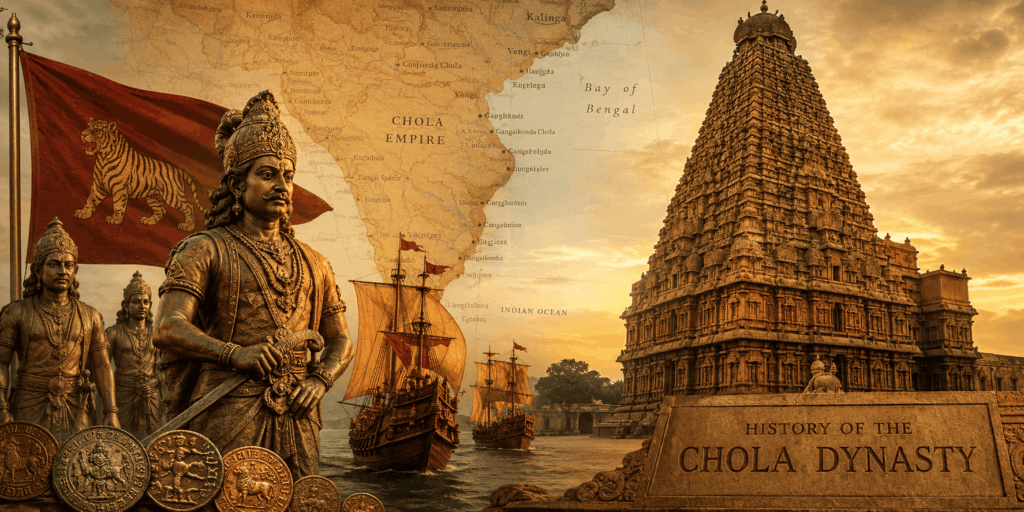
The history of India is filled with remarkable kingdoms that shaped the country’s culture, politics, economy, and architecture. Among these, the Chola Empire occupies a special place. Known for its powerful rulers, magnificent temples, advanced administration, strong navy, and flourishing trade, the Cholas transformed South India into one of the most influential regions of the medieval world.
For nearly four centuries, the Chola Empire dominated much of South India and extended its influence across Sri Lanka, the Maldives, and several parts of Southeast Asia. The empire reached extraordinary heights under legendary rulers such as Rajaraja Chola I and Rajendra Chola I, whose military campaigns and administrative reforms made the Cholas one of the greatest dynasties in Indian history.
However, like every great empire, the Cholas eventually faced political instability, military defeats, economic challenges, and the rise of powerful rivals. Their decline was gradual, but their legacy continues to live through magnificent temples, inscriptions, literature, irrigation systems, and cultural traditions that still inspire millions today.
This article explores the complete journey of the Chola Empire—from its humble beginnings to its rise as a global maritime power and finally to its decline—offering valuable insights for history lovers, students, researchers, tourists, and competitive exam aspirants.
The Early Beginnings of the Cholas
The Cholas were one of the Three Crowned Kingdoms of Tamilakam alongside the Cheras and the Pandyas. Their history can be traced back to the Sangam Age (around 300 BCE–300 CE) , where ancient Tamil literature describes them as courageous rulers and generous patrons of poets, merchants, and farmers.
The fertile Kaveri River Delta served as the heartland of the Chola kingdom. Blessed with rich agricultural land, abundant water resources, and access to the Bay of Bengal, the region naturally supported economic growth and trade.
Ancient capitals such as Uraiyur and the thriving port city of Kaveripoompattinam (Poompuhar) became important centres of commerce. Roman merchants, Southeast Asian traders, and Arab sailors frequently visited these ports, exchanging spices, pearls, textiles, gemstones, and ivory.
Karikala Chola: The Legendary Early Ruler
Among the earliest Chola rulers, Karikala Chola is remembered as one of the most celebrated kings.
Although historical records from this period are limited, Tamil literature credits him with major achievements that laid the foundation for future prosperity.
His contributions include:
Expanding Chola territory
Defeating rival Tamil kingdoms
Promoting agriculture
Developing irrigation
Encouraging maritime trade
One of his greatest engineering achievements was the construction of the Kallanai (Grand Anicuacross the Kaveri River.
Even today, nearly two thousand years later, the Kallanai continues to function, making it one of the world’s oldest operational water-diversion structures. It remains a symbol of the Cholas’ remarkable understanding of water management and public welfare.
Decline After the Sangam Age
Following the Sangam period, the Cholas gradually lost their political influence.
Several factors contributed to this decline:
Continuous wars with neighbouring kingdoms
Internal succession disputes
Rise of the Pallavas
Growing power of the Pandyas
Changing political alliances
For almost three centuries, the Cholas remained relatively minor rulers while the Pallavas dominated much of South India.
However, history was about to take a dramatic turn.
The Revival of the Chola Empire
The true rise of the Chola Empire began during the 9th century CE.
A capable ruler named Vijayalaya Chola revived the dynasty and established what historians call the Imperial Chola Empire.
Around 850 CE Vijayalaya captured Thanjavur from the Muttaraiyars and declared it the new Chola capital.
This victory proved to be one of the most important turning points in South Indian history.
Why Thanjavur Was an Ideal Capital
The selection of Thanjavur was a masterstroke.
The city offered several strategic advantages:
Fertile Agricultural Land
The Kaveri Delta produced abundant rice and other crops, ensuring food security and economic prosperity.
Strong Natural Defences
The surrounding rivers and fertile plains made the city easier to defend against invasions.
Trade Opportunities
Its location allowed merchants easy access to inland markets and coastal ports.
Religious and Cultural Importance
Temples became centres of administration, education, music, dance, and social welfare.
Over time, Thanjavur developed into one of India’s greatest medieval capitals.
Vijayalaya Chola: Founder of the Imperial Cholas
Although Vijayalaya ruled a relatively small kingdom compared to later Chola emperors, his achievements were extraordinary.
His reign focused on:
Rebuilding the Chola military
Strengthening administration
Expanding territorial control
Encouraging temple construction
Establishing political stability
He also built temples dedicated to Goddess Durga, reflecting the close relationship between religion and royal authority.
More importantly, he laid the strong foundation upon which future rulers built one of Asia’s greatest empires.
Aditya I: Expanding the Kingdom
Vijayalaya was succeeded by his son Aditya I, who transformed the revived kingdom into an emerging regional power.
Aditya achieved several military victories, including defeating the Pallavas and annexing their territories.
His reign significantly increased Chola prestige throughout South India.
Besides military expansion, Aditya promoted:
Temple construction
Agricultural development
Peaceful administration
Religious patronage
These measures helped create stability across newly conquered regions.
Parantaka I: Consolidating the Empire
The next major ruler was Parantaka I , whose reign lasted nearly five decades.
His administration focused on strengthening every aspect of the kingdom.
Major achievements included:
Administrative Reforms
Revenue collection became more systematic.
Village assemblies received greater authority to manage local affairs.
Detailed land surveys improved taxation.
Economic Growth
Agriculture expanded due to improved irrigation.
Merchants enjoyed protection from the state.
Trade routes remained secure.
Temple institutions became important economic centres.
Military Strength
Parantaka expanded the Chola army considerably.
His campaigns extended Chola influence into neighbouring regions.
Although he later faced setbacks against the Rashtrakutas, his long reign established the administrative systems that later emperors perfected.
The Secret Behind the Chola Rise
Unlike many kingdoms that depended only on military conquest, the Cholas developed multiple sources of strength.
Agriculture
The fertile Kaveri Delta became one of India’s richest agricultural regions.
Large irrigation projects ensured reliable food production.
Rice cultivation generated enormous revenue for the state.
Efficient Administration
The Cholas maintained detailed records through inscriptions carved on temple walls.
These inscriptions recorded:
Taxes
Donations
Land ownership
Administrative decisions
Village elections
Many historians consider these inscriptions among the finest administrative records in medieval India.
Village Self-Government
One of the most remarkable features of the Chola Empire was its local administration.
Village assemblies known as:
Sabha
Nagaram
managed local governance independently.
They supervised:
Roads
Water tanks
Schools
Temple maintenance
Tax collection
Public welfare
This decentralised system made governance highly efficient.
Rise of Maritime Trade
The Cholas understood the importance of overseas commerce.
Their ports connected India with:
Sri Lanka
Maldives
China
Indonesia
Malaysia
Cambodia
Thailand
Arabia
Ships carried:
Pepper
Cotton textiles
Silk
Sandalwood
Precious stones
Ivory
Pearls
International trade brought enormous wealth into the kingdom and strengthened diplomatic ties with foreign kingdoms.
A Powerful Navy Begins to Emerge
Unlike most Indian kingdoms of the time, the Cholas invested heavily in naval power.
Initially created to protect merchant ships, the navy gradually evolved into one of the strongest maritime forces in Asia.
Its responsibilities included:
Protecting sea trade
Defending ports
Supporting military campaigns
Transporting troops
Establishing overseas influence
This naval strength would later enable Rajaraja Chola I and Rajendra Chola I to conduct successful overseas expeditions, making the Cholas one of the few Indian empires to project military power far beyond the subcontinent.