
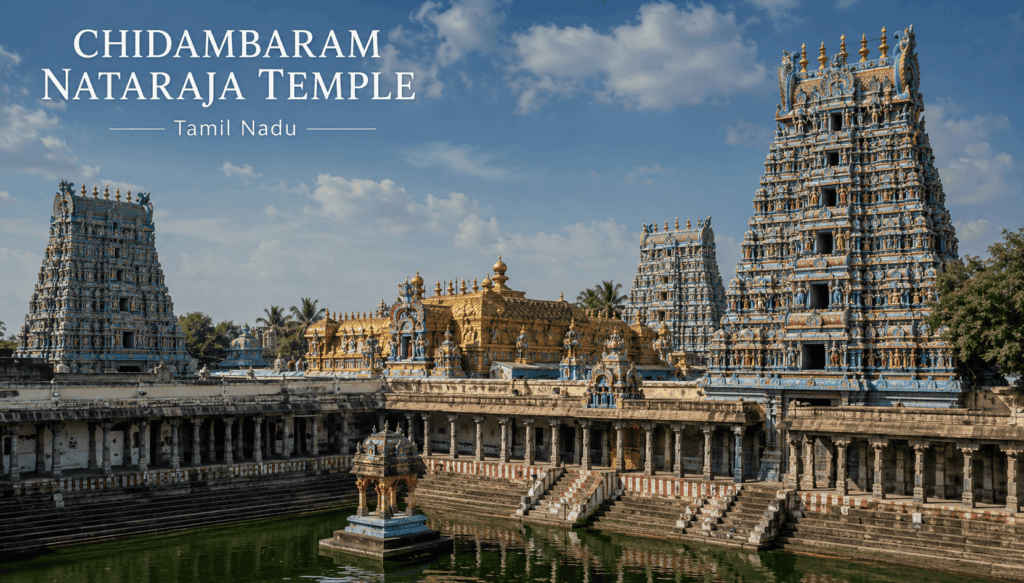
Among India’s countless ancient temples, the Chidambaram Nataraja Temple occupies a truly unique place. Located in the historic town of Chidambaram in Tamil Nadu’s Cuddalore district, this magnificent temple is dedicated to Lord Nataraja—the cosmic dancing form of Lord Shiva. Unlike most Shiva temples where the deity is worshipped as a Shiva Lingam, Chidambaram is renowned for its iconic bronze image of Nataraja performing the **Ananda Tandava**, the Dance of Bliss.
For more than a thousand years, this temple has served as a center of spirituality, philosophy, art, music, dance, and Tamil culture. It is not only one of the holiest pilgrimage destinations for Shaivites but also a living symbol of India’s artistic and scientific heritage. Scholars, devotees, architects, researchers, and tourists from around the world continue to admire its architectural brilliance, sacred traditions, and profound spiritual symbolism.
The Chidambaram Nataraja Temple is also one of the Pancha Bhoota Sthalams, representing the element of Akasha (Space or Ether). This makes it an essential pilgrimage destination for devotees seeking to understand the deeper philosophical concepts of Hinduism.
This article explores the fascinating history of Chidambaram Nataraja Temple, its legends, architectural marvels, dynastic contributions, and lasting cultural significance.
Chidambaram: A City Steeped in History
The town of Chidambaram has been an important center of Tamil civilization for centuries. Situated in present-day Cuddalore district, it was once known as **Thillai**, named after the dense forests of Thillai trees (*Excoecaria agallocha*) that once covered the region.
Ancient Tamil literature and devotional hymns frequently mention Thillai as a sacred place where sages performed penance and Lord Shiva revealed his divine cosmic dance.
Over the centuries, Chidambaram developed into an important religious, educational, and cultural center. Kings from various dynasties—including the Pallavas, Cholas, Pandyas, Vijayanagara rulers, and Nayaks—contributed to the temple’s expansion and preservation.
Even today, Chidambaram remains one of Tamil Nadu’s most visited spiritual destinations, attracting pilgrims, history enthusiasts, classical dancers, and international tourists.
The Legend of Lord Nataraja
The spiritual significance of Chidambaram begins with one of Hinduism’s most profound legends.
According to tradition, a group of powerful sages living in the Thillai forest believed that rituals and magical powers alone governed the universe. To teach them a deeper truth, Lord Shiva entered the forest as a wandering ascetic, accompanied by Lord Vishnu in the enchanting form of Mohini.
The sages became enraged and attempted to destroy Shiva using their mystical powers. They unleashed deadly creatures and supernatural weapons, but Shiva effortlessly overcame each challenge.
He subdued a fierce tiger and wore its skin as a garment. He transformed a venomous serpent into an ornament around his neck. Finally, he defeated the dwarf demon Apasmara, who symbolized ignorance and ego.
Standing upon the defeated demon, Shiva performed the **Ananda Tandava**, the Dance of Eternal Bliss, revealing that divine consciousness transcends pride, illusion, and ignorance.
This cosmic dance symbolizes the five eternal acts of Shiva:
Creation
Preservation
Destruction
Concealment
Grace
The bronze idol of Nataraja inside the temple beautifully represents these universal principles.
Chidambara Rahasyam: The Sacred Secret
One of the temple’s most distinctive features is the **Chidambara Rahasyam**, meaning “The Secret of Chidambaram.”
Behind a curtain inside the sanctum lies an apparently empty space adorned with golden Bilva leaves. This sacred space represents the **formless presence of Lord Shiva**, emphasizing that the Divine is beyond physical form and exists as infinite consciousness.
The unveiling of this sacred space during rituals symbolizes the removal of ignorance and the realization of ultimate truth.
For philosophers and spiritual seekers, Chidambara Rahasyam illustrates one of Hinduism’s deepest teachings—that the supreme reality is both manifest and unmanifest, visible and invisible.
This unique concept distinguishes Chidambaram from virtually every other temple in India.
The Temple and the Pancha Bhoota Sthalams
Chidambaram Nataraja Temple is one of the five sacred Shiva temples representing the five natural elements, known collectively as the **Pancha Bhoota Sthalams**.
Each temple symbolizes a different element:
Earth (Prithvi) – Ekambareswarar Temple, Kanchipuram
Water (Appu) – Jambukeswarar Temple, Tiruchirappalli
Fire (Agni) – Arunachaleswarar Temple, Tiruvannamalai
Air (Vayu) – Srikalahasteeswara Temple, Andhra Pradesh
Space (Akasha) – Chidambaram Nataraja Temple
Among these, Chidambaram uniquely represents **Space (Akasha)**, symbolizing infinity, consciousness, and the boundless nature of the universe.
Ancient Origins of the Temple
Although the present temple largely dates to the medieval period, historians believe that a sacred shrine existed at Chidambaram long before the construction of the granite complex.
Tamil Shaivite saints such as Appar, Sambandar, and Sundarar composed devotional hymns praising Lord Nataraja during the 7th century CE, indicating that Chidambaram was already a major pilgrimage center by that time.
The temple’s association with dance, music, philosophy, and spiritual learning likely predates even these literary references.
Archaeological evidence and inscriptions suggest that successive dynasties expanded the temple over several centuries, transforming it into one of South India’s most important religious institutions.
Pallava Contributions
The Pallava dynasty, which ruled much of northern Tamil Nadu between the 6th and 9th centuries CE, played an important role in the early development of Chidambaram.
Known for pioneering stone temple architecture, the Pallavas supported Shaivism and patronized religious institutions throughout their kingdom.
Although many of the temple’s present structures belong to later periods, inscriptions indicate that Pallava rulers made donations and encouraged the worship of Lord Nataraja.
Their architectural innovations laid the foundation for the grand expansions carried out by the Cholas.
The Rise of the Cholas and Their Devotion to Nataraja
No dynasty contributed more to Chidambaram than the Imperial Cholas.
Beginning in the 9th century CE, Chola kings regarded Lord Nataraja as their royal deity. They viewed themselves as protectors of the temple and generously supported its expansion.
Kings including Aditya Chola I, Parantaka Chola I, Rajaraja Chola I, Rajendra Chola I, Kulothunga Chola I, and later Chola rulers made extensive donations of land, gold, precious jewels, lamps, and agricultural resources.
One of the most celebrated contributions of the Cholas was the gilding of the temple’s roof with gold plates, symbolizing the divine brilliance of Lord Nataraja.
The Cholas also commissioned magnificent bronze sculptures, many of which remain among the finest examples of Indian metal art.
Chidambaram: A Center of Learning and Culture
During the Chola period, Chidambaram evolved into much more than a religious center.
The temple became an institution supporting:
Vedic education
Tamil literature
Classical music
Bharatanatyam dance
Sculpture
Bronze casting
Social welfare
Temple inscriptions reveal that scholars, musicians, dancers, accountants, priests, artisans, and administrators were employed within the complex.
Villages donated agricultural lands to support temple rituals, festivals, and charitable activities.
This integration of religion, education, art, and governance made Chidambaram one of medieval South India’s most influential cultural centers.