
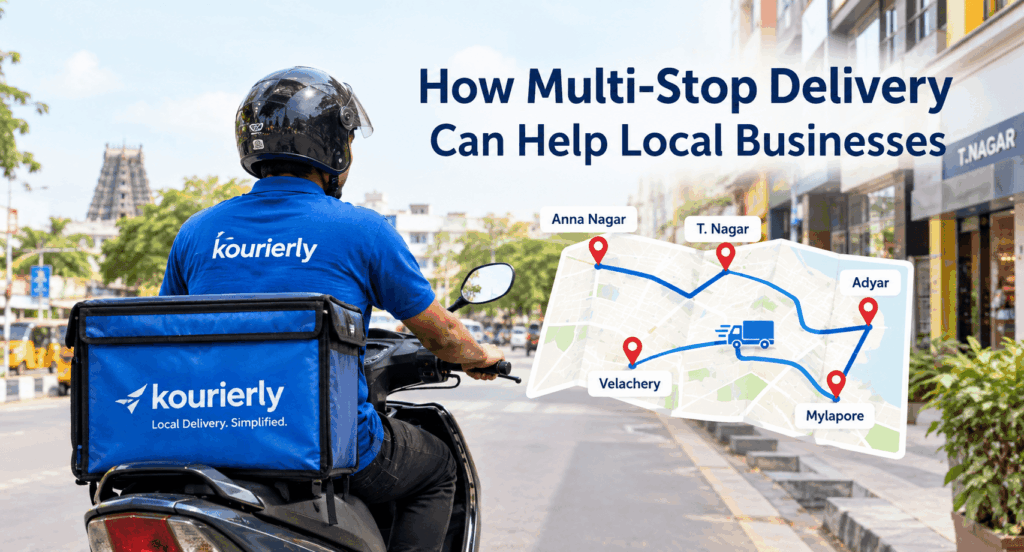
For a local business, delivery is no longer just about moving a product from Point A to Point B. Customers today expect convenient, reliable and timely delivery—whether they are ordering groceries, clothing, food, spare parts, documents or products from a neighbourhood shop.
This is especially important in a busy city like Chennai. A business may have customers in T. Nagar, Anna Nagar, Adyar, Velachery, Porur, Tambaram, OMR and other parts of the city on the same day. Making separate delivery trips for every customer can quickly increase fuel costs, travel time and operational pressure.
Multi-stop delivery offers a practical solution. Instead of sending a driver separately for every order, multiple deliveries can be planned as one route with several stops. Route planning systems can arrange stops based on factors such as location, traffic, delivery windows and vehicle capacity.
For Chennai’s local retailers, supermarkets, restaurants, pharmacies, D2C brands and other small businesses, this approach can make everyday delivery operations much easier.
What Is Multi-Stop Delivery?
Multi-stop delivery means completing several deliveries during a single delivery trip.
For example, imagine a clothing shop in Anna Nagar has five orders:
- One customer in Kilpauk
- One customer in Nungambakkam
- One customer in T. Nagar
- One customer in Mylapore
- One customer in Adyar
Instead of arranging five completely separate trips, the business can group these orders into one planned delivery route.
The driver collects the packages, follows the planned sequence and completes multiple drop-offs during the same run.
This is particularly useful for businesses handling several local orders every day.
Why Is Multi-Stop Delivery Useful in Chennai?
Chennai has a combination of busy commercial areas, residential neighbour
A business may receive several orders from customers located relatively close to each other. If every order is treated as a completely separate delivery, the driver may repeatedly travel through the same roads.
Multi-stop delivery helps businesses think differently:
Instead of:
One order → one trip → one customer
Businesses can plan:
Multiple orders → one route → multiple customers
This can improve the way delivery resources are used.
1. Reduce Unnecessary Travel
One of the biggest advantages of multi-stop delivery is reducing unnecessary back-and-forth travel.
Suppose a bakery receives orders from three offices around Guindy and Saidapet. Sending a driver back to the shop after every delivery can result in additional kilometres.
With a properly planned multi-stop route, the driver can complete the nearby deliveries together before returning.
Fewer unnecessary kilometres can mean less fuel consumption and better use of the driver’s working time.
2. Save Time for Your Delivery Team
Time is valuable for small businesses.
A shop owner who manages deliveries manually may spend a lot of time deciding:
- Which order should be delivered first?
- Which customer is nearby?
- Which road should the driver take?
- Can two orders be delivered during the same trip?
- When should the driver return for the next batch?
Multi-stop planning can make this process more organised.
Modern route optimisation tools can consider multiple stops, vehicle capacity, traffic and customer time windows when arranging routes.
This allows the business owner and delivery team to focus more on customers and daily operations rather than constantly planning routes.
3. Make Local Delivery More Cost-Efficient
For small businesses, delivery expenses can have a noticeable impact on margins.
Every separate trip can involve:
- Fuel
- Driver time
- Vehicle usage
- Parking or waiting time
- Additional coordination
Combining suitable deliveries into one route can help businesses use their delivery resources more efficiently.
This doesn’t mean every order should automatically be combined. Urgent orders, fragile products or specific delivery-time requirements may need individual handling.
The goal is to identify deliveries that can realistically be completed together.
4. Serve More Customers With the Same Resources
A local business doesn’t always need a large delivery fleet to increase its delivery capacity.
Better route planning can help existing drivers handle more suitable deliveries during their working hours.
For example, instead of one driver making three separate delivery runs during the morning, a business may be able to organise several nearby orders into planned routes.
This can be particularly useful for:
- Grocery stores
- Bakeries
- Restaurants
- Pharmacies
- Flower shops
- Clothing stores
- Electronics shops
- Hardware stores
- Spare-parts dealers
- Small manufacturers
- Online sellers
5. Improve the Customer Experience
Customers don’t necessarily need a delivery to be extremely fast. What they often need is reliable delivery.
A customer would rather receive a clear delivery estimate and have the order arrive as promised than receive an uncertain delivery window.
Route planning can help businesses organise deliveries around promised time windows
For Chennai customers, this can be especially helpful when businesses serve different neighbourhoods during the same day.
A simple message such as:
“Your order is scheduled for delivery between 3 PM and 5 PM.”
can create a much better experience than:
“Our delivery person will come sometime today.”
6. Help Businesses Compete With Larger Platforms
Customers are increasingly accustomed to convenient local delivery. Chennai has seen major expansion in quick-commerce and hyperlocal delivery services, increasing expectations around speed and convenience.
But local businesses have an important advantage: they already know their customers and neighbourhoods.
A local supermarket, bakery or speciality store doesn’t necessarily need to become a massive e-commerce company.
It needs a simple way to:
- Receive orders
- Prepare products
- Organise nearby deliveries
- Track deliveries
- Keep customers informed
Multi-stop delivery can become an important part of that local delivery system.
7. Useful for Recurring Business Deliveries
Multi-stop delivery isn’t only useful for individual customer orders.
Businesses can also use it for recurring deliveries.
For example:
A wholesale bakery
One morning route could include:
- Café A
- Restaurant B
- Hotel C
- Tea shop D
- Bakery E
Similarly, a stationery supplier could deliver products to multiple schools or offices during one route.
A spare-parts business could send components to several workshops.
A pharmacy distributor could plan deliveries to multiple stores.
When the same locations need service regularly, businesses can build repeatable delivery routes.
8. Better Use of Drivers and Vehicles
Not every delivery requires the same type of vehicle.
A few documents or small parcels may be suitable for a two-wheeler, while larger orders may require a three-wheeler or mini-truck.
Kourierly offers different vehicle options for local transportation, including two-wheelers, three-wheelers and mini-trucks, depending on the delivery requirement.
This gives local businesses the flexibility to match the delivery vehicle with the order instead of using a larger vehicle unnecessarily.
9. Multi-Stop Delivery Can Support Different Chennai Business Models
The concept works across many types of local businesses.
Supermarkets
A supermarket can group multiple nearby household orders into a planned delivery route.
Restaurants
A restaurant or catering business can deliver several orders to offices or events located within the same area.
Clothing Stores
A clothing shop can send multiple customer purchases to different nearby locations during one route.
Pharmacies
Local pharmacies can organise suitable non-urgent deliveries in nearby areas.
Hardware & Spare Parts
Businesses can deliver parts, tools and materials to several workshops or construction locations.
Home Businesses
Small Instagram, WhatsApp and home-based sellers can use local delivery services without maintaining their own delivery fleet.
How Kourierly Can Help Chennai Businesses
Kourierly is designed around local delivery and neighbourhood businesses.
The platform connects local businesses with delivery support, allowing businesses to focus on preparing and selling their products while the delivery side is handled through its delivery network. Kourierly also supports multi-stop deliveries in a single booking
For a Chennai business, the basic process can be simple:
1. Receive your orders
Collect the day’s customer orders.
2. Identify nearby deliveries
Group orders that can reasonably be served together.
3. Arrange the delivery
Choose an appropriate vehicle and delivery requirements.
4. Complete multiple stops
The driver handles the planned delivery locations.
5. Track the delivery
Kourierly provides real-time tracking and delivery visibility. Kourierly
This approach can help a small business offer a more organised delivery experience without building a large in-house logistics operation.
A Simple Example
Consider a supermarket in Velachery.
During the afternoon, the supermarket receives six orders from customers around:
- Velachery
- Taramani
- Perungudi
- Adambakkam
- Madipakkam
- Pallikaranai
Instead of treating each order independently, the business can look at the delivery locations and organise suitable orders into a route.
The driver collects the packages and completes the stops according to the planned sequence.
The result is a more structured delivery operation, with fewer disconnected trips and better utilisation of the vehicle and driver’s time.
What Businesses Should Consider Before Combining Deliveries
Multi-stop delivery is useful, but businesses should not simply combine every order.
Before creating a route, consider:
Delivery time
Does each customer have a specific delivery window?
Product type
Are the products fragile, perishable, valuable or temperature-sensitive?
Vehicle capacity
Can the vehicle safely carry all the packages?
Distance
Are the delivery locations close enough to make one route practical?
Traffic
Will peak-hour traffic significantly affect the planned route?
Customer priority
Does one order need immediate delivery while another can wait?
Good multi-stop delivery is about smart grouping, not simply adding more stops.
Why This Matters for Small Businesses
Large companies may have dedicated logistics teams, warehouses and delivery technology.
A local Chennai business may have just:
- One shop
- A few employees
- One or two delivery vehicles
- Orders coming through WhatsApp, phone calls, Instagram or its website
For these businesses, every delivery decision matters.
A simple improvement in route planning can make the daily operation more organised.
And when delivery becomes easier to manage, the business owner can spend more time on what really matters—serving customers, managing products and growing the business.
The Future of Local Delivery Is More Connected
Chennai’s delivery ecosystem is changing quickly. Customers increasingly expect businesses to provide convenient local delivery, while businesses are looking for practical ways to control delivery costs and improve reliability.
Multi-stop delivery is one way local businesses can adapt.
It doesn’t require every business to become a large e-commerce company. Instead, it gives neighbourhood businesses a way to make better use of the delivery resources they already have.
For a supermarket in Anna Nagar, a bakery in Adyar, a clothing shop in T. Nagar or a small online seller operating from home, organised local delivery can become an important part of the customer experience.