
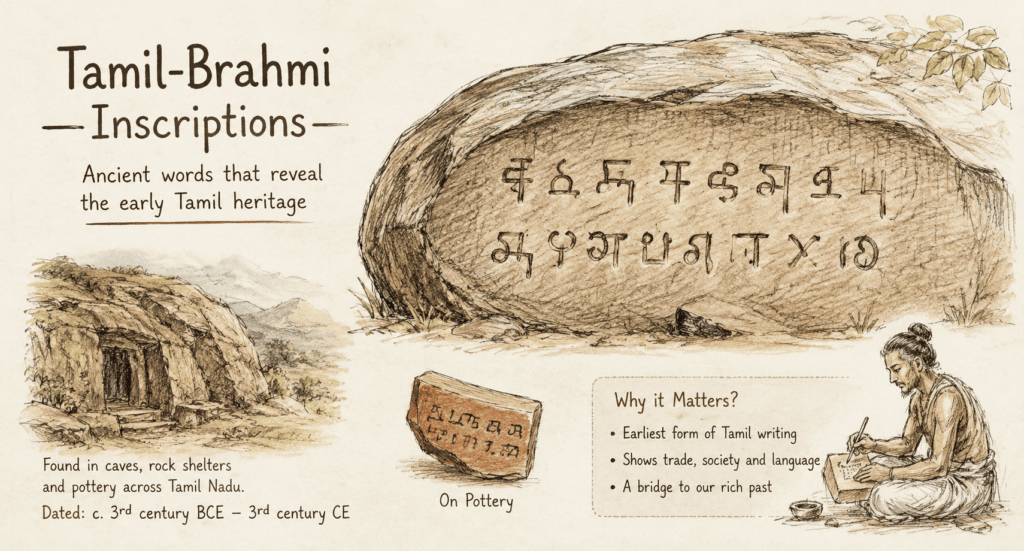
For centuries, historians have relied on literature, oral traditions, and archaeological discoveries to understand India’s ancient past. Among the most remarkable pieces of evidence are Tamil-Brahmi inscriptions—the earliest known written records of the Tamil language. These inscriptions provide direct insight into the lives, trade, beliefs, and literacy of people who lived more than 2,000 years ago.
Recent archaeological discoveries at sites such as Keezhadi, Kodumanal, Porunthal, Mangulam, Adichanallur, and Jambai have brought renewed global attention to Tamil-Brahmi inscriptions. For readers in the United States interested in archaeology, ancient civilizations, or world history, these inscriptions offer a fascinating glimpse into one of the world’s oldest continuously spoken languages.
What Are Tamil-Brahmi Inscriptions?
Tamil-Brahmi inscriptions are writings created using a regional adaptation of the Brahmi script, modified to represent the unique sounds of the Tamil language.
While the original Brahmi script appeared across much of the Indian subcontinent during the Mauryan period, Tamil-speaking scholars and scribes adapted it to better fit Tamil phonetics. This adaptation became known as Tamil-Brahmi.
Most scholars date these inscriptions between approximately the 3rd century BCE and the 3rd century CE, although some archaeological findings suggest that writing traditions in southern India may have developed even earlier.
These inscriptions are found on:
- Pottery
- Rock shelters
- Cave walls
- Coins
- Rings
- Beads
- Hero stones
- Metal objects
- Burial artifacts
Unlike royal monuments that often celebrate kings and wars, many Tamil-Brahmi inscriptions document everyday people and activities, making them especially valuable to historians.
Why Are Tamil-Brahmi Inscriptions Important?
Tamil-Brahmi inscriptions are significant because they provide primary historical evidence rather than relying solely on literary traditions.
They help researchers understand:
- Early Tamil language development
- Literacy in ancient South India
- Trade and commerce
- Religious practices
- Social organization
- Personal names
- Occupations
- Regional governance
- Cultural exchange
These inscriptions bridge the gap between archaeology and classical Tamil literature, particularly the Sangam corpus, which describes prosperous cities, merchants, poets, and rulers.
The Origins of Tamil Writing
One of the biggest historical questions has been:
When did people begin writing in Tamil?
Tamil-Brahmi inscriptions provide the earliest widely accepted evidence that written Tamil existed over 2,000 years ago.
Archaeological excavations continue to refine the chronology through scientific dating methods such as radiocarbon analysis. While researchers debate the exact timeline of the earliest inscriptions, there is broad agreement that Tamil-Brahmi represents one of the oldest documented writing systems in South Asia.
Where Have Tamil-Brahmi Inscriptions Been Found?
Keezhadi
Keezhadi has become internationally known for discoveries that reveal an urban settlement with evidence of literacy.
Archaeologists discovered:
- Pottery containing Tamil-Brahmi inscriptions
- Brick-built structures
- Industrial workshops
- Drainage systems
- Craft production areas
These discoveries suggest that literacy extended beyond royal elites and may have been used in everyday commercial life.
Mangulam
Mangulam contains some of the earliest known Tamil-Brahmi cave inscriptions.
These inscriptions mention workers connected to Pandyan rulers and demonstrate that writing was already being used for official and religious purposes.
Kodumanal
Kodumanal was an important industrial and trade center.
Tamil-Brahmi inscriptions found here appear on:
- Pottery
- Beads
- Industrial artifacts
The site demonstrates that artisans and merchants likely used written markings to identify ownership or products.
Porunthal
Excavations at Porunthal uncovered pottery bearing Tamil-Brahmi characters alongside burial remains.
Scientific dating has made Porunthal one of the key sites in discussions about the antiquity of Tamil writing.
Jambai
One of the most famous Tamil-Brahmi inscriptions comes from Jambai.
It mentions the ruler Athiyaman Neduman Anji, a well-known figure in Sangam literature.
This discovery is especially valuable because it connects archaeology with historical texts, strengthening historians’ understanding of early Tamil kingdoms.
What Do the Inscriptions Say?
Unlike lengthy historical records, many Tamil-Brahmi inscriptions are short.
They often include:
- Personal names
- Merchant marks
- Donations
- Religious dedications
- Ownership records
- Titles
- References to rulers
Although brief, these inscriptions provide direct evidence of daily life that written literature alone cannot fully capture.
Evidence of Trade
Tamil-Brahmi inscriptions also reveal the importance of commerce in ancient South India.
Archaeological discoveries indicate trade with:
- Sri Lanka
- The Roman Empire
- Southeast Asia
- Other regions of the Indian subcontinent
Ports such as Korkai, Poompuhar, and Muziris played major roles in international trade.
Artifacts including Roman coins, imported ceramics, beads, and luxury goods suggest that Tamil merchants participated in extensive maritime trade networks.
Written markings helped identify goods, merchants, and ownership, demonstrating the practical value of literacy.
Religion and Society
Many cave inscriptions record donations made to Jain monks.
These inscriptions indicate:
- Religious patronage
- Organized communities
- Philanthropy
- Social status
- Community leadership
They also reveal that ordinary individuals—not only kings—contributed to religious institutions.
The Language Behind the Script
Tamil-Brahmi represents an early stage in the evolution of written Tamil.
Over time, the script gradually evolved into later forms such as:
- Vatteluttu
- Pallava Grantha (for Sanskrit in the region)
- Modern Tamil script
Today’s Tamil alphabet has changed significantly in appearance, but its historical roots can be traced through Tamil-Brahmi.
Archaeology Continues to Rewrite History
Modern excavations have transformed our understanding of early South India.
Advances in archaeological science—including radiocarbon dating, residue analysis, GIS mapping, and digital imaging—allow researchers to study inscriptions and artifacts with greater precision than ever before.
As new discoveries emerge, historians continue refining their understanding of the development of literacy, urbanization, and trade in ancient Tamil society.
Why This Matters Beyond India
For American readers, Tamil-Brahmi inscriptions demonstrate that complex urban societies and sophisticated writing traditions developed independently across different parts of the ancient world.
They contribute to broader conversations about:
- The origins of writing systems
- Ancient globalization
- Cross-cultural trade
- Urban development
- Preservation of cultural heritage
Studying Tamil-Brahmi also highlights the importance of archaeology in reconstructing history through physical evidence rather than relying solely on later written accounts.
Challenges in Interpretation
Although thousands of inscriptions have been documented, many remain incomplete or damaged.
Researchers continue to debate:
- Exact dates for some inscriptions
- Regional variations in script
- The evolution of certain characters
- Connections between archaeological layers and written evidence
These discussions are a normal part of archaeological research and help improve our understanding as new evidence becomes available.
Preserving an Ancient Legacy
Tamil-Brahmi inscriptions are vulnerable to weathering, urban development, and natural erosion. Preservation efforts by archaeologists, museums, universities, and heritage organizations are essential to ensure these records remain available for future generations.
Digital documentation, 3D scanning, and high-resolution photography are increasingly being used to record inscriptions before they deteriorate.