
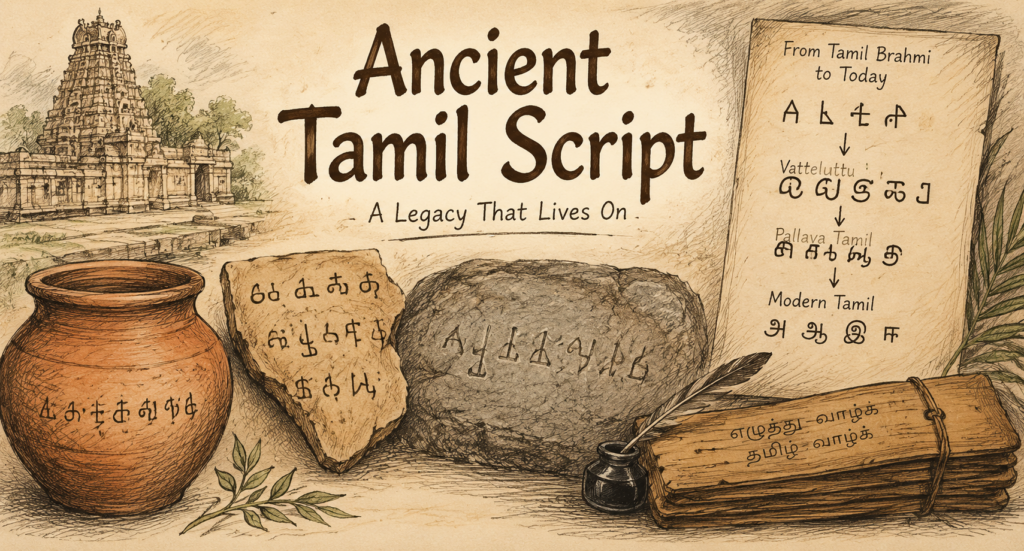
Writing is one of humanity’s greatest inventions. It transformed societies by allowing people to record history, conduct trade, preserve literature, administer kingdoms, and pass knowledge from one generation to the next. Around the world, ancient writing systems such as Egyptian hieroglyphs, Mesopotamian cuneiform, Chinese characters, and the Greek alphabet have become symbols of great civilizations.
Among these remarkable writing traditions is the Ancient Tamil Script, one of the oldest continuously evolving writing systems still in use today. Originating in southern India, the Tamil script has a history spanning more than two millennia and serves as the foundation of one of the world’s oldest living classical languages—Tamil.
For many readers in the United States, Tamil may be unfamiliar compared to languages such as Latin, Greek, or Sanskrit. Yet Tamil possesses one of the richest literary traditions in the world. Its ancient inscriptions, cave records, pottery writings, coins, and manuscripts provide valuable insights into the political, cultural, economic, and social life of early South India.
Modern archaeological discoveries at sites such as Keezhadi, Kodumanal, Porunthal, Mangulam, Jambai, and Pugalur have significantly expanded historians’ understanding of the development of writing in ancient Tamil society. These discoveries show that literacy was already being used for trade, ownership, administration, and daily life during the Early Historic period.
Today, the Ancient Tamil Script stands not only as a symbol of Tamil heritage but also as an important chapter in the global history of writing.
What Is the Ancient Tamil Script
The term Ancient Tamil Script generally refers to the earliest forms of writing used to record the Tamil language.
Rather than being a single script throughout history, Tamil writing evolved through several stages:
- Tamil-Brahmi (earliest known writing system used for Tamil)
- Vatteluttu (“Rounded Script”)
- Pallava Grantha influences for Sanskrit loanwords
- Medieval Tamil Script
- Modern Tamil Script
Each stage reflects changes in society, writing materials, politics, religion, and artistic traditions.
Despite these changes, the Tamil language itself has remained remarkably continuous, allowing modern readers to appreciate literary works whose origins stretch back more than 2,000 years.
Why the Ancient Tamil Script Matters
Ancient writing systems are more than collections of letters—they preserve the story of civilizations.
The Ancient Tamil Script helps historians understand:
- Government administration
- Trade and commerce
- Religious practices
- Land ownership
- Personal names
- Social organization
- Economic activities
- Literary development
Without inscriptions and written records, much of early Tamil history would remain unknown.
For archaeologists, even a short inscription on a pottery fragment can reveal valuable information about the people who made, owned, or traded an object.
The Origins of Tamil Writing
One of the most frequently asked questions is:
“When did the Tamil language begin to be written?”
Based on current archaeological evidence, the earliest widely accepted written form of Tamil is Tamil-Brahmi, which appears in inscriptions dating from roughly the 3rd century BCE onward. Some discoveries from archaeological sites such as Porunthal and Keezhadi have led researchers to propose earlier dates for certain inscriptions or associated contexts. However, these interpretations remain the subject of ongoing scholarly discussion.
What is widely accepted is that by the Early Historic period, Tamil-speaking communities were already using writing for practical purposes, including marking pottery, recording donations, identifying individuals, and supporting trade.
Understanding Tamil-Brahmi
Tamil-Brahmi represents an adaptation of the broader Brahmi script to accurately record the unique sounds of the Tamil language.
Unlike standard Brahmi, Tamil-Brahmi includes modifications to represent phonetic features specific to Tamil.
These innovations allowed scribes to write:
- Personal names
- Commercial markings
- Religious donations
- Ownership inscriptions
- Administrative records
Tamil-Brahmi is therefore not simply Brahmi written in Tamil; it is an adapted script designed to meet the linguistic needs of Tamil speakers.
Where Has Tamil-Brahmi Been Found?
Archaeologists have discovered Tamil-Brahmi inscriptions at numerous locations across Tamil Nadu.
Some of the most important sites include:
Keezhadi
Pottery fragments bearing Tamil-Brahmi inscriptions suggest that literacy formed part of everyday urban life.
Kodumanal
Inscribed pottery found alongside industrial workshops indicates that writing was closely connected with trade and manufacturing.
Porunthal
Discoveries at Porunthal strengthened archaeological evidence for the use of written Tamil during the Early Historic period.
Mangulam
Among the earliest known Tamil-Brahmi cave inscriptions, Mangulam records donations associated with workers connected to the Pandya kingdom.
Jambai
The famous Jambai inscription is especially important because it mentions the ruler Atiyan Neduman Anji, helping historians connect archaeological evidence with references in Sangam literature.
Pugalur
Pugalur inscriptions provide valuable genealogical information about members of the Chera dynasty.
Together, these sites demonstrate that writing was used across different regions and social settings in ancient Tamilakam.
Writing Beyond Stone
Many people imagine ancient writing carved only into monuments.
In reality, ancient Tamil writing appears on a variety of materials.
Archaeologists have found inscriptions on:
- Pottery
- Cave walls
- Rock shelters
- Coins
- Metal objects
- Rings
- Seals
- Stone monuments
Pottery inscriptions are particularly valuable because they reveal that writing was not limited to kings or religious institutions—it also played a role in everyday economic life.
Tamil and the Sangam Age
The Sangam Age (generally dated between approximately 300 BCE and 300 CE) is celebrated as one of the golden periods of early Tamil culture.
Classical Tamil literature from this era describes:
- Kings
- Merchants
- Farmers
- Poets
- Warriors
- Coastal trade
- Love
- Warfare
- Nature
Archaeological discoveries complement these literary works by providing physical evidence of settlements, industries, trade networks, and literacy.
Together, literature and archaeology offer a richer understanding of early Tamil civilization.
The Importance of Cave Inscriptions
One of the earliest surviving examples of Tamil writing appears in rock-cut cave inscriptions.
These inscriptions often record donations made to Jain monks and ascetics.
They typically include:
- Donor names
- Occupations
- Family connections
- Religious dedications
Although many inscriptions contain only a few lines, they provide historians with invaluable information about the society, economy, and religious life of ancient Tamil Nadu.
Literacy in Everyday Life
One of the most significant conclusions drawn from archaeological discoveries is that writing was not confined solely to royal courts.
Evidence suggests literacy was used in:
- Trade
- Manufacturing
- Religious donations
- Personal ownership
- Commercial identification
This widespread use of writing reflects an increasingly organized and interconnected society.