
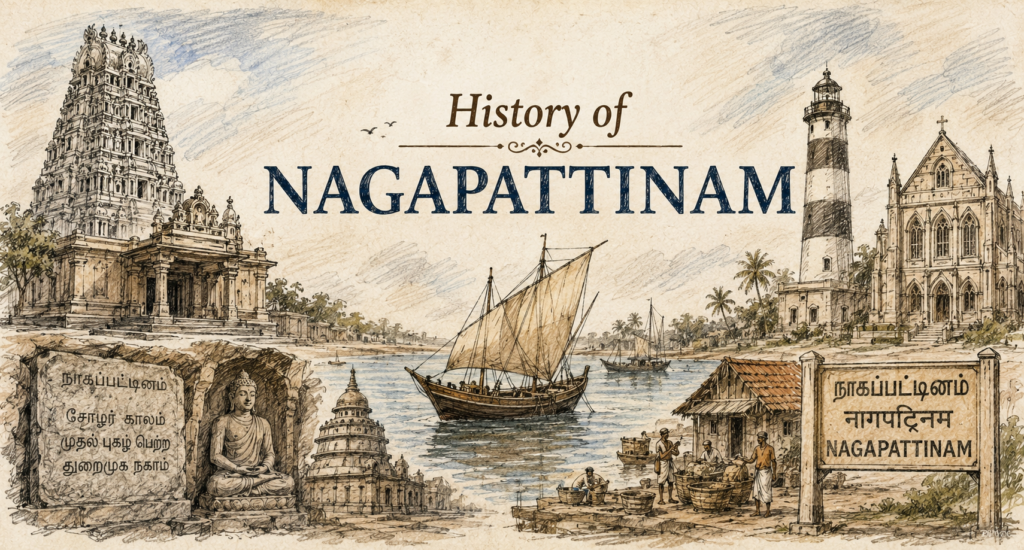
Nagapattinam is one of India’s oldest and most historically significant coastal cities. Situated on the Coromandel Coast along the Bay of Bengal in the southeastern state of Tamil Nadu, the city has served as a thriving seaport, cultural crossroads, religious center, and international trading hub for more than two thousand years.
Today, Nagapattinam is known for its rich spiritual heritage, historic churches, ancient temples, vibrant fishing industry, and proximity to UNESCO-recognized Chola monuments. However, beneath its modern identity lies a remarkable story of maritime commerce, powerful South Indian empires, overseas diplomacy, and colonial competition.
For readers in the United States and around the world, Nagapattinam offers a fascinating perspective on India’s role in early global trade. Long before the Age of European exploration, merchants from Tamil Nadu sailed from this port to Sri Lanka, Southeast Asia, China, and the Middle East, carrying spices, textiles, precious stones, and cultural traditions across the Indian Ocean.
Throughout its long history, Nagapattinam came under the influence of several powerful dynasties, including the Early Cholas, Pallavas, Later Cholas, Pandyas, Vijayanagara Empire, Portuguese, Dutch, and British. Each period contributed to the city’s unique architectural, religious, and commercial heritage.
This article explores the early history of Nagapattinam, tracing its journey from ancient Tamil settlements to one of South India’s greatest maritime ports.
Where is Nagapattinam?
Nagapattinam is located approximately 300 kilometers south of Chennai, on the eastern coast of Tamil Nadu.
The city lies beside the Bay of Bengal and is surrounded by fertile lands nourished by the distributaries of the Cauvery River Delta, one of India’s most productive agricultural regions.
Its strategic coastal location made it an ideal center for:
- Maritime trade
- Shipbuilding
- Fishing
- Agriculture
- Cultural exchange
- Religious pilgrimage
Even today, Nagapattinam remains an important coastal district with strong links to Tamil Nadu’s fishing and agricultural economy.
Origin of the Name “Nagapattinam”
The name Nagapattinam has several traditional interpretations.
One widely accepted explanation derives the name from:
- “Naga” – referring either to serpent worshippers or ancient Naga communities.
- “Pattinam” – the Tamil word for a port town or coastal city.
Thus, Nagapattinam is often interpreted as “The Port of the Nagas.”
Ancient inscriptions and literary references also record variations such as Nagai and Nagai Pattinam, reflecting its long-standing importance as a seaport.
Ancient Human Settlement
Archaeological evidence indicates that the Nagapattinam region has been inhabited for thousands of years.
Excavations across the Cauvery Delta have uncovered:
- Megalithic burial sites
- Iron Age tools
- Black-and-red ware pottery
- Early agricultural settlements
- Ancient coins
- Trade-related artifacts
These discoveries show that prosperous communities developed here because of:
- Fertile river plains
- Abundant freshwater
- Access to the sea
- Rich fishing grounds
- Excellent trading opportunities
Nagapattinam During the Sangam Age
The Sangam Age (approximately 300 BCE–300 CE) marks one of the earliest documented periods of Tamil civilization.
Although nearby Kaveripoompattinam (Poompuhar) dominated much of the literary record, Nagapattinam gradually emerged as another important coastal settlement benefiting from expanding maritime commerce.
During this era, Tamil merchants exported:
- Pepper
- Cotton textiles
- Pearls
- Ivory
- Spices
- Precious stones
- Aromatic woods
Ships from the Mediterranean, Arabia, and Southeast Asia visited ports along the Coromandel Coast, bringing gold, horses, glassware, and luxury goods.
Roman coins discovered throughout Tamil Nadu highlight the extensive overseas trade networks that supported coastal towns like Nagapattinam.
The Chola Empire and the Rise of Nagapattinam
The golden age of Nagapattinam began under the Imperial Cholas between the 9th and 13th centuries.
The Chola rulers transformed South India into one of the world’s greatest maritime powers.
Under kings such as:
- Vijayalaya Chola
- Rajaraja I
- Rajendra I
- Kulothunga I
Nagapattinam flourished as an international port.
The city became a gateway connecting India with:
- Sri Lanka
- Indonesia
- Malaysia
- Thailand
- Cambodia
- Myanmar
- China
Merchant guilds operating from Nagapattinam established commercial colonies throughout Southeast Asia.
Maritime Trade and International Commerce
Nagapattinam became one of the busiest ports in the Bay of Bengal.
Major exports included:
- Fine cotton textiles
- Pepper
- Cardamom
- Cinnamon
- Rice
- Bronze sculptures
- Precious stones
Imports included:
- Horses from Arabia
- Silk from China
- Ceramics
- Gold
- Luxury goods
- Exotic spices
This international trade generated enormous wealth that supported temple construction, public works, and cultural development across the Chola Empire.
Chola Naval Expeditions
The Cholas were among the few Indian dynasties to maintain a powerful blue-water navy.
Nagapattinam served as one of the principal naval bases for expeditions launched toward Southeast Asia.
During the reign of Rajendra Chola I, naval campaigns extended Chola influence across parts of modern-day:
- Indonesia
- Malaysia
- Sumatra
- The Malay Peninsula
These expeditions secured important sea routes and strengthened commercial relationships throughout the Indian Ocean.
A Centre of Buddhism and International Diplomacy
One of Nagapattinam’s unique historical features was its role as a center for Buddhism, alongside its strong Hindu traditions.
Historical records indicate that the rulers of the Srivijaya Empire (based in present-day Indonesia) supported the construction of a Buddhist monastery in Nagapattinam during the Chola period.
This remarkable cooperation illustrates the city’s role as a meeting point for different cultures and religions connected through maritime trade.
Chinese travelers and Southeast Asian merchants frequently visited the port, contributing to its cosmopolitan atmosphere.
Religious Diversity
Nagapattinam has long been a city where multiple faiths coexisted.
The region became home to:
- Ancient Hindu temples
- Buddhist monasteries
- Islamic trading communities
- Christian churches established during European rule
This diversity reflects centuries of international commerce and cultural exchange.
Today, the district remains an important pilgrimage destination for people of different faiths.
Agriculture Along the Cauvery Delta
Although renowned as a seaport, Nagapattinam also benefited from one of India’s richest agricultural regions.
The fertile Cauvery Delta supported cultivation of:
- Rice
- Coconut
- Sugarcane
- Banana
- Pulses
- Sesame
The agricultural surplus supplied both local communities and overseas markets.
Rice exported from the delta became one of the important commodities traded through Nagapattinam’s port.
Pandya and Vijayanagara Period
Following the decline of the Chola Empire, Nagapattinam came under the influence of the Pandya Kingdom and later the Vijayanagara Empire.
These rulers maintained the city’s commercial importance by:
- Protecting maritime trade
- Supporting agriculture
- Strengthening local administration
- Maintaining coastal security
Although political control changed, Nagapattinam continued functioning as a major trading port.
Arrival of the Portuguese
The arrival of the Portuguese during the early 16th century marked the beginning of European influence.
Recognizing the city’s commercial value, Portuguese merchants established trading activities along the coast.
Christian missionaries also began constructing churches and introducing new religious institutions.
This period marked the beginning of significant cultural exchanges between Europe and South India.
Dutch Rule
During the 17th century, the Dutch East India Company (VOC) gradually replaced Portuguese influence.
Nagapattinam became one of the Dutch Company’s principal settlements on the Coromandel Coast.
The Dutch expanded:
- Warehouses
- Trade facilities
- Maritime commerce
- Administrative buildings
For several decades, Nagapattinam served as the capital of Dutch possessions on India’s eastern coast.
British Administration
In the late 18th century, British forces gained control of Nagapattinam after conflicts with the Dutch.
Under British administration:
- Port facilities were modernized.
- Roads improved.
- Trade expanded.
- Revenue administration became more organized.
Although the port later faced competition from Chennai and Tuticorin, Nagapattinam remained an important coastal center.
Important Historical Landmarks
- Nagore Dargah, one of India’s most respected Islamic pilgrimage centers.
- Basilica of Our Lady of Good Health, Velankanni, attracting millions of pilgrims annually.
- Soundararaja Perumal Temple, reflecting the region’s ancient Vaishnavite heritage.
- Dutch Cemetery, preserving reminders of European colonial history.
These landmarks demonstrate the city’s rich multicultural legacy.