
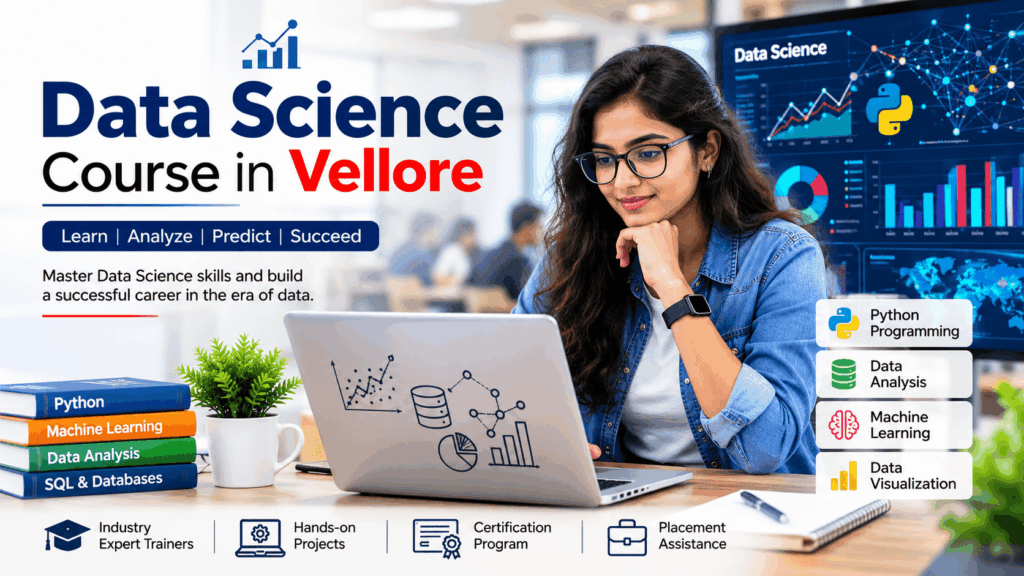
Data Science Course in Vellore
Are you looking for the best Data Science Course in Vellore to start a successful career in analytics, artificial intelligence, and machine learning? If yes, you’re in the right place.
Data Science is one of the fastest-growing career fields in India. Companies across banking, healthcare, retail, IT, manufacturing, and e-commerce are actively hiring skilled data professionals. Whether you’re a student, a working professional, or someone planning a career change, learning Data Science can open doors to exciting job opportunities with attractive salary packages.
If you’re based in Vellore or nearby locations like Ranipet, Katpadi, Arcot, Ambur, Gudiyatham, or Chittoor, enrolling in a practical Data Science course can help you gain industry-ready skills without relocating to a metro city.
In this guide, we’ll explain everything you need to know about learning Data Science in Vellore, including course syllabus, career opportunities, required skills, salary expectations, and how to choose the right training institute.
What is Data Science?
Data Science is the process of collecting, analyzing, and interpreting data to solve real-world business problems. It combines programming, statistics, mathematics, and business understanding to help organizations make informed decisions.
A Data Scientist works with large datasets to identify patterns, predict future trends, and create intelligent solutions using Machine Learning and Artificial Intelligence.
Today, almost every industry generates huge amounts of data. Businesses need skilled professionals who can convert this data into valuable insights.
Why Choose a Data Science Course in Vellore?
Many students believe they need to move to Chennai, Bangalore, or Hyderabad to learn Data Science. That’s no longer true.
A quality training institute in Vellore offers:
- Industry-oriented curriculum
- Experienced trainers
- Practical lab sessions
- Live projects
- Placement support
- Affordable course fees
- Flexible weekday and weekend batches
Learning locally also saves accommodation and travel expenses while allowing students to receive personalized guidance.
Who Can Join This Course?
The course is suitable for:
- Engineering students
- Arts and Science graduates
- Computer Science students
- IT professionals
- Software Developers
- Testing Engineers
- Fresh graduates
- Working professionals
- Career switchers
- Business Analysts
Even beginners with no coding background can start learning if the course begins with programming fundamentals.
Skills You’ll Learn
A professional Data Science training program covers both technical and practical skills.
Python Programming
Python is the most popular programming language used in Data Science.
You’ll learn:
- Variables
- Functions
- Loops
- File handling
- Object-Oriented Programming
- Python libraries
Statistics
Statistics helps in understanding and analyzing data.
Topics include:
- Mean
- Median
- Mode
- Probability
- Standard deviation
- Correlation
- Hypothesis testing
SQL
Almost every company stores data in databases.
You’ll learn:
- Database concepts
- SQL queries
- Joins
- Functions
- Views
- Stored procedures
Data Analysis
Understand how to clean and prepare raw data using:
- NumPy
- Pandas
- Excel
Data Visualization
Present data in a meaningful format using:
- Power BI
- Tableau
- Matplotlib
- Seaborn
Machine Learning
This is the heart of Data Science.
You’ll learn algorithms like:
- Linear Regression
- Logistic Regression
- Decision Trees
- Random Forest
- KNN
- Support Vector Machine
- Clustering
- Naive Bayes
Deep Learning Basics
Introduction to:
- Neural Networks
- TensorFlow
- Keras
Artificial Intelligence Concepts
Understand how AI systems work in modern businesses.
Capstone Projects
Students work on real datasets to build practical experience.
Data Science Course Syllabus
A comprehensive course generally includes:
Module 1 – Programming Fundamentals
- Python Basics
- Functions
- Data Types
- Exception Handling
Module 2 – Advanced Python
- OOP Concepts
- Modules
- Packages
- APIs
Module 3 – SQL Database
- MySQL
- Database Design
- Queries
Module 4 – Statistics
- Descriptive Statistics
- Inferential Statistics
Module 5 – Data Analysis
- Data Cleaning
- Feature Engineering
Module 6 – Data Visualization
- Dashboards
- Charts
- Reporting
Module 7 – Machine Learning
- Supervised Learning
- Unsupervised Learning
- Model Evaluation
Module 8 – Deep Learning
- Neural Networks
- Image Classification Basics
Module 9 – Real-Time Projects
- Sales Analysis
- Customer Prediction
- Healthcare Analytics
- Banking Analytics
Module 10 – Interview Preparation
- Resume Building
- Mock Interviews
- Aptitude Training
- HR Preparation
Why Practical Learning Matters
Many learners make the mistake of studying only theory.
A good institute focuses on:
- Live coding sessions
- Hands-on assignments
- Real datasets
- Case studies
- Business scenarios
- Mini projects
- Industry projects
This practical experience increases confidence during interviews.
Career Opportunities After Data Science
After completing the course, you can apply for roles such as:
- Data Scientist
- Data Analyst
- Business Analyst
- Machine Learning Engineer
- AI Engineer
- Python Developer
- Data Engineer
- BI Developer
- Research Analyst
- Analytics Consultant
Industries Hiring Data Science Professionals
Data Science professionals are in demand across:
- IT Services
- Banking
- Finance
- Healthcare
- Manufacturing
- Insurance
- Retail
- Telecommunications
- E-commerce
- Logistics
- Automobile
- Education
- Pharmaceuticals
Salary After Learning Data Science
Salary depends on skills, projects, certifications, and interview performance.
Typical salary ranges in India are:
- Freshers: ₹4 LPA – ₹7 LPA
- 2–5 Years Experience: ₹8 LPA – ₹15 LPA
- Senior Professionals: ₹18 LPA and above
Professionals with strong Python, SQL, Machine Learning, and Power BI skills often enjoy faster career growth.
Why Python is Important in Data Science
Python is simple to learn and widely used across industries.
Advantages include:
- Easy syntax
- Large community support
- Powerful libraries
- Machine Learning support
- Automation capabilities
- High demand in the job market
Learning Python significantly improves your employability.
Real-Time Projects You May Work On
Hands-on projects help you understand how businesses use data.
Examples include:
- Sales Forecasting Dashboard
- Customer Churn Prediction
- Loan Approval Prediction
- Employee Attrition Analysis
- Hospital Data Analytics
- Product Recommendation System
- Student Performance Analysis
- Stock Market Prediction (basic)
- Fraud Detection
- Retail Sales Analysis
These projects strengthen your portfolio and make your resume stand out.
Why Choose Our Data Science Course in Vellore?
Our training program is designed for students and professionals who want practical knowledge and career-focused learning.
Experienced Trainers
Learn from professionals with real industry experience.
Updated Curriculum
Course content is regularly updated to match current industry requirements.
Hands-On Practice
Every topic includes practical exercises and projects.
Flexible Timings
Choose from weekday, weekend, or fast-track batches based on your schedule.
Placement Assistance
Receive guidance for resume preparation, mock interviews, and job opportunities.
Affordable Fees
Get quality training at a competitive fee structure without compromising on learning.
Individual Attention
Small batch sizes allow trainers to provide personalized support and clear doubts effectively.
Tips to Become a Successful Data Scientist
Success in Data Science comes from continuous learning and consistent practice.
Here are a few tips:
- Practice coding every day.
- Build multiple real-world projects.
- Learn SQL thoroughly.
- Improve your statistics knowledge.
- Participate in coding challenges.
- Maintain a GitHub portfolio.
- Stay updated with industry trends.
- Work on communication and problem-solving skills.