
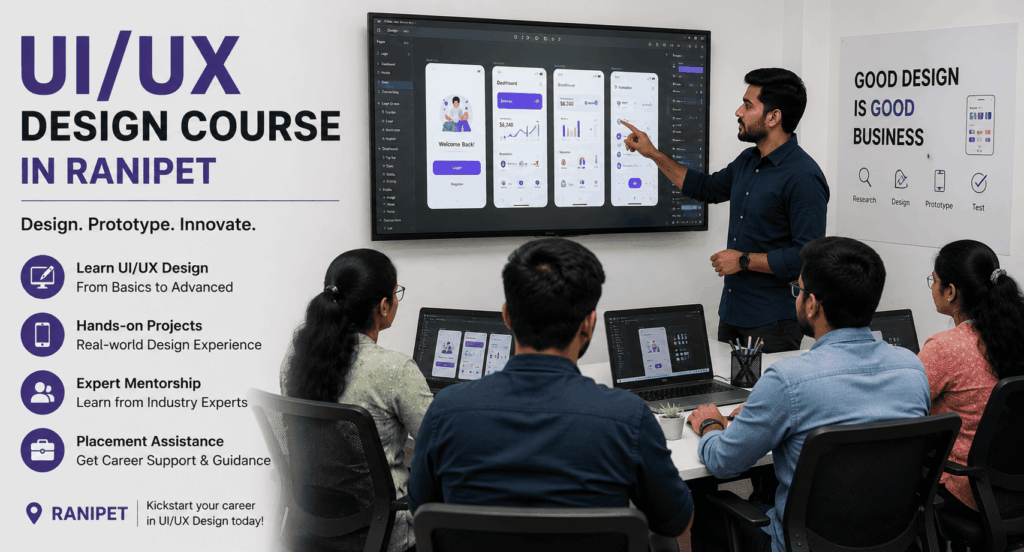
UI/UX Design Course in Ranipet – Learn to Design Modern Websites and Mobile Apps
In today’s digital world, people expect websites and mobile apps to be simple, attractive, and easy to use. Whether it is online shopping, food delivery, banking, education, or healthcare, a good user experience plays an important role in the success of every digital product.
This is where UI/UX Design becomes important. Companies are investing in skilled designers who can create visually appealing interfaces while ensuring users enjoy a smooth and intuitive experience. As businesses continue to focus on customer satisfaction, the demand for UI/UX Designers is increasing across India and around the world.
If you are looking for the best UI/UX Design Course in Ranipet, this guide will help you understand everything about the course, including the skills you will learn, career opportunities, salary expectations, and why practical training is essential for building a successful career.
Whether you are a student, fresher, graphic designer, web developer, or working professional looking to switch careers, UI/UX Design offers excellent opportunities in the IT and digital design industries.
What is UI/UX Design?
UI/UX Design is the process of designing digital products that are visually attractive, easy to use, and capable of providing a positive user experience.
Although UI (User Interface) and UX (User Experience) are closely connected, they focus on different aspects of product design.
A successful digital product requires both a beautiful interface and a user-friendly experience.
What is UI Design?
UI (User Interface) Design focuses on the visual appearance of websites and mobile applications.
UI Designers work on elements such as:
- Colours
- Typography
- Icons
- Buttons
- Layouts
- Images
- Navigation menus
- Design consistency
Their goal is to create interfaces that look modern, professional, and easy to understand.
What is UX Design?
UX (User Experience) Design focuses on how users interact with a product.
UX Designers study user behaviour and create experiences that are:
- Simple
- Fast
- Convenient
- Accessible
- User-friendly
- Efficient
They ensure users can complete their tasks without confusion or unnecessary effort.
Difference Between UI and UX
Although the two roles work together, they have different responsibilities.
- UI Design
- Focuses on visual design
- Creates attractive interfaces
- Works with colours, fonts, icons, and layouts
- Improves the appearance of digital products
- UX Design
- Focuses on user experience
- Studies user behaviour
- Plans user journeys
- Improves usability and functionality
Professional UI/UX Designers usually understand both disciplines to build better digital products.
Why Choose UI/UX Design as a Career?
UI/UX Design has become one of the fastest-growing creative careers because businesses understand the importance of delivering excellent digital experiences.
Some major reasons to choose UI/UX Design include:
High Industry Demand
Companies from almost every industry hire UI/UX Designers.
These include:
- Software Companies
- Product-based Companies
- Digital Marketing Agencies
- E-commerce Businesses
- Healthcare
- Banking
- Education
- Travel
- Entertainment
- Startups
As more businesses build websites and mobile applications, the demand for skilled designers continues to grow.
Attractive Salary Packages
UI/UX Designers receive competitive salary packages based on their skills, creativity, and portfolio.
Freshers with strong design projects often receive excellent opportunities, while experienced professionals can move into senior design and product roles.
Creative and Rewarding Work
Unlike repetitive jobs, UI/UX Design allows professionals to solve real user problems through creativity.
Designers work on:
- Mobile applications
- Websites
- Dashboards
- E-commerce platforms
- Banking applications
- Healthcare systems
- Educational portals
Every project presents new design challenges and learning opportunities.
Global Career Opportunities
UI/UX Design skills are recognised worldwide.
Companies in the USA, Canada, the UK, Germany, Australia, Singapore, and the UAE regularly hire skilled UI/UX Designers.
Remote work opportunities have also increased, allowing designers to work with international clients from India.
Why Learn UI/UX Design in Ranipet?
Earlier, many students travelled to bigger cities to learn professional design tools. Today, quality training institutes are making industry-oriented UI/UX education available closer to home.
Benefits of joining a UI/UX Design course in Ranipet include:
- Easy daily travel
- Affordable training
- Experienced mentors
- Practical design sessions
- Portfolio development
- Individual guidance
- Interview preparation
- Placement support
Learning locally also gives students more time to practise their skills and build a professional portfolio.
Who Can Join a UI/UX Design Course?
One of the biggest advantages of UI/UX Design is that students from different educational backgrounds can learn it successfully.
This course is suitable for:
- BE and B.Tech students
- BCA graduates
- MCA students
- B.Sc. students
- Diploma holders
- Graphic Designers
- Web Developers
- Fresh graduates
- Working professionals
- Entrepreneurs
- Freelancers
- Career switchers
Even beginners without previous design experience can start learning through a structured training programme.
Skills You Will Learn During the Course
A professional UI/UX Design course combines creativity, research, design thinking, and modern design tools.
Below are some of the major skills covered.
Design Thinking
Students first understand the complete design process.
Topics include:
- User research
- Problem identification
- Idea generation
- User-centred design
- Design validation
Design Thinking helps create products that solve real customer problems.
Wireframing
Wireframes are simple layouts used to plan website and mobile application screens.
Students learn:
- Screen structure
- Navigation planning
- User flow
- Content hierarchy
- Layout organisation
Wireframes help teams visualise ideas before creating final designs.
Prototyping
Prototypes simulate the behaviour of a website or mobile application.
Students learn how to:
- Create clickable prototypes
- Build user journeys
- Test interactions
- Demonstrate application flow
Prototyping improves communication between designers, developers, and clients.
Figma
Figma is one of the most popular UI/UX design tools used by software companies worldwide.
Students learn:
- Interface design
- Components
- Auto Layout
- Design systems
- Team collaboration
- Interactive prototypes
Figma has become an essential skill for modern UI/UX Designers.
Adobe XD
Adobe XD helps designers create professional website and mobile application interfaces.
Topics include:
- Artboards
- Components
- Responsive layouts
- Interactive prototypes
- Design sharing
Adobe XD remains widely used in many design teams.
Photoshop and Illustrator
These tools help designers create graphics and visual assets.
Students learn:
- Image editing
- Icon creation
- Banner design
- Logo basics
- Visual enhancement
- Graphic optimisation
These skills improve the overall quality of digital interfaces.
Design Systems
Consistency is an important part of modern UI design.
Students learn:
- Typography
- Colour systems
- Components
- Buttons
- Cards
- Icons
- Style guides
Design systems help large teams maintain consistency across products.
Practical Learning Through Portfolio Projects
UI/UX Design is a practical skill that improves through continuous practice.
Students typically create projects such as:
- Business website design
- E-commerce application
- Food delivery app
- Hospital management interface
- Banking application
- Educational portal
- Travel booking application
- Dashboard design
- Mobile banking app
- Personal portfolio website
These projects help students build an impressive portfolio that showcases their creativity and technical skills.
Why Portfolio Projects Matter
Recruiters usually evaluate a designer’s portfolio before scheduling interviews.
Working on real projects helps students:
- Improve creativity
- Build design confidence
- Understand user behaviour
- Learn industry workflows
- Prepare for interviews
- Showcase practical skills
A strong portfolio often creates a positive first impression and increases the chances of getting hired.