
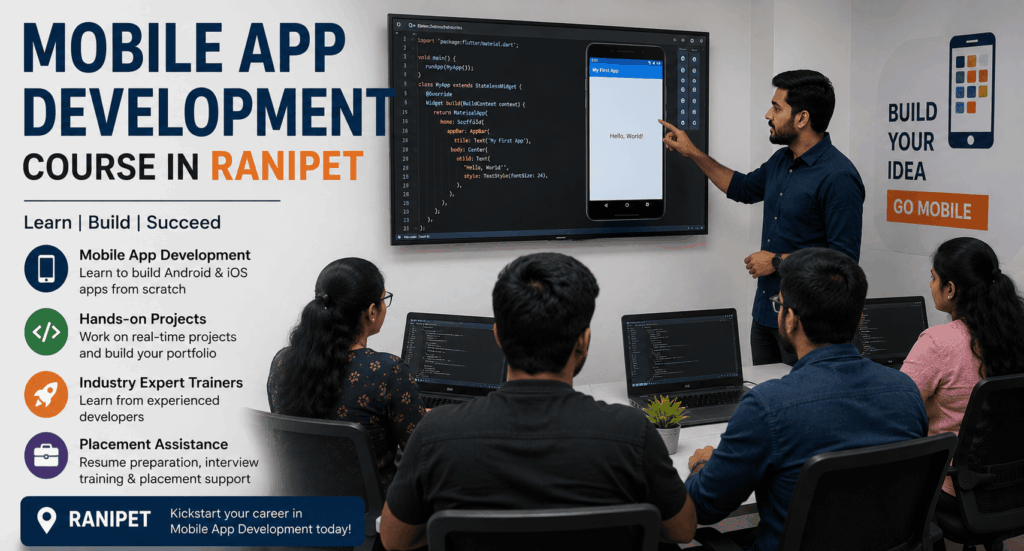
Mobile App Development Course in Ranipet – Learn to Build Android and Cross-Platform Apps
Smartphones have become an essential part of our daily lives. From online shopping and food delivery to banking, healthcare, education, entertainment, and social media, almost every service is now available through mobile applications. As businesses continue to invest in digital solutions, the demand for skilled Mobile App Developers is growing rapidly.
Whether it is a startup launching a new app or a large company improving its customer experience, organisations need professionals who can design, develop, and maintain high-quality mobile applications. This has made Mobile App Development one of the most rewarding career options in the IT industry.
If you are searching for the best Mobile App Development Course in Ranipet, this guide will help you understand everything about the course, including the technologies you will learn, career opportunities, salary expectations, and why practical training is important for becoming job-ready.
Whether you are a college student, fresher, graduate, or working professional looking to upgrade your skills, learning Mobile App Development can help you build a successful and future-ready career.
What is Mobile App Development?
Mobile App Development is the process of creating software applications that run on smartphones and tablets. These applications are designed to provide users with specific services, improve productivity, or offer entertainment.
Mobile apps can be developed for different platforms, including:
- Android
- iOS
- Cross-platform applications
Developers use programming languages, frameworks, and development tools to create fast, secure, and user-friendly applications that work smoothly on mobile devices.
Types of Mobile Applications
There are different approaches to developing mobile apps, depending on business requirements and target users.
Native Applications
Native apps are built specifically for one operating system.
Examples:
- Android applications
- iOS applications
These apps generally offer excellent performance and a smooth user experience.
Cross-Platform Applications
Cross-platform development allows developers to create a single application that works on both Android and iOS devices.
Frameworks such as Flutter help reduce development time while maintaining high performance.
Progressive Web Applications (PWA)
Progressive Web Apps combine the features of websites and mobile applications, allowing users to access services directly through their browsers while enjoying an app-like experience.
Why Choose Mobile App Development as a Career?
The number of smartphone users continues to increase every year, creating a strong demand for skilled mobile application developers.
Here are some reasons why Mobile App Development is a great career choice.
Growing Industry Demand
Businesses from almost every industry require mobile applications.
Some of the sectors hiring Mobile App Developers include:
- Software Companies
- E-commerce
- Healthcare
- Banking
- Education
- Logistics
- Travel
- Entertainment
- Retail
- Startups
As digital transformation continues, mobile development remains one of the most valuable technical skills.
Attractive Salary Packages
Mobile App Developers are highly valued because skilled professionals are always in demand.
Freshers with practical experience and strong projects often receive competitive salary packages. As experience grows, developers can move into senior technical and leadership roles.
Freelancing and Startup Opportunities
Mobile App Development also offers opportunities beyond regular employment.
Many developers choose to:
- Build applications for clients
- Work as freelancers
- Launch startup products
- Develop subscription-based applications
- Create business apps
- Publish apps on the Google Play Store
This flexibility makes Mobile App Development an attractive career path.
Global Career Opportunities
Mobile development skills are recognised worldwide.
Companies in countries such as the USA, Canada, Australia, the UK, Germany, Singapore, and the UAE regularly hire experienced mobile application developers.
Remote work opportunities have also increased, allowing professionals to collaborate with international companies from India.
Why Learn Mobile App Development in Ranipet?
Earlier, many students travelled to metropolitan cities for advanced software training. Today, professional training institutes closer to home are making industry-oriented courses more accessible.
Benefits of joining a Mobile App Development course in Ranipet include:
- Easy daily commute
- Affordable course fees
- Experienced trainers
- Practical coding sessions
- Live project development
- Individual mentoring
- Interview preparation
- Placement assistance
Learning locally also provides students with more time to practise coding and build a strong portfolio.
Who Can Join a Mobile App Development Course?
This course is suitable for beginners as well as professionals who want to enhance their technical skills.
The course is recommended for:
- BE and B.Tech students
- BCA graduates
- MCA students
- B.Sc. Computer Science students
- Diploma holders
- Fresh graduates
- Software Developers
- Web Developers
- IT professionals
- Entrepreneurs
- Freelancers
- Career changers
Even beginners with basic computer knowledge can learn app development through a structured training programme.
Skills You Will Learn During the Course
A professional Mobile App Development course combines programming, user interface design, databases, APIs, and deployment.
Below are the major skills covered.
Java Programming
Java is one of the most widely used programming languages for Android application development.
Students learn:
- Variables
- Loops
- Functions
- Classes
- Object-Oriented Programming
- Exception handling
- Collections
A strong understanding of Java helps students build reliable Android applications.
Kotlin
Kotlin is Google’s preferred language for Android development.
Topics include:
- Kotlin syntax
- Variables
- Functions
- Classes
- Null safety
- Coroutines
- Android integration
Kotlin makes Android app development faster and more efficient.
Flutter and Dart
Flutter allows developers to build applications for Android and iOS using a single codebase.
Students learn:
- Dart programming
- Widgets
- Layouts
- Navigation
- State management
- API integration
- Responsive UI development
Flutter is widely used for cross-platform application development.
Android Studio
Android Studio is the official development environment for Android applications.
Students learn:
- Project setup
- Emulator configuration
- Layout design
- Debugging
- Testing
- APK generation
Practical sessions help students become familiar with professional development workflows.
Firebase
Firebase provides cloud services for mobile applications.
Students learn:
- Authentication
- Cloud Firestore
- Realtime Database
- Push notifications
- Cloud Storage
- App hosting
Firebase simplifies backend development for mobile applications.
REST APIs
Most modern applications exchange data using APIs.
Students learn:
- API concepts
- JSON
- HTTP requests
- Data integration
- Authentication
- Error handling
API integration enables mobile apps to communicate with servers securely.
Git and GitHub
Version control is an essential skill for professional developers.
Students learn:
- Repository creation
- Branching
- Merging
- Code collaboration
- Version tracking
- Portfolio management
GitHub also helps students showcase their work to recruiters.
Practical Learning Through Live Projects
Hands-on learning is one of the most important aspects of Mobile App Development training.
Students typically build projects such as:
- Food Delivery Application
- E-commerce Mobile App
- Hospital Appointment App
- Student Management App
- Attendance System
- Expense Tracker
- Online Shopping App
- Weather Application
- Chat Application
- Task Management App
Working on these projects helps students understand how professional mobile applications are planned, developed, tested, and deployed.
Why Live Projects Matter
Recruiters look for candidates who can demonstrate practical development skills.
Working on projects helps students:
- Improve coding confidence
- Understand software development workflows
- Build problem-solving skills
- Create a strong project portfolio
- Prepare for technical interviews
- Gain practical experience that employers value
A portfolio containing real mobile applications can significantly improve placement opportunities.