
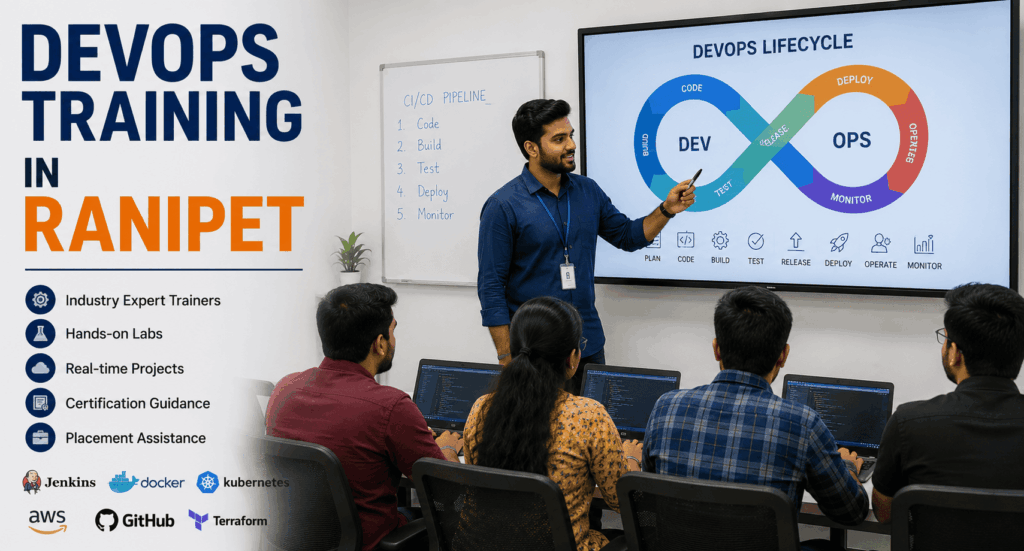
DevOps Training in Ranipet – Learn the Skills That Top IT Companies Are Hiring For
The software industry is changing rapidly. Today, companies are expected to develop applications faster, release updates more frequently, and provide reliable services to customers without interruptions. To achieve this, organisations are adopting DevOps practices that bring development and operations teams together.
DevOps has become one of the most in-demand skills in the IT industry because it helps companies automate software development, testing, deployment, and infrastructure management. From startups to multinational companies, businesses are actively looking for professionals who understand DevOps tools and modern cloud technologies.
If you are searching for the best DevOps Training in Ranipet, this guide will help you understand everything you need to know before joining a course. We will explain what DevOps is, the skills you will learn, career opportunities, salary expectations, and how practical training can help you build a successful IT career.
Whether you are a student, fresher, software developer, system administrator, or working professional, learning DevOps can significantly improve your career prospects.
What is DevOps?
DevOps is a modern software development approach that improves collaboration between software developers and IT operations teams.
Instead of working separately, both teams work together throughout the software development lifecycle. This helps organisations develop applications faster, improve software quality, and reduce deployment issues.
DevOps combines automation, continuous testing, continuous integration, continuous deployment, monitoring, and cloud technologies to deliver software efficiently.
The main objectives of DevOps include:
- Faster software development
- Frequent software releases
- Better collaboration between teams
- Improved software quality
- Reduced manual work
- Better customer satisfaction
- Faster issue resolution
Today, DevOps is used by leading technology companies across the world.
Why Choose DevOps as a Career?
DevOps has become one of the fastest-growing career options because almost every software company wants to automate its development process.
Here are some reasons why students and professionals choose DevOps.
High Industry Demand
Companies are actively hiring DevOps professionals for cloud infrastructure, automation, deployment, and application management.
Industries hiring DevOps engineers include:
- IT Services
- Product-based Companies
- Banking
- Healthcare
- E-commerce
- Telecommunications
- Manufacturing
- Logistics
- Education Technology
- Government Projects
As digital transformation continues, DevOps professionals remain in high demand.
Excellent Salary Packages
DevOps is considered one of the highest-paying career paths in the IT industry.
Professionals with practical knowledge of automation tools, cloud platforms, and deployment pipelines often receive attractive salary packages.
As your experience grows, your salary and responsibilities increase significantly.
Opportunities to Work with Modern Technologies
A DevOps engineer works with several advanced technologies, including:
- Cloud Computing
- Automation
- Containerisation
- Continuous Integration
- Continuous Deployment
- Infrastructure as Code
- Monitoring
- Security
This makes the role exciting and keeps your skills aligned with industry trends.
Global Career Opportunities
DevOps skills are recognised worldwide.
Countries such as the USA, Canada, the UK, Germany, Singapore, Australia, and the UAE actively recruit experienced DevOps professionals.
Learning DevOps can therefore create opportunities for both Indian and international careers.
Why Join DevOps Training in Ranipet?
Earlier, many students travelled to larger cities for advanced DevOps training. Today, quality training institutes closer to home are helping learners build industry-ready skills through structured classroom sessions and practical labs.
Joining a DevOps course in Ranipet offers several advantages:
- Easy daily travel
- Affordable learning
- Experienced trainers
- Hands-on practical sessions
- Live infrastructure projects
- Mock interviews
- Resume preparation
- Placement assistance
Learning in a structured environment helps students develop confidence and practical knowledge.
Who Can Join a DevOps Course?
DevOps is suitable for both beginners and experienced IT professionals.
This course is ideal for:
- BE and B.Tech students
- BCA graduates
- MCA students
- B.Sc. Computer Science graduates
- Diploma holders
- Fresh graduates
- Software Developers
- System Administrators
- Network Engineers
- Technical Support Engineers
- Cloud Engineers
- Working professionals planning to upskill
Even beginners can start with Linux and cloud fundamentals before learning advanced DevOps tools.
Skills You Will Learn During DevOps Training
A professional DevOps course focuses on practical implementation rather than only theoretical concepts.
Below are some of the major skills covered.
Linux Administration
Linux is one of the most important operating systems used in DevOps.
Students learn:
- Linux commands
- File management
- User management
- Permissions
- Shell scripting basics
- Process management
Strong Linux knowledge forms the foundation for DevOps engineering.
Git and GitHub
Version control helps development teams collaborate efficiently.
Students learn:
- Repository creation
- Branching
- Merging
- Pull requests
- Conflict resolution
- Code management
- Team collaboration
Git is one of the essential tools used in software development.
Jenkins
Jenkins automates software build and deployment processes.
Students understand:
- Continuous Integration (CI)
- Build automation
- Pipeline creation
- Deployment automation
- Plugin management
- Job scheduling
Jenkins helps organisations deliver software quickly and consistently.
Docker
Docker allows applications to run consistently across different environments.
Students learn:
- Containers
- Docker images
- Docker Hub
- Docker Compose
- Container deployment
- Container management
Docker has become a standard tool in modern software development.
Kubernetes
Kubernetes helps manage containerised applications at scale.
Students are introduced to:
- Pods
- Deployments
- Services
- Replica Sets
- Scaling
- Cluster management
Kubernetes is widely used in enterprise cloud environments.
Cloud Computing Basics
Cloud platforms play an important role in DevOps.
Students gain exposure to cloud concepts using platforms such as AWS.
Topics include:
- Virtual servers
- Storage services
- Identity management
- Networking
- Monitoring
- Cloud deployment
Understanding cloud infrastructure improves career opportunities.
Hands-On Learning Through Live Projects
DevOps is best learned through practical implementation.
Students work on real-world deployment scenarios that simulate industry environments.
Typical projects include:
- Automated website deployment
- CI/CD pipeline creation
- Docker container deployment
- Kubernetes application deployment
- AWS infrastructure setup
- Infrastructure automation
- Monitoring and logging
- Cloud application hosting
Working on these projects helps students understand how modern software delivery works in real organisations.
Why Practical Experience Matters
Recruiters prefer candidates who can demonstrate practical skills rather than only theoretical knowledge.
Hands-on training helps students:
- Build technical confidence
- Improve troubleshooting skills
- Understand real DevOps workflows
- Prepare for technical interviews
- Build an impressive project portfolio
- Gain experience using industry-standard tools
Consistent practice makes students more confident during interviews and better prepared for workplace responsibilities.
Course Duration
Most professional DevOps training programmes can be completed within 4 to 6 months, depending on the learning schedule and student commitment.
Weekend, weekday, and fast-track batches are generally available, making the course suitable for both college students and working professionals.
With regular practice, live labs, and project work, students can become job-ready by the end of the training programme.