
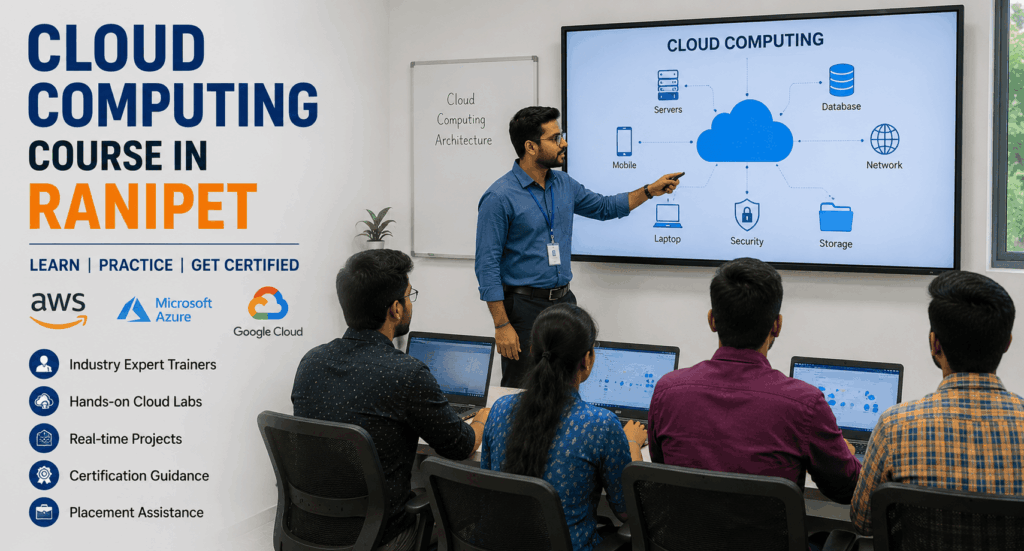
Cloud Computing Course in Ranipet – Learn the Technology Powering Modern Businesses
Technology has changed the way businesses operate. Today, companies no longer rely only on physical servers to store data or run applications. Instead, they use cloud computing to access powerful computing resources over the internet. This approach helps organisations reduce costs, improve security, and scale their applications whenever needed.
From online banking and e-commerce websites to healthcare applications and video streaming platforms, cloud computing supports many of the digital services we use every day.
Because businesses are rapidly adopting cloud technology, the demand for skilled cloud professionals is growing across India. Companies are actively looking for candidates who understand cloud platforms, infrastructure, networking, security, and cloud deployment.
If you are searching for the best Cloud Computing Course in Ranipet, this guide will help you understand everything about the course, including the skills you will learn, career opportunities, salary expectations, and why practical training is important for getting a successful IT job.
Whether you are a college student, engineering graduate, IT professional, or someone planning to switch careers, Cloud Computing can help you build a rewarding future in the technology industry.
What is Cloud Computing?
Cloud Computing is the delivery of computing services such as servers, storage, databases, networking, software, analytics, and security over the internet instead of using local computers or traditional data centres.
Rather than buying expensive hardware, businesses can rent cloud resources whenever they need them and pay only for what they use.
Some common examples of cloud computing include:
- Online file storage
- Internet banking
- Food delivery applications
- Online shopping websites
- Video streaming services
- Email platforms
- Online learning portals
Cloud Computing makes technology more flexible, secure, and cost-effective for businesses of all sizes.
Why is Cloud Computing Important?
Almost every organisation today depends on digital infrastructure.
Cloud Computing helps companies:
- Reduce infrastructure costs
- Improve application performance
- Store data securely
- Access information from anywhere
- Scale resources quickly
- Improve disaster recovery
- Increase business continuity
- Support remote teams
These benefits have made Cloud Computing one of the most valuable technologies in today’s IT industry.
Why Choose Cloud Computing as a Career?
Cloud Computing has become one of the fastest-growing career options because businesses continue to move their infrastructure to cloud platforms.
Here are some of the biggest reasons to learn Cloud Computing.
High Demand Across Industries
Cloud professionals are required in almost every sector, including:
- Software Companies
- Banking
- Healthcare
- Manufacturing
- E-commerce
- Telecommunications
- Retail
- Government Organisations
- Education
- Logistics
As more companies adopt cloud technology, the demand for trained professionals continues to increase.
Attractive Salary Packages
Cloud Computing professionals are among the highest-paid employees in the IT industry.
Candidates with strong practical knowledge and hands-on project experience often receive competitive salary packages.
As you gain experience and certifications, your career opportunities continue to grow.
Multiple Career Opportunities
Learning Cloud Computing opens the door to several job roles.
Some popular positions include:
- Cloud Engineer
- Cloud Administrator
- Cloud Support Engineer
- AWS Cloud Engineer
- Azure Administrator
- Google Cloud Engineer
- DevOps Engineer
- Solutions Architect
- Infrastructure Engineer
- Site Reliability Engineer (SRE)
Students can choose a career path based on their interests and technical skills.
Global Opportunities
Cloud Computing skills are recognised across the world.
Countries such as the USA, Canada, Germany, Australia, Singapore, the UK, and the UAE actively recruit cloud professionals.
Learning cloud technologies can therefore create opportunities both in India and internationally.
Why Join a Cloud Computing Course in Ranipet?
Earlier, students often travelled to larger cities for advanced cloud training. Today, quality institutes are bringing industry-oriented training closer to home, making learning more convenient and affordable.
Joining a Cloud Computing course in Ranipet offers several advantages:
- Easy daily commute
- Lower travel expenses
- Classroom interaction with experienced trainers
- Practical lab sessions
- Live cloud projects
- Personal mentoring
- Interview preparation
- Placement support
Learning in a structured environment also helps students stay focused and develop practical skills that employers expect.
Who Can Join a Cloud Computing Course?
Cloud Computing is suitable for beginners as well as experienced professionals.
This course is ideal for:
- BE and B.Tech students
- BCA graduates
- MCA students
- B.Sc. Computer Science students
- Diploma holders
- Fresh graduates
- Software Developers
- Network Engineers
- System Administrators
- Technical Support Engineers
- DevOps professionals
- Working professionals looking to upskill
Even candidates with basic computer knowledge can begin learning cloud technologies through a structured training programme.
Skills You Will Learn During the Course
A professional Cloud Computing course covers cloud concepts, infrastructure, networking, security, and practical deployment.
Below are some of the important skills covered.
Cloud Fundamentals
Students begin by understanding the basics of cloud technology.
Topics include:
- Cloud Computing concepts
- Cloud service models
- Deployment models
- Public Cloud
- Private Cloud
- Hybrid Cloud
- Benefits of Cloud Computing
These fundamentals help students understand how modern cloud platforms operate.
Amazon Web Services (AWS)
AWS is the world’s leading cloud platform.
Students learn:
- EC2
- S3
- IAM
- VPC
- RDS
- CloudWatch
- Route 53
- Load Balancing
- Auto Scaling
Hands-on practice helps students understand how cloud infrastructure is deployed and managed.
Microsoft Azure
Azure is widely used by enterprises around the world.
Topics include:
- Azure Virtual Machines
- Azure Storage
- Azure Networking
- Azure Active Directory
- Azure Resource Groups
- Monitoring services
Students gain exposure to enterprise cloud environments.
Google Cloud Platform (GCP)
Google Cloud is another popular platform used for cloud infrastructure and data services.
Students learn:
- Compute Engine
- Cloud Storage
- Networking basics
- Identity management
- Deployment concepts
Understanding multiple cloud platforms increases career opportunities.
Networking Basics
Cloud engineers should understand networking concepts.
Topics include:
- IP Addressing
- DNS
- Firewalls
- Routing
- Subnets
- VPN
- Network Security
Strong networking knowledge helps professionals design secure cloud environments.
Cloud Security
Security is one of the most important aspects of cloud computing.
Students learn:
- Identity management
- Access control
- Data encryption
- Security policies
- Backup strategies
- Disaster recovery
Cloud security skills are highly valued by employers.
Practical Learning Through Live Labs
Cloud Computing is best learned through practical implementation.
Students spend time working on cloud platforms rather than only reading theory.
Typical lab exercises include:
- Launching cloud servers
- Creating storage services
- Configuring user permissions
- Deploying websites
- Managing cloud databases
- Monitoring cloud resources
- Creating virtual networks
- Configuring cloud security
Practical sessions help students become comfortable with real cloud environments.
Why Hands-On Practice Matters
Recruiters expect candidates to demonstrate practical knowledge during interviews.
Working on cloud labs helps students:
- Build technical confidence
- Understand real business environments
- Improve troubleshooting skills
- Prepare for certification exams
- Gain practical experience
- Perform better in technical interviews
Students who regularly practise cloud deployment and management are often better prepared for workplace responsibilities.
Course Duration
Most professional Cloud Computing courses are designed to be completed within 4 to 6 months, depending on the training schedule and learning pace.
Weekend, weekday, and fast-track batches are generally available, allowing both students and working professionals to learn at a convenient time.
Consistent practice, combined with live labs and project work, helps learners become job-ready by the end of the programme.