
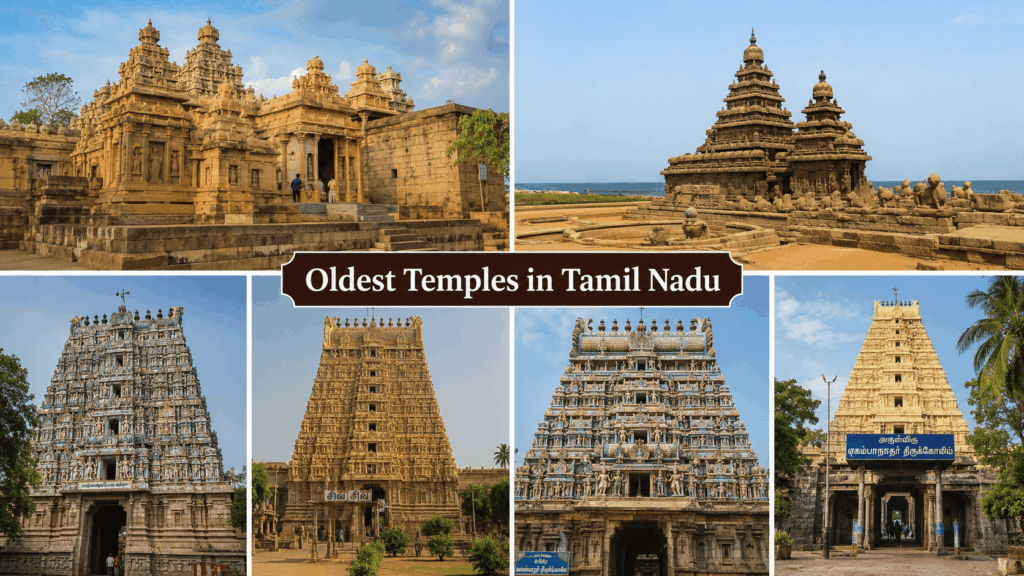
Tamil Nadu is often called the Land of Temples,”and for good reason. The state is home to more than 38,000 temples, many of which have stood for over a thousand years. These magnificent structures are not merely places of worship; they are living museums that preserve India’s rich cultural heritage, architectural brilliance, religious traditions, and historical legacy.
Some of Tamil Nadu’s oldest temples date back to the **Pallava, Pandya, and early Chola periods**, while many sacred sites are believed, according to Hindu tradition, to have existed even earlier. Over the centuries, these temples have witnessed the rise and fall of kingdoms, foreign invasions, cultural transformations, and social evolution, yet they continue to serve as vibrant centers of faith and community life.
From the majestic **Kailasanathar Temple** in Kanchipuram to the iconic **Shore Temple** in Mamallapuram, these ancient monuments showcase remarkable engineering, intricate stone carvings, and timeless devotion. Today, they attract millions of pilgrims, tourists, historians, architects, researchers, photographers, and students from across India and around the world.
In this article, we explore the oldest temples in Tamil Nadu, their fascinating history, architectural significance, religious importance, and enduring legacy.
Why is Tamil Nadu Known as the Land of Temples?
Tamil Nadu has one of the richest temple traditions in India. The state became a major center of temple construction because successive dynasties—including the Pallavas, Cholas, Pandyas, Cheras, Vijayanagara rulers, and Nayaks—patronized religion, art, and architecture.
Temples in Tamil Nadu served many purposes beyond worship. They functioned as:
Educational institutions
Cultural centers
Libraries
Music and dance academies
Economic hubs
Administrative offices
Community gathering places
Many temples also owned agricultural lands, employed artisans, and supported scholars, making them vital institutions in ancient society.
What Makes a Temple “Old”?
Determining the age of a temple can be challenging because many sacred sites were rebuilt, expanded, or renovated over centuries.
Historians rely on several sources to estimate a temple’s age:
Stone inscriptions
Copper plate grants
Literary references
Archaeological excavations
Architectural style
Historical records
In many cases, the original shrine may be far older than the current stone structure.
Evolution of Temple Architecture in Tamil Nadu
The earliest places of worship in Tamil Nadu were simple shrines built using wood, brick, and clay. Unfortunately, very few of these structures survived because of the tropical climate and the perishable nature of the materials.
The transition to permanent stone temples began during the Pallava Dynasty in the 7th century CE. Initially, artisans carved temples directly into hillsides, creating remarkable rock-cut cave temples. Over time, they developed the technology to construct freestanding stone temples, giving rise to the distinctive Dravidian style of architecture .
This architectural tradition later reached its peak under the Cholas, who built monumental temples with soaring vimanas, intricate sculptures, and vast temple complexes.
1. Kailasanathar Temple, Kanchipuram
Among the oldest surviving structural stone temples in Tamil Nadu, the Kailasanathar Temple is a masterpiece of early Dravidian architecture.
Built during the reign of Pallava King Narasimhavarman II (Rajasimha) in the early 8th century CE, the temple is dedicated to Lord Shiva.
Historical Significance
The Kailasanathar Temple marks an important turning point in South Indian temple architecture. Before its construction, many temples were carved into rock faces. Here, architects successfully demonstrated how large temples could be built using carefully cut sandstone blocks.
This innovation influenced generations of temple builders throughout South India.
Architectural Highlights
Some of the temple’s most remarkable features include:
Beautiful sandstone carvings
Numerous miniature shrines
Lion-based pillars
Intricate sculptures of Lord Shiva
Ancient murals and inscriptions
Well-preserved sanctum
Art historians regard this temple as one of the finest examples of early Pallava craftsmanship.
2. Shore Temple, Mamallapuram
Standing proudly along the Bay of Ben*gal, the Shore Temple is one of India’s most iconic monuments.
Constructed during the reign of Narasimhavarman IIaround the early 8th century CE, the temple forms part of the UNESCO World Heritage Site known as theGroup of Monuments at Mamallapuram
Why is the Shore Temple Famous?
Unlike earlier rock-cut monuments at Mamallapuram, the Shore Temple is a structural temple built with granite blocks.
It consists of shrines dedicated to both Lord Shiva and Lord Vishnu, reflecting the religious harmony of the Pallava period.
Architectural Features
Visitors admire:
Twin Shiva shrines
Reclining Vishnu sculpture
Granite walls
Nandi sculptures
Elegant vimanas
Stunning coastal setting
Despite centuries of exposure to sea winds and saltwater, the temple remains an extraordinary example of Pallava engineering.
3. Ekambareswarar Temple, Kanchipuram
The Ekambareswarar Temple is one of the largest and most revered Shiva temples in India.
Although the present structure mainly reflects later Chola and Vijayanagara additions, the temple’s origins are believed to date back more than 1,500 years.
Religious Importance
According to Hindu tradition, Goddess Parvati performed penance beneath a sacred mango tree at this site to win the hand of Lord Shiva.
The temple is one of the Pancha Bhoota Sthalams representing the Earth (Prithvi) element.
Major Attractions
Massive Rajagopuram
Ancient mango tree
Thousand-pillared hall
Large temple tank
Beautiful stone sculptures
The temple continues to attract devotees from across India.
4. Jambukeswarar Temple, Tiruvanaikaval
Located near Tiruchirappalli, the **Jambukeswarar Temple** is another ancient Shiva temple associated with the Pancha Bhoota Sthalams.
This temple represents the Water (Appu) element.
Historical Background
The temple has existed as a sacred site for many centuries, with the current structure receiving major contributions from the early Cholas.
Subsequent rulers, including the Pandyas and Vijayanagara kings, expanded the temple complex.
Unique Features
The sanctum contains a natural underground water spring, and the Shiva Lingam is continually surrounded by water, symbolizing the water element.
5. Sri Ranganathaswamy Temple, Srirangam
The Sri Ranganathaswamy Temple is among the largest functioning Hindu temple complexes in the world.
Dedicated to Lord Vishnu in his reclining form, the temple occupies an entire island between the Kaveri and Kollidam rivers.
Historical Significance
The temple finds mention in Tamil Sangam literature and the hymns of the Alvars, indicating its antiquity.
While many of the present structures belong to the Chola, Pandya, Vijayanagara, and Nayak periods, the sacred site itself is believed to have been revered for over two millennia.
Architectural Highlights
The temple complex includes:
21 magnificent gopurams
Seven concentric enclosures (prakarams)
Vast courtyards
Sacred tanks
Ornate mandapas
Rich sculptures
It remains one of the most important pilgrimage centers for Vaishnavites.
6. Mandagapattu Cave Temple
The Mandagapattu Cave Temple, near Villupuram, is widely regarded as the first rock-cut Hindu temple in Tamil Nadu.
Built during the reign of Mahendravarman I in the early 7th century CE, it represents the beginning of Pallava rock-cut architecture.
An inscription proudly states that the temple was constructed **without bricks, timber, metal, or mortar**, emphasizing the transition to durable stone architecture.
7. Mamandur Cave Temples
Located near Kanchipuram, the Mamandur cave complex consists of several rock-cut shrines created during the Pallava period.
These caves provide valuable evidence of the experimental phase of temple construction before large structural temples became common.
Visitors can still observe:
Pillared halls
Shiva sanctums
Ancient inscriptions
Unfinished excavations that reveal the carving process
Architectural Evolution from Caves to Stone Temples
The oldest temples in Tamil Nadu illustrate a remarkable architectural journey.
This evolution can be broadly understood in three stages:
Rock-Cut Temples
Temples carved directly into hills and rocky outcrops.
Structural Stone Temples
Freestanding temples built using carefully shaped stone blocks.
Monumental Temple Complexes
Large temple cities with towering gopurams, multiple shrines, extensive corridors, tanks, and elaborate sculptures.
This gradual progression laid the foundation for some of India’s greatest architectural achievements.
Why These Ancient Temples Matter Today
Tamil Nadu’s oldest temples are invaluable because they preserve:
Early Dravidian architecture
Ancient Tamil inscriptions
Hindu mythology in stone
Royal history
Medieval engineering techniques
Traditional rituals that continue even today
They remain important not only for devotees but also for historians, archaeologists, architects, students, and travelers seeking to understand India’s cultural heritage.