
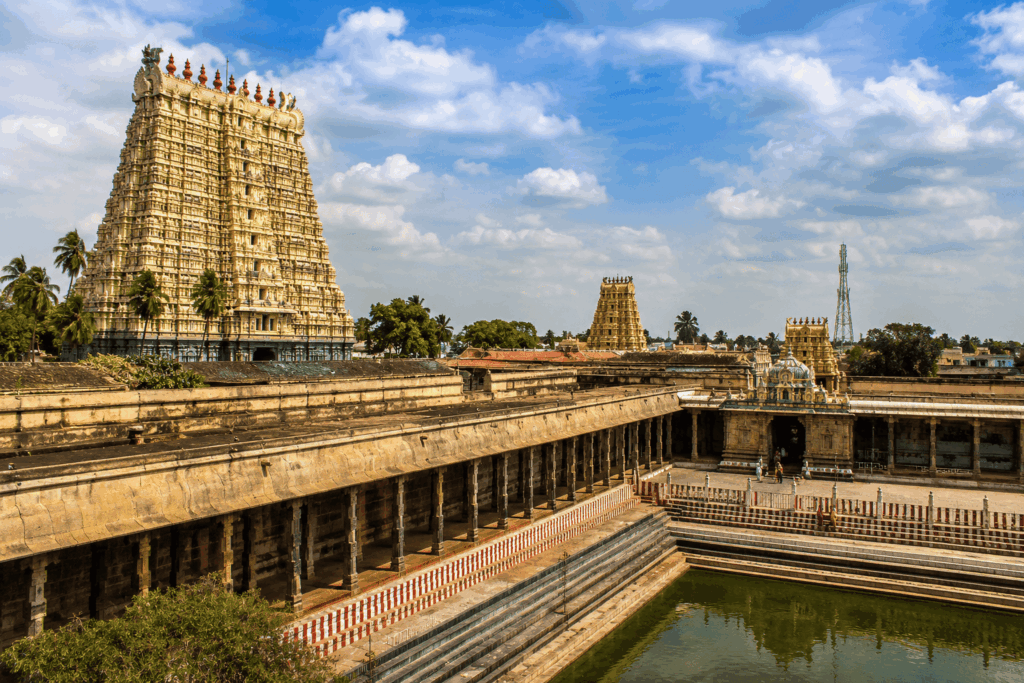
The Rameswaram Temple, officially known as the Ramanathaswamy Temple, is one of India’s most sacred Hindu pilgrimage sites. Located on Rameswaram Island in Tamil Nadu’s Ramanathapuram district, this magnificent temple is dedicated to Lord Shiva and holds a unique place in Hindu tradition because of its deep connection with Lord Rama and the epic *Ramayana*.
Every year, millions of devotees, pilgrims, tourists, and history enthusiasts visit Rameswaram to experience its spiritual atmosphere, remarkable architecture, and centuries-old traditions. The temple is famous for its majestic corridors, towering gopurams, sacred wells known as the 22 Theerthams , and its status as one of the Twelve Jyotirlingas revered across India.
Ramanathaswamy Temple is also one of the four sacred destinations of the Char Dham Yatra , making it an essential pilgrimage site for Hindus. Its religious significance is complemented by its architectural brilliance, historical inscriptions, and contributions from several South Indian dynasties.
More than just a temple, Rameswaram represents a unique blend of mythology, history, engineering, culture, and devotion. This article explores the fascinating history of Rameswaram Temple, its legends, architectural marvels, and enduring importance for Indian heritage.
Rameswaram: The Island of Faith
Rameswaram is situated on Pamban Island in the Gulf of Mannar, off the southeastern coast of Tamil Nadu. It is connected to mainland India by the iconic Pamban Bridge, India’s first sea bridge, which has long served as a gateway for pilgrims traveling to the island.
The town occupies a special place in Hindu belief because it is closely associated with Lord Rama’s journey to Lanka in search of Goddess Sita. According to tradition, this was the place where Rama prepared to cross the sea by constructing the legendary Rama Setu.
Its strategic coastal location also made Rameswaram an important center for maritime trade, fishing, and cultural exchange throughout history. The temple became the heart of the island’s spiritual and social life, attracting devotees from across the Indian subcontinent.
Today, Rameswaram continues to be one of Tamil Nadu’s most visited religious destinations and an important center of Shaivite worship.
The Legend of Lord Rama and the Shiva Lingam
The history of Rameswaram Temple is deeply intertwined with the *Ramayana*, one of India’s greatest epics.
According to Hindu tradition, after defeating Ravana, Lord Rama wished to seek forgiveness for the sin of killing a Brahmin king, as Ravana was considered a learned Brahmin despite his actions.
Following the advice of sages, Rama decided to worship Lord Shiva before returning to Ayodhya.
Hanuman was sent to Mount Kailash to bring a Shiva Lingam. As his return was delayed, Goddess Sita fashioned a Lingam from the island’s sand so that the auspicious ritual could begin at the proper time.
Lord Rama worshipped this Sand Lingam, which came to be known as **Ramanathaswamy**, meaning “Lord of Rama.”
When Hanuman finally arrived with the Lingam from Kailash, Rama installed it alongside the original Lingam. According to tradition, devotees first worship Hanuman’s Lingam before offering prayers to Ramanathaswamy.
This sacred legend has made Rameswaram one of the holiest pilgrimage destinations in Hinduism.
Why the Temple is Called Ramanathaswamy Temple
The name Ramanathaswamy combines two important elements of Hindu devotion:
- Rama the seventh incarnation of Lord Vishnu.
meaning Lord, referring to Lord Shiva.
The temple symbolizes harmony between Shaivism and Vaishnavism, demonstrating the mutual respect between the two major traditions of Hinduism.
This unique association has helped the temple become a place of devotion for followers of both Lord Shiva and Lord Vishnu.
Historical Origins of the Temple
Although mythology attributes the temple’s origins to Lord Rama, historians believe that an early shrine existed on the island many centuries before the construction of the present structure.
Archaeological studies and historical records suggest that the temple gradually evolved between the 12th and 17th centuries through the contributions of several dynasties and local rulers.
Stone inscriptions preserved within the temple provide valuable evidence about donations, renovations, festivals, and administrative practices carried out over many centuries.
These inscriptions continue to serve as important sources for historians studying medieval South India.
Contributions of the Pandya Dynasty
The Pandya rulers were among the earliest royal patrons of Rameswaram Temple.
Between the 12th and 13th centuries, they expanded the shrine by constructing stone sanctums, halls, and outer walls. Their generous donations supported daily worship, temple festivals, and charitable activities.
The Pandyas also strengthened the temple’s reputation as one of South India’s leading pilgrimage centers.
Their patronage attracted priests, scholars, artisans, and merchants, contributing to the growth of Rameswaram as both a religious and commercial center.
Chola Influence on the Temple
Although the Cholas are best known for monuments such as the Brihadeeswarar Temple, they also supported several important Shiva temples across Tamil Nadu, including Rameswaram.
During the Chola period, improvements were made to temple administration, land management, and ritual practices.
Donations from Chola rulers and local chiefs helped maintain temple activities, ensuring that daily worship and religious festivals continued uninterrupted.
The Chola emphasis on temple administration influenced the organizational systems that later rulers further developed.
The Temple as a Major Pilgrimage Centre
By the medieval period, Rameswaram had become one of the most important pilgrimage destinations in India.
Devotees from every corner of the country traveled long distances to worship Ramanathaswamy and perform sacred rituals associated with purification and ancestral offerings.
Pilgrims traditionally bathe in the sea at **Agni Theertham**, located near the temple, before entering the temple complex to visit the 22 sacred wells. Each well is believed to possess unique spiritual significance, and the ritual bathing sequence remains an integral part of the pilgrimage.
The temple’s role in uniting devotees from different regions also strengthened cultural exchange across India.
Rameswaram and the Char Dham Yatra
Rameswaram occupies a unique position as one of the **Char Dham**, the four most sacred pilgrimage destinations established in Hindu tradition.
The four sites are:
Badrinath (North)
Dwarka (West)
Puri (East)
Rameswaram (South)
Completing the Char Dham pilgrimage is regarded by many Hindus as one of the highest spiritual achievements.
Rameswaram’s inclusion reflects its immense religious importance and its association with both Lord Rama and Lord Shiva.
A Center of Faith, Culture, and Community
Throughout its history, Ramanathaswamy Temple has served as much more than a place of worship.
It has supported education, music, temple arts, charitable feeding, cultural festivals, and community gatherings. Priests, sculptors, musicians, artisans, administrators, and scholars all contributed to the temple’s vibrant ecosystem.
Temple festivals created opportunities for trade, social interaction, and cultural celebrations, strengthening the local economy and preserving traditional arts.
This multifaceted role helped make Rameswaram one of the most influential temple towns in South India.