
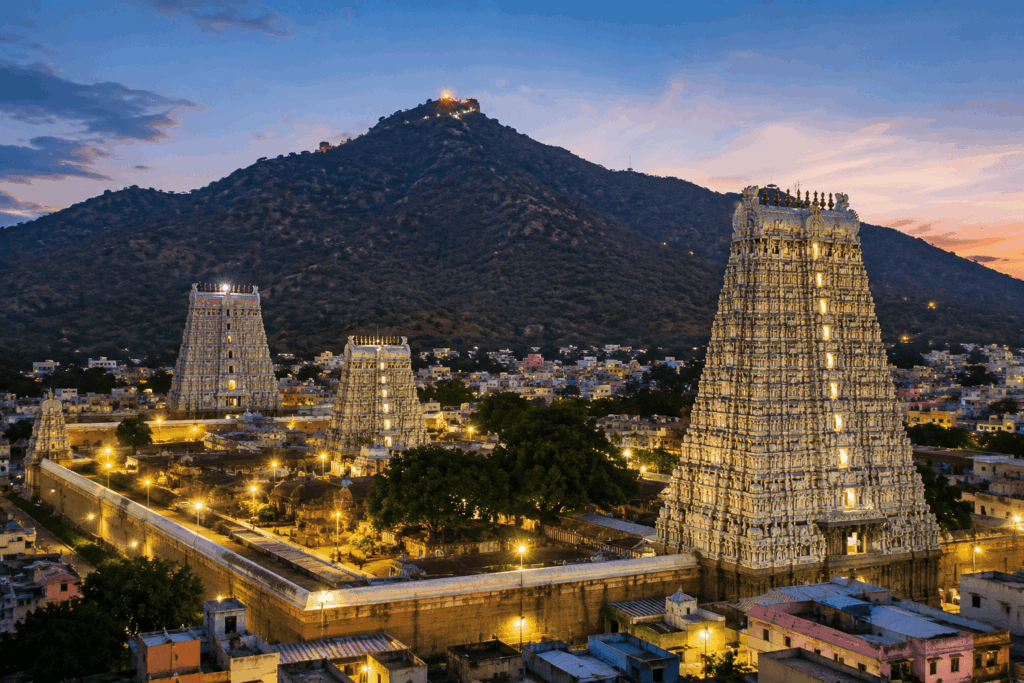
The Chola Empire played a defining role in shaping the Arunachaleswarar Temple into one of South India’s largest temple complexes. Between the 10th and 13th centuries CE, Chola rulers expanded the existing shrine with granite structures, spacious courtyards, mandapams, and beautifully sculpted sanctums.
Kings such as Rajaraja Chola I, Rajendra Chola I, and Kulothunga Chola made generous donations of land, gold, cattle, lamps, and jewels. Hundreds of stone inscriptions carved on the temple walls record these grants, providing valuable information about administration, taxation, agriculture, and temple management.
During the Chola period, the temple became not only a spiritual center but also an institution that supported education, music, dance, and public welfare. Its influence extended to nearby villages, where agricultural lands were assigned to ensure the temple’s continuous maintenance.
The Vijayanagara Empire and a New Era of Expansion
After the decline of the Cholas and later the Pandyas, the Vijayanagara Empire emerged as a powerful force in South India during the 14th century.
Recognizing the temple’s immense religious importance, Vijayanagara rulers undertook large-scale restoration and expansion projects. They strengthened the temple’s walls, built new halls, enlarged the courtyards, and commissioned towering entrance gateways.
The most famous contribution from this period is the magnificent **Eastern Rajagopuram**, one of the tallest temple towers in India. Rising to approximately 66 meters (217 feet), it dominates the skyline of Tiruvannamalai and serves as a welcoming gateway for millions of devotees.
King Krishnadevaraya, one of the greatest rulers of the Vijayanagara Empire, is remembered for his generous patronage of the temple. Inscriptions from his reign record donations for festivals, temple maintenance, and charitable activities.
Contributions of the Nayak Rulers
Following the Vijayanagara period, the Nayak rulers continued to beautify the temple.
They added elegant mandapams, pillared corridors, decorative sculptures, and artistic embellishments that enhanced the temple’s grandeur.
The Nayaks also promoted temple festivals, classical music, dance, and religious processions, many of which continue to this day.
Their architectural style blended seamlessly with earlier Chola constructions, creating the magnificent temple complex visitors admire today.
Temple Architecture: A Masterpiece of Dravidian Design
Arunachaleswarar Temple is among the finest examples of classical Dravidian architecture.
Spread across nearly 25 acres, the temple consists of:
Four massive Rajagopurams
High granite enclosure walls
Multiple concentric prakarams (courtyards)
Sacred shrines
Pillared halls
Temple tanks
Gardens
Administrative buildings
Hundreds of intricately carved sculptures
Every structure reflects centuries of architectural evolution while maintaining remarkable harmony in design.
The Majestic Rajagopurams
One of the temple’s most striking features is its towering gateway towers, known as Rajagopurams.
The temple has four principal gopurams facing the cardinal directions.
Eastern Rajagopuram
The Eastern Rajagopuram is the tallest and most famous.
Standing at around 217 feet, it is visible from several kilometers away and serves as a symbolic entrance to the sacred world within.
Thousands of detailed sculptures depicting Hindu deities, saints, mythical creatures, dancers, musicians, and celestial beings adorn its many tiers.
Southern, Northern and Western Gopurams
The remaining gateway towers are equally impressive, though slightly smaller.
Together they create a magnificent visual balance while marking the sacred boundaries of the temple complex.
The Sanctum of Lord Arunachaleswarar
At the spiritual heart of the temple lies the sanctum housing the sacred Shiva Lingam.
This Lingam represents Lord Shiva as the eternal flame of divine knowledge.
The sanctum maintains a serene atmosphere, illuminated by traditional oil lamps and filled with the sound of Vedic chants.
Daily rituals performed according to ancient Agamic traditions continue uninterrupted, preserving practices followed for centuries.
Goddess Unnamulai Amman Shrine
Adjacent to Lord Arunachaleswarar’s sanctum stands the shrine of Goddess Unnamulai Amman, also known as Apeethakuchambal.
She is worshipped as the divine mother who grants compassion, prosperity, and protection.
Devotees traditionally visit both shrines, symbolizing the inseparable union of Shiva and Shakti.
Thousand Pillared Hall
Among the temple’s architectural highlights is the famous Thousand Pillared Hall.
Although the actual number of pillars differs from its traditional name, the hall remains an extraordinary example of medieval stone craftsmanship.
Each pillar displays intricate carvings featuring:
Hindu deities
Mythological scenes
Floral motifs
Yalis (mythical lion-like creatures)
Warriors
Musicians
Dancers
The hall has historically hosted religious gatherings, cultural performances, and scholarly discussions.
Temple Tanks
Water has always held great spiritual significance in Hindu temples.
Arunachaleswarar Temple contains several sacred tanks used for ritual purification and festival ceremonies.
The most important among them is the **Shivaganga Tank**, where devotees perform ceremonial ablutions before entering the temple.
These tanks also demonstrate the sophisticated water management systems developed by ancient Tamil engineers.
Stone Inscriptions: Windows into Medieval Tamil Society
The temple preserves hundreds of inscriptions dating from the Chola, Pandya, Vijayanagara, and Nayak periods.
These inscriptions provide invaluable historical information about:
Land grants
Tax systems
Temple administration
Agricultural management
Donations
Village governance
Music and dance traditions
Festival organization
For historians and researchers, these inscriptions serve as primary evidence for understanding medieval South Indian society.
Sculptures and Artistic Excellence
Every corner of Arunachaleswarar Temple reflects exceptional artistic talent.
The walls, pillars, and towers feature thousands of sculptures portraying:
Lord Shiva in various forms
Goddess Parvati
Ganesha
Murugan
Nataraja
Saints
Celestial dancers
Animals
Mythological narratives
The level of detail achieved by medieval sculptors continues to astonish architects and art historians.
Karthigai Deepam: The Festival of Divine Light
The most celebrated event associated with Arunachaleswarar Temple is **Karthigai Deepam**.
Observed during the Tamil month of Karthigai (November–December), this festival attracts millions of devotees from across India and abroad.
The highlight occurs when a gigantic bronze cauldron filled with clarified butter (ghee) is lit atop Arunachala Hill.
The enormous flame can be seen from several kilometers away and symbolizes Lord Shiva’s infinite pillar of fire.
As the beacon is lit, devotees chant “Annamalaiyarukku Arohara!” while thousands of lamps illuminate homes, streets, and the temple complex.
The festival beautifully combines mythology, devotion, and community participation, making it one of Tamil Nadu’s most iconic religious celebrations.
Girivalam: The Sacred Circumambulation
Girivalam, also known as Giri Pradakshina, is among the temple’s most cherished spiritual traditions.
Pilgrims walk barefoot around Arunachala Hill along a 14-kilometre route, offering prayers and visiting the eight sacred lingams located along the path.
According to tradition, completing the circumambulation with devotion helps purify the mind, remove negative karma, and bring inner peace.
Full moon nights witness lakhs of devotees participating in this sacred journey, transforming Tiruvannamalai into a vibrant center of faith and devotion.
Daily Rituals and Worship
Arunachaleswarar Temple follows an elaborate schedule of daily worship based on ancient Shaivite Agama traditions.
Priests perform multiple poojas throughout the day, accompanied by Vedic chanting, temple bells, devotional music, and ceremonial offerings.
Special rituals during festivals attract thousands of devotees, preserving customs that have been practiced for generations.
The continuity of these traditions highlights the temple’s role as a living center of worship rather than merely a historical monument.