
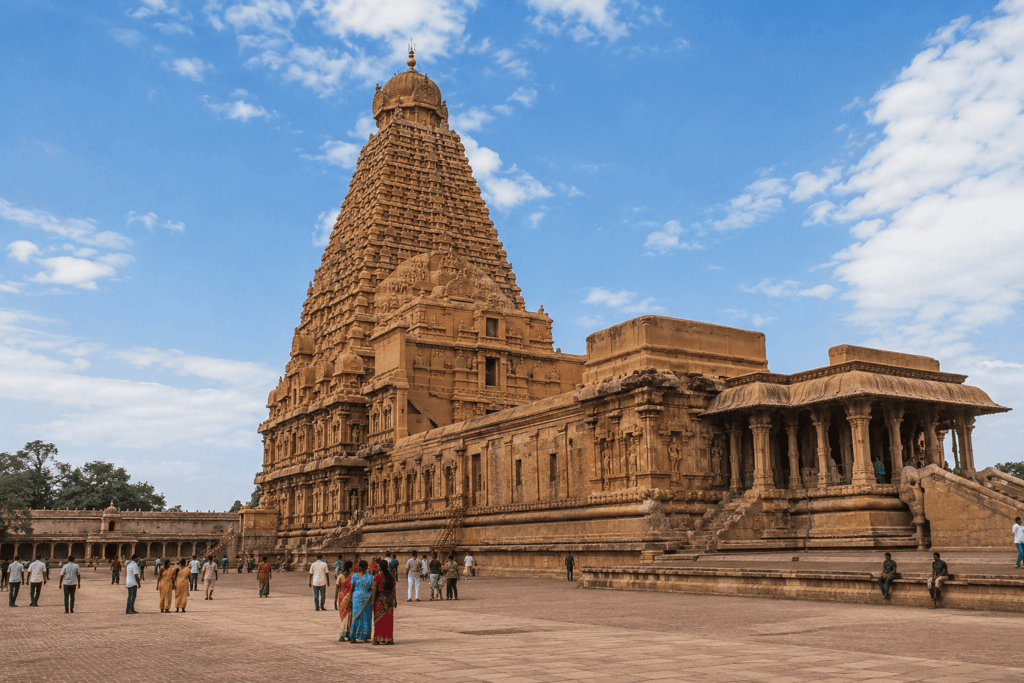
Standing majestically in the heart of Thanjavur, the Brihadeeswarar Temple is one of India’s greatest architectural masterpieces and a shining symbol of Tamil heritage. More than a thousand years old, this magnificent temple reflects the engineering brilliance, artistic excellence, and spiritual devotion of the Chola Empire. Built during the reign of Emperor Rajaraja Chola I, it continues to amaze visitors with its towering granite structure, intricate sculptures, and remarkable construction techniques.
Known as the “Big Temple” (Peruvudaiyar Kovil), Brihadeeswarar Temple is not just a place of worship dedicated to Lord Shiva. It is a living monument that narrates the story of one of India’s most powerful dynasties. Every stone, inscription, and sculpture within the temple complex tells a chapter of Tamil history, making it an invaluable destination for pilgrims, tourists, researchers, students, and history enthusiasts.
In 1987, UNESCO recognized its global importance by declaring it part of the “Great Living Chola Temples,” a World Heritage Site. Today, the temple remains one of Tamil Nadu’s most visited historical landmarks and continues to inspire architects, historians, and devotees from around the world.
This article explores the fascinating history of Brihadeeswarar Temple, its construction, architecture, cultural significance, and enduring legacy.
The Historical Background
The story of Brihadeeswarar Temple begins during the golden age of the Chola Empire. By the late 10th century CE, the Cholas had become one of the most powerful kingdoms in South Asia. Their influence extended across present-day Tamil Nadu, Kerala, Karnataka, Andhra Pradesh, Sri Lanka, and even parts of Southeast Asia through a strong naval presence.
The architect behind this era of prosperity was Rajaraja Chola I, one of the greatest rulers in Indian history. Ascending the throne in 985 CE, he transformed the Chola kingdom into a vast empire through military conquests, efficient administration, and economic development.
While Rajaraja Chola was a formidable warrior, he also believed in preserving culture, religion, education, and art. His vision extended beyond territorial expansion. He wanted to create a monument that would symbolize the empire’s strength, prosperity, and
Why Was the Temple Built?
Historians believe the temple served several important purposes.
A Symbol of Devotion
Rajaraja Chola I was a devoted follower of Lord Shiva. Building a grand temple dedicated to Shiva was his way of expressing gratitude and devotion.
Celebrating Imperial Power
The temple also celebrated the success of the Chola Empire. Its monumental scale demonstrated the kingdom’s wealth, engineering capabilities, and political stability.
Administrative Centre
Beyond its religious role, the temple functioned as an administrative hub. Inscriptions reveal that it managed land grants, collected revenues, employed artisans, and supported educational and cultural activities.
Cultural Institution
Music, dance, sculpture, literature, and religious festivals flourished within the temple complex. It became a center where art and spirituality merged seamlessly.
Construction of Brihadeeswarar Temple
Construction began around 1003 CE and was completed in approximately seven years, with the temple being consecrated in 1010 CE. Considering the technology available at the time, completing such a massive granite structure within a relatively short period remains one of history’s greatest engineering achievements.
One remarkable aspect of the temple is that it was built almost entirely of granite. Interestingly, the region around Thanjavur has very few natural granite deposits, meaning enormous stone blocks had to be transported from distant locations.
Historians continue to study how thousands of workers, engineers, sculptors, and craftsmen coordinated this ambitious project with such precision.
The construction showcased exceptional planning, organization, and craftsmanship, reflecting the advanced engineering knowledge of the Cholas.
Rajaraja Chola I: The Visionary Emperor
Few rulers have left a legacy as enduring as Rajaraja Chola I. Under his leadership, the Chola Empire reached unprecedented heights in administration, military strength, trade, and culture.
His achievements include:
Expansion of the Chola Empire across South India and Sri Lanka.
Development of a powerful navy that established maritime dominance.
Strengthening of trade relations with Southeast Asia and beyond.
Promotion of Tamil literature and temple architecture.
Administrative reforms that improved governance and revenue collection.
Brihadeeswarar Temple stands as his greatest architectural legacy. The temple’s inscriptions even mention his donations, administrative orders, and details of temple management, providing historians with valuable insights into Chola governance.
The Name “Brihadeeswarar”
The temple is known by several names:
Brihadeeswarar Temple
Peruvudaiyar Kovil
Rajarajeswaram (its original name)
Big Temple
The Sanskrit term “Brihadeeswarar” means “The Great Lord,” referring to Lord Shiva. The Tamil name “Peruvudaiyar Kovil” also conveys the idea of the “Temple of the Great Lord.”
The name “Big Temple” became popular because of its enormous size and towering vimana, which dominates the skyline of Thanjavur.
Architectural Planning
One of the most impressive aspects of Brihadeeswarar Temple is its meticulous planning. The temple complex follows the principles of traditional Dravidian architecture while introducing several innovative features.
The temple is oriented along an east-west axis, allowing the morning sunlight to illuminate the sanctum. High granite walls enclose the vast complex, creating a sense of grandeur and serenity.
The layout includes:
Grand entrance gateways (Gopurams)
Spacious courtyards
The towering Vimana
Sanctum housing the massive Shiva Linga
Subsidiary shrines
Pillared halls
Circumambulatory paths
Every element reflects careful planning and symbolic significance.
The Great Chola Capital: Thanjavur
During Rajaraja Chola I’s reign, Thanjavur emerged as the political and cultural capital of the Chola Empire. Its strategic location in the fertile Kaveri delta supported agriculture, trade, and administration.
The city attracted scholars, artisans, merchants, and pilgrims from different parts of India and abroad. Brihadeeswarar Temple became the focal point of this thriving urban center, symbolizing the empire’s prosperity and cultural achievements.
Even today, Thanjavur is celebrated for its rich traditions in classical music, dance, painting, and bronzesculpture, many of which trace their roots to the Chola period.
UNESCO World Heritage Status
The exceptional historical and architectural value of Brihadeeswarar Temple earned it international recognition. In 1987, UNESCO included it in the list of the **Great Living Chola Temples**, alongside the Gangaikonda Cholapuram Temple and the Airavatesvara Temple.
This designation acknowledges the temple’s outstanding universal value and its continued role as an active place of worship. Unlike many ancient monuments that are preserved solely as archaeological sites, Brihadeeswarar Temple remains a vibrant center of faith, where daily rituals and festivals continue as they have for centuries.
The UNESCO recognition has also helped promote conservation efforts and increased global awareness of Tamil Nadu’s rich cultural heritage.
Engineering Brilliance Ahead of Its Time
The construction of Brihadeeswarar Temple continues to puzzle engineers and historians. The temple’s towering vimana, rising over 60 meters (approximately 216 feet), was built using massive granite blocks without the aid of modern machinery.
One of the enduring theories suggests that builders used a long earthen ramp extending several kilometers to transport heavy stones to the top of the structure using rollers, ropes, and the strength of elephants and workers. Although the exact methods remain debated, the precision and durability of the construction are undeniable.
The temple has withstood centuries of monsoons, heat, and natural wear, standing as a testament to the remarkable engineering skills of the Chola craftsmen.