
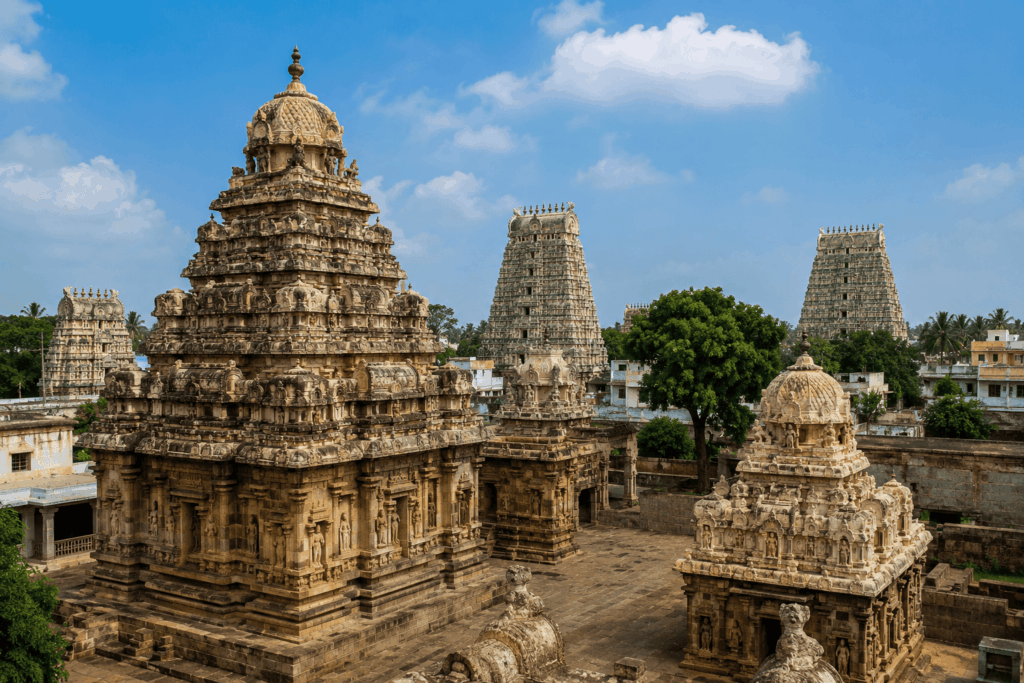
Kanchipuram, often called the “City of a Thousand Temples” and the “Golden City of South India,” is one of the oldest continuously inhabited cities in India. Located in present-day Tamil Nadu, Kanchipuram has been a center of religion, learning, architecture, trade, and political power for more than two thousand years. The city’s rich history spans the Sangam Age, the rule of the Pallavas, Cholas, Vijayanagara Empire, and later dynasties, making it one of the most significant heritage destinations in India.
Ancient Kanchipuram earned worldwide recognition not only for its magnificent temples but also for its role as an important center of Hinduism, Buddhism, and Jainism. Scholars, philosophers, saints, and travelers from different parts of Asia visited the city to study religion, literature, philosophy, and art. Chinese Buddhist monk Xuanzang (Hiuen Tsang), who visited Kanchipuram during the 7th century CE, described it as a prosperous and well-planned city with flourishing educational institutions and magnificent temples.
The city also became famous under the Pallava dynasty, whose rulers transformed Kanchipuram into their capital and built remarkable monuments that still stand as masterpieces of early Dravidian architecture. Temples such as the Kailasanathar Temple and Vaikunta Perumal Temple continue to attract historians, pilgrims, architects, and tourists from around the world.
Apart from its religious importance, Kanchipuram has long been associated with the world-famous Kanchipuram silk sarees, a weaving tradition that has continued for centuries. Even today, the city’s economy and cultural identity remain closely linked to this historic craft.
This article explores the fascinating history of ancient Kanchipuram, tracing its origins, political significance, architectural achievements, educational traditions, and lasting contribution to Indian civilization.
Where Is Kanchipuram Located?
Kanchipuram is situated about 75 kilometers southwest of Chennai in the Indian state of Tamil Nadu.
The city lies along the banks of the Vegavathi River, a tributary of the Palar River.
Its strategic location offered several advantages:
- Fertile agricultural surroundings.
- Easy access to inland trade routes.
- Natural protection from coastal invasions.
- Connection to important South Indian kingdoms.
- Favorable conditions for urban development.
Because of its location, Kanchipuram grew into one of the most prosperous cities in ancient South India.
Origin of the Name Kanchipuram
The name Kanchipuram has several traditional interpretations.
According to one belief, the word “Kanchi” refers to a sacred girdle or ornament, symbolizing beauty and prosperity.
Ancient Sanskrit and Tamil texts refer to the city by names such as:
- Kanchi
- Kanchipura
- Kachipedu
Over centuries, the city became widely known as Kanchipuram, meaning “The Sacred City of Kanchi.”
Kanchipuram in Ancient Literature
The antiquity of Kanchipuram is supported by references in Sangam literature, Sanskrit texts, and inscriptions.
Tamil literary works describe Kanchi as:
- A prosperous capital.
- A center of learning.
- A thriving commercial city.
- A religious destination.
- A place of artistic excellence.
Classical Tamil poets praised the city’s:
- Beautiful streets.
- Strong fortifications.
- Magnificent temples.
- Prosperous markets.
- Learned scholars.
- Generous rulers.
These descriptions suggest that Kanchipuram had already become an important urban center by the early centuries CE.
Kanchipuram During the Sangam Age
Although later famous as the Pallava capital, Kanchipuram was already an important settlement during the Sangam Age (approximately 300 BCE–300 CE).
Its strategic position connected northern Tamil Nadu with Andhra Pradesh and other regions of South India.
Trade caravans passed through Kanchipuram carrying:
- Cotton textiles.
- Rice.
- Pepper.
- Spices.
- Precious stones.
- Metal goods.
- Handcrafted products.
The city gradually developed into an important commercial and administrative center.
Rise of the Pallava Dynasty
The greatest chapter in Kanchipuram’s history began with the rise of the Pallava dynasty.
Between the 4th and 9th centuries CE, the Pallavas transformed Kanchipuram into one of India’s leading political and cultural capitals.
Their kingdom extended across much of northern Tamil Nadu and parts of present-day Andhra Pradesh.
Kanchipuram served as their royal capital.
Why the Pallavas Chose Kanchipuram
Several factors influenced the Pallavas’ decision to establish their capital at Kanchipuram.
The city offered:
- Strong defensive advantages.
- Rich agricultural resources.
- Access to inland trade.
- Religious prestige.
- Existing urban infrastructure.
These advantages allowed the Pallavas to develop a stable and prosperous kingdom.
Famous Pallava Kings
Several remarkable rulers shaped the history of ancient Kanchipuram.
Mahendravarman I (c. 600–630 CE)
Mahendravarman I was an accomplished ruler, scholar, poet, and patron of architecture.
His contributions include:
- Promotion of Sanskrit and Tamil literature.
- Construction of early rock-cut temples.
- Encouragement of art and music.
- Strengthening Pallava administration.
His reign marked the beginning of significant architectural developments.
Narasimhavarman I (Mamalla)
Narasimhavarman I, also known as Mamalla, became one of the greatest Pallava rulers.
He achieved several notable victories, including the defeat of the Chalukya king Pulakeshin II.
His reign witnessed:
- Military expansion.
- Architectural innovation.
- Economic prosperity.
- Cultural growth.
Although he is closely associated with Mamallapuram (Mahabalipuram), Kanchipuram remained the administrative heart of the Pallava kingdom.
Nandivarman II
Nandivarman II continued the Pallava tradition of supporting religion, education, and temple construction.
He commissioned the magnificent Vaikunta Perumal Temple, which remains an important architectural landmark.
Kanchipuram: A Great Center of Learning
Ancient Kanchipuram earned a reputation as one of India’s leading educational centers.
Students from different parts of India visited the city to study:
- Philosophy.
- Sanskrit.
- Tamil literature.
- Mathematics.
- Grammar.
- Logic.
- Religion.
The city hosted numerous learning institutions attached to temples and monasteries.
Scholars engaged in intellectual discussions that influenced South Indian culture for centuries.
Xuanzang’s Visit to Kanchipuram
One of the most valuable historical accounts comes from the Chinese Buddhist monk Xuanzang, who visited Kanchipuram during the 7th century CE.
He described the city as:
- Wealthy.
- Well-planned.
- Densely populated.
- Rich in temples.
- Home to Buddhist monasteries.
- A center of education.
His writings provide important evidence of Kanchipuram’s international reputation during the Pallava period.
Religious Importance
Kanchipuram became one of Hinduism’s most sacred cities.
It is regarded as one of the Sapta Puri, the seven holy cities believed to grant salvation.
The city developed into an important center for:
- Shaivism.
- Vaishnavism.
- Shaktism.
It also welcomed followers of:
- Buddhism.
- Jainism.
This religious diversity encouraged peaceful coexistence and intellectual exchange.
The Famous Temples of Ancient Kanchipuram
The Pallavas built some of South India’s earliest structural stone temples.
Among the most famous are:
Kailasanathar Temple
Built during the reign of Narasimhavarman II (Rajasimha), this temple is considered one of the finest examples of early Dravidian architecture.
Its intricate carvings and sandstone construction influenced later South Indian temple architecture.
Vaikunta Perumal Temple
Constructed during the reign of Nandivarman II, this temple is renowned for:
- Beautiful sculptures.
- Historical inscriptions.
- Multi-level sanctum.
- Pallava architectural innovations.
These temples continue to attract historians, archaeologists, architects, and pilgrims from around the world.
Why Ancient Kanchipuram Remains Important Today
Kanchipuram’s historical importance extends far beyond its temples.
The city represents:
- The political capital of the Pallavas.
- A center of ancient education.
- A birthplace of remarkable architecture.
- A major religious destination.
- A thriving commercial city.
- One of India’s oldest continuously inhabited urban settlements.
Its enduring legacy continues to shape Tamil Nadu’s cultural identity and attracts millions of visitors each year.