
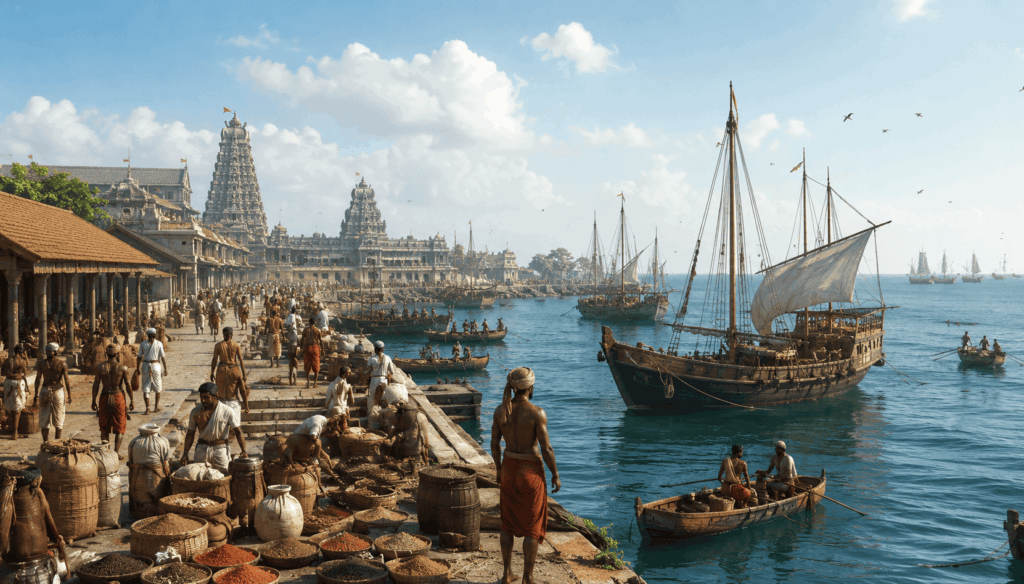
Tamil Nadu has been one of India’s greatest maritime regions for over two thousand years. Long before the arrival of European traders, the Tamil coast was home to bustling ports that connected South India with distant civilizations such as Rome, Egypt, Greece, Arabia, Sri Lanka, China, and Southeast Asia. These ancient ports were not merely centers of commerce; they were melting pots of culture, technology, religion, and diplomacy. Through maritime trade, Tamil kingdoms spread their influence across the Indian Ocean while welcoming merchants, travelers, and scholars from around the world.
The ports of ancient Tamil Nadu played a vital role during the Sangam Age (approximately 300 BCE–300 CE) and continued to flourish under the Cholas, Pandyas, and Pallavas. Goods such as spices, pearls, precious stones, textiles, ivory, sandalwood, and fine pottery were exported, while gold coins, wine, glassware, horses, and luxury items were imported. Historical records from Sangam literature, Greek and Roman writings, Chinese travel accounts, and archaeological discoveries provide valuable insights into the prosperity of these coastal trading centers.
Today, the remains of these ports attract historians, archaeologists, tourists, and researchers eager to understand India’s rich maritime heritage. Many competitive examinations also include questions about these ancient ports because of their importance in Indian history.
This article explores the famous ancient ports of Tamil Nadu, their historical significance, archaeological discoveries, trade connections, and their contribution to India’s economic and cultural development.
Tamil Nadu: The Maritime Gateway of Ancient India
Tamil Nadu occupies a strategic location along the southeastern coast of India, bordered by the Bay of Bengal, the Palk Strait, and the Gulf of Mannar. This geographical advantage allowed ancient Tamil kingdoms to establish extensive sea routes linking India with Asia, Africa, and Europe.
Unlike many inland kingdoms, the Tamil rulers recognized the importance of maritime trade early in history. They invested in developing ports, building ships, protecting sea routes, and encouraging international commerce.
Several factors contributed to Tamil Nadu’s maritime success:
Long coastline extending over 1,000 kilometers.
Favorable monsoon winds that supported seasonal navigation.
Rich agricultural and mineral resources.
Abundant pearl fisheries along the Gulf of Mannar.
Skilled shipbuilders and experienced sailors.
Strong royal patronage from the Cholas, Pandyas, and Pallavas.
These advantages helped Tamil ports become some of the busiest trading centers in the ancient world.
Ancient Maritime Trade During the Sangam Age
The Sangam Age marked the beginning of large-scale overseas trade from Tamil Nadu.
Sangam literature frequently describes busy ports where:
Ships from foreign lands arrived with valuable goods.
Merchants traded spices, pearls, textiles, and precious stones.
Markets bustled with activity.
Warehouses stored imported and exported products.
Customs officials collected taxes.
Foreign merchants from Rome, Greece, Egypt, and Arabia regularly visited Tamil ports.
Ancient Roman writers such as Pliny the Elder and the anonymous author of the Periplus of the Erythraean Sea described the wealth of South India’s coastal trade. Roman gold coins discovered across Tamil Nadu further confirm these commercial relationships.
Kaveripoompattinam (Poompuhar): The Great Chola Port
Among the most famous ancient ports of Tamil Nadu, **Kaveripoompattinam**, also known as **Poompuhar**, occupies a special place.
Located at the mouth of the River Kaveri on the Bay of Bengal, Poompuhar served as the principal port of the early Cholas.
Historical Background
Sangam literature describes Poompuhar as a magnificent city filled with:
Busy marketplaces
Large docks
Merchant quarters
Warehouses
Royal palaces
Religious centers
Residential neighborhoods
The city flourished between the early centuries BCE and the early medieval period.
The famous Tamil epic **Silappadikaram** provides vivid descriptions of its prosperity and cosmopolitan culture.
Trade Activities
Poompuhar exported:
Pepper
Fine cotton textiles
Silk
Ivory
Sandalwood
Pearls
Precious stones
Imports included:
Roman gold coins
Wine
Glassware
Coral
Horses
Luxury goods
Its strategic location made it one of the busiest ports on India’s eastern coast.
Archaeological Discoveries
Marine archaeological studies conducted off the coast of Poompuhar have revealed:
Stone structures
Brick remains
Wharf-like constructions
Pottery fragments
Ancient habitation sites
Many historians believe that portions of the ancient city were submerged due to coastal erosion and rising sea levels.
Korkai: The Pearl Capital of the Pandya Kingdom
Another famous ancient port was **Korkai**, situated near the Gulf of Mannar in present-day Thoothukudi district.
Korkai served as the early capital and principal port of the Pandya dynasty.
Why Korkai Was Famous
Korkai became internationally known for its pearl fisheries.
The Gulf of Mannar produced some of the finest pearls in the ancient world.
Pearl divers harvested oysters from the sea, supplying valuable pearls to international markets.
International Trade
Merchants from:
Rome
Greece
Arabia
Sri Lanka
visited Korkai to purchase:
Pearls
Fish products
Shell ornaments
Textiles
The wealth generated through pearl exports significantly strengthened the Pandya economy.
Archaeological Evidence
Excavations have uncovered:
Black-and-red ware pottery
Roman coins
Shell artifacts
Iron tools
Beads
Burial sites
These findings confirm Korkai’s importance as an international trading center.
Arikamedu: India’s Roman Trading Settlement
Although located near present-day Puducherry, **Arikamedu** formed an important part of the ancient Tamil maritime trade network.
Discovery
Archaeological excavations carried out by Sir Mortimer Wheeler and later researchers uncovered one of India’s most significant Indo-Roman trading sites.
The discoveries included:
Roman amphorae
Wine jars
Glassware
Beads
Pottery
Coins
Brick structures
Roman Connection
Arikamedu served as an important center for trade with the Roman Empire.
Goods exported included:
Cotton textiles
Gemstones
Ivory
Pepper
Shell products
Imports consisted of:
Fine pottery
Wine
Olive oil
Luxury ceramics
Gold coins
These discoveries demonstrate the extensive commercial relationship between South India and the Mediterranean world.
Nagapattinam: The Flourishing Medieval Port
Although Nagapattinam became particularly prominent during the Chola period, its origins as a trading port date back many centuries.
Strategic Importance
Located on the Coromandel Coast, Nagapattinam connected South India with:
Sri Lanka
Southeast Asia
China
Burma (Myanmar)
Indonesia
It later became one of the Cholas’ principal ports during their overseas expansion.
Trade and Cultural Exchange
Nagapattinam handled exports such as:
Rice
Spices
Textiles
Bronze sculptures
Temple art
Precious stones
It also became an important center for Buddhist and Hindu cultural exchange.
Chinese records mention commercial relations with Nagapattinam, highlighting its international significance.
Why Ancient Tamil Ports Became So Prosperous
Several factors contributed to the success of these ports:
Strategic Coastal Geography
Tamil Nadu’s location allowed easy access to both eastern and western maritime routes.
Monsoon Navigation
Ancient sailors skillfully used seasonal monsoon winds to travel between India, Arabia, Africa, and Southeast Asia.
Valuable Export Goods
Tamil Nadu produced highly sought-after commodities including:
Pepper
Pearls
Cotton textiles
Sandalwood
Precious stones
Ivory
Fine handicrafts
Strong Royal Support
The Cholas, Pandyas, and Pallavas encouraged maritime trade by maintaining ports, protecting sea routes, and supporting merchant guilds.
Skilled Merchants
Tamil merchant guilds such as the **Ayyavole 500** and **Manigramam** established trading networks that extended across Asia.