
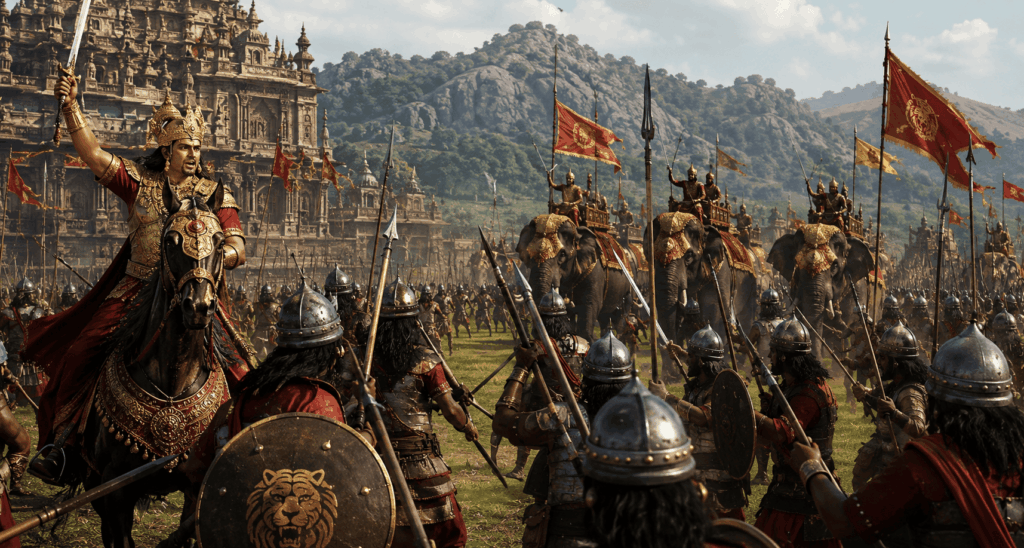
The Chola dynasty stands as one of the most glorious chapters in Indian history. Known for their powerful kings, magnificent temples, efficient administration, thriving trade networks, and remarkable naval strength, the Cholas transformed South India into a major political and cultural center between the 9th and 13th centuries CE. While their architectural masterpieces like the Brihadeeswarar Temple continue to inspire millions, the foundation of the Chola Empire was built on a series of decisive military victories.
From defeating rival South Indian kingdoms to launching successful naval expeditions across Southeast Asia, the Cholas demonstrated exceptional military planning, discipline, and strategic vision. Their victories expanded the empire from the banks of the Kaveri River to Sri Lanka, the Maldives, and parts of present-day Indonesia and Malaysia. These campaigns not only increased their territorial control but also strengthened trade, promoted Tamil culture, and established the Cholas as one of the most influential maritime powers in medieval Asia.
This article explores the famous battles fought by the Cholas, the rulers who led these campaigns, their military strategies, and the lasting impact of these victories. Whether you are a student preparing for competitive examinations, a history enthusiast, a researcher, or a tourist interested in Tamil Nadu’s rich heritage, this guide provides an easy-to-understand yet comprehensive overview of the Chola Empire’s greatest military achievements.
The Rise of the Chola Empire
Although the Cholas were mentioned in ancient Sangam literature, their real rise to imperial power began in the 9th century CE. Before this period, South India was dominated by powerful dynasties such as the Pallavas, Pandyas, and Rashtrakutas. The Cholas gradually emerged as a formidable force under the leadership of Vijayalaya Chola.
Vijayalaya Chola: The Founder of the Imperial Cholas
Around 850 CE, Vijayalaya Chola captured Thanjavur (Tanjore) from the Mutharaiyars. This victory laid the foundation for the Imperial Chola dynasty.
Recognizing the strategic importance of Thanjavur, Vijayalaya made it his capital and strengthened its defenses. This success enabled the Cholas to expand their influence across the fertile Kaveri Delta, which later became the economic heart of the empire.
His achievement was not merely a territorial conquest—it marked the beginning of one of India’s longest-lasting and most powerful empires.
The Strength of the Chola Military
Several factors contributed to the Cholas’ military success:
Well-Trained Standing Army
Unlike many kingdoms that relied heavily on temporary forces, the Cholas maintained a professional standing army. Soldiers underwent regular training and remained prepared throughout the year.
Powerful Cavalry and Elephant Corps
War elephants played a significant role in breaking enemy formations, while cavalry units provided speed and mobility during battles.
Highly Organized Infantry
The infantry formed the backbone of the Chola army. Equipped with swords, spears, shields, bows, and armor, these soldiers fought with remarkable discipline.
Strong Naval Fleet
The Cholas are widely regarded as one of the few Indian dynasties to build a powerful blue-water navy. Their fleet enabled overseas campaigns, protected maritime trade routes, and projected military power across the Bay of Bengal.
Effective Administration
Military campaigns were supported by efficient tax collection, organized logistics, and a prosperous economy. These administrative strengths ensured that armies remained well-equipped and supplied during long expeditions.
Battle for Thanjavur: The Beginning of Chola Expansion
The capture of Thanjavur by Vijayalaya Chola was one of the earliest and most significant military achievements in Chola history.
Background
During the mid-9th century, the region was controlled by the Mutharaiyar chiefs. Political instability among neighboring kingdoms created an opportunity for Vijayalaya to launch his campaign.
The Battle
Historical inscriptions suggest that Vijayalaya successfully defeated the Mutharaiyars and seized control of Thanjavur after a determined military effort.
Although detailed battle accounts are unavailable, historians believe this victory resulted from careful planning, strong local support, and strategic timing.
Importance
The conquest of Thanjavur:
- Established the Imperial Chola dynasty.
- Secured control over the fertile Kaveri Delta.
- Created a strong administrative center.
- Enabled future territorial expansion.
Without this victory, the rise of the Chola Empire might never have occurred.
The Battle of Sripurambiyam (c. 885 CE)
One of the most important turning points in South Indian history was the Battle of Sripurambiyam.
Background
This conflict involved several major powers:
- Cholas
- Pallavas
- Pandyas
- Western Gangas
At the time, the Pandyas sought to dominate South India, while the Pallavas attempted to retain their influence.
Aditya I, the son of Vijayalaya Chola, allied with the Pallavas to counter the Pandya threat.
The Battle
The combined forces of the Cholas and Pallavas confronted the Pandya army near Sripurambiyam, close to present-day Kumbakonam.
Although the battle was fierce, the alliance emerged victorious.
Consequences
The victory had far-reaching effects:
- Weakened the Pandya kingdom.
- Increased Chola military prestige.
- Strengthened Aditya I’s political influence.
- Marked the beginning of Chola dominance in Tamil Nadu.
Within a few years, Aditya I consolidated Chola control over former Pallava territories, significantly expanding the kingdom.
Aditya I’s Campaign Against the Pallavas
History often remembers Aditya I as both an ally and later a conqueror of the Pallavas.
Changing Political Landscape
After helping the Pallavas defeat the Pandyas, Aditya I gradually increased Chola power.
When Pallava influence declined, he launched campaigns to bring their territories under Chola rule.
Victory
Aditya I successfully defeated the Pallava ruler Aparajita and annexed large parts of northern Tamil Nadu.
Significance
This victory:
- Ended centuries of Pallava political dominance.
- Expanded Chola territory substantially.
- Increased access to important trade routes.
- Established the Cholas as the leading power in South India.
Campaigns of Parantaka I Against the Pandyas
Parantaka I (907–955 CE) continued the expansion of the Chola Empire through a series of successful military campaigns.
Battle for Madurai
Madurai, the historic capital of the Pandya kingdom, remained a prized objective.
Parantaka I launched multiple expeditions against the Pandyas and eventually captured Madurai.
Following this victory, he adopted the title:
“Maduraikonda Parakesari” (The King Who Conquered Madurai).
Strategic Importance
Control over Madurai provided:
- Access to southern trade routes.
- Greater political influence.
- Rich agricultural resources.
- Increased tax revenues.
The conquest also demonstrated the growing military capability of the Cholas.
The Battle of Takkolam (949 CE)
Not every battle ended in victory for the Cholas.
The Battle of Takkolam remains one of the most significant setbacks in Chola history.
Background
The Rashtrakuta Empire sought to challenge Chola expansion into northern territories.
Parantaka I’s son, Rajaditya, led the Chola army against the Rashtrakutas near Takkolam in present-day Tamil Nadu.
The Battle
The fighting was intense and prolonged.
During the conflict, Crown Prince Rajaditya was reportedly killed while leading his troops from atop a war elephant.
His death severely affected the morale of the Chola army.
The Rashtrakutas eventually secured victory.
Historical Impact
Although the Cholas suffered a major defeat, they recovered within a few decades.
The loss highlighted the importance of military adaptation and strategic planning, lessons that later rulers such as Rajaraja I and Rajendra I used to rebuild and strengthen the empire.