
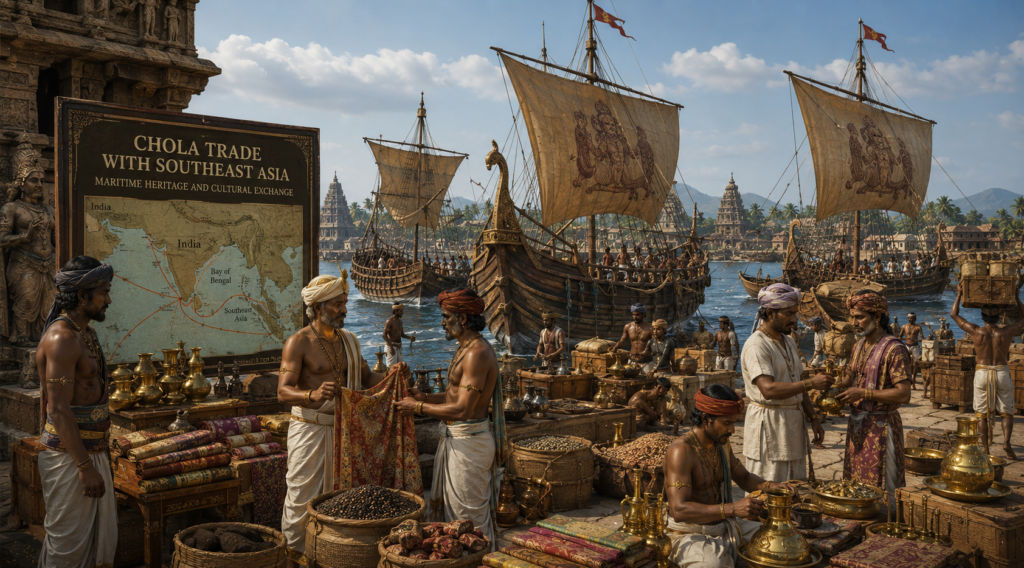
Today, historians regard Chola maritime trade as one of the greatest achievements of medieval India. Archaeological discoveries, inscriptions, foreign records, and temple donations all highlight the importance of overseas commerce in the prosperity of the Chola Empire.
This article explores how the Cholas built an extensive trading network with Southeast Asia, the ports they developed, the goods they exchanged, the role of merchant guilds, and the lasting legacy of this remarkable maritime relationship.
Why Southeast Asia Was Important to the Cholas
The Chola Kingdom occupied a strategic position along the southeastern coast of India, facing the Bay of Bengal. This location made overseas trade both practical and profitable.
Across the sea lay prosperous kingdoms rich in natural resources and connected to major international trade routes.
Southeast Asia offered access to:
- Valuable spices
- Aromatic woods
- Gold
- Tin
- Camphor
- Forest products
- Luxury goods
- Expanding commercial markets
For the Cholas, maritime trade was an essential source of economic growth and political influence.
Rise of Chola Maritime Commerce
Although maritime trade existed in Tamilakam during the Sangam Age, it expanded significantly under the Imperial Cholas.
The revival of the Chola dynasty under Vijayalaya Chola laid the political foundation for future commercial growth.
During the reigns of Rajaraja Chola I (985–1014 CE) and Rajendra Chola I (1014–1044 CE), trade reached unprecedented levels.
Several factors contributed to this expansion:
- Political stability
- Strong naval protection
- Efficient administration
- Flourishing agriculture
- Investment in ports
- Support for merchant guilds
Together, these factors enabled the Cholas to dominate maritime trade across the Bay of Bengal.
Major Chola Ports
The prosperity of overseas commerce depended on efficient port cities.
The Cholas developed several important ports that handled international trade.
Nagapattinam
Nagapattinam became one of the busiest ports of the Chola Empire.
It served as:
- An international trading centre
- A naval base
- A customs collection point
- A diplomatic gateway to Southeast Asia
Merchants from many countries visited the port to exchange goods.
Kaveripoompattinam (Poompuhar)
Known from Sangam literature, Poompuhar remained an important commercial centre during the early medieval period.
Its markets sold:
- Fine textiles
- Pepper
- Pearls
- Ivory
- Precious stones
- Handcrafted goods
The city connected inland agricultural regions with overseas markets.
Kadalur and Other Coastal Harbours
Several smaller ports along the Coromandel Coast supported:
- Shipbuilding
- Warehousing
- Customs administration
- Merchant accommodation
- Coastal trade
Together, these ports created a highly efficient maritime network.
Merchant Guilds: The Backbone of Chola Trade
Trade during the Chola period was organized by powerful merchant guilds.
These guilds managed commercial activities across India and Southeast Asia.
Some of the most famous guilds included:
Ayyavole 500 (Ainnurruvar)
One of the largest merchant organizations in medieval Asia.
Its members traded across South India, Sri Lanka, Southeast Asia, and beyond.
Manigramam
This guild specialized in inland and overseas trade.
Its merchants frequently operated from major Chola ports.
Nanadesi
The Nanadesi merchants traveled widely and maintained commercial networks across multiple kingdoms.
Their activities helped strengthen economic ties between India and Southeast Asia.
Goods Exported by the Cholas
Tamil merchants exported a wide variety of products that were highly valued in foreign markets.
Major exports included:
Spices
South India was famous for:
- Pepper
- Cardamom
- Cinnamon
- Turmeric
These spices were among the most valuable commodities in international trade.
Cotton Textiles
Tamil weavers produced fine cotton fabrics admired for their quality and craftsmanship.
These textiles were exported in large quantities.
Pearls
Pearls harvested from the Gulf of Mannar were considered luxury items.
They were highly sought after by wealthy buyers across Asia.
Precious Stones
Exports included:
- Rubies
- Sapphires
- Garnets
- Quartz
These gemstones enhanced the reputation of Tamil merchants.
Ivory and Handicrafts
Skilled artisans produced carved ivory, bronze objects, jewellery, and decorative items that attracted international buyers.
Goods Imported from Southeast Asia
Trade was not one-sided.
The Cholas imported several valuable products, including:
- Gold
- Camphor
- Sandalwood
- Tin
- Forest products
- Exotic woods
- Fine ceramics
- Silk
- Luxury goods
These imports enriched the Chola economy and satisfied growing demand among nobles, merchants, and temples.
Maritime Routes Across the Bay of Bengal
The Cholas mastered seasonal monsoon winds that enabled ships to sail safely across the Bay of Bengal.
Their routes connected Tamil ports with important destinations such as:
- Sri Lanka
- Myanmar
- Thailand
- Malaysia
- Sumatra
- Java
- Cambodia
- Vietnam
Experienced navigators used stars, wind patterns, ocean currents, and accumulated maritime knowledge to undertake long-distance voyages.
The Role of the Chola Navy
Commercial success depended on secure sea routes.
The powerful Chola navy protected:
- Merchant ships
- Coastal settlements
- Strategic ports
- Trade routes
It also discouraged piracy and ensured the safe movement of goods across the Indian Ocean.
Military strength and commercial prosperity worked hand in hand.