
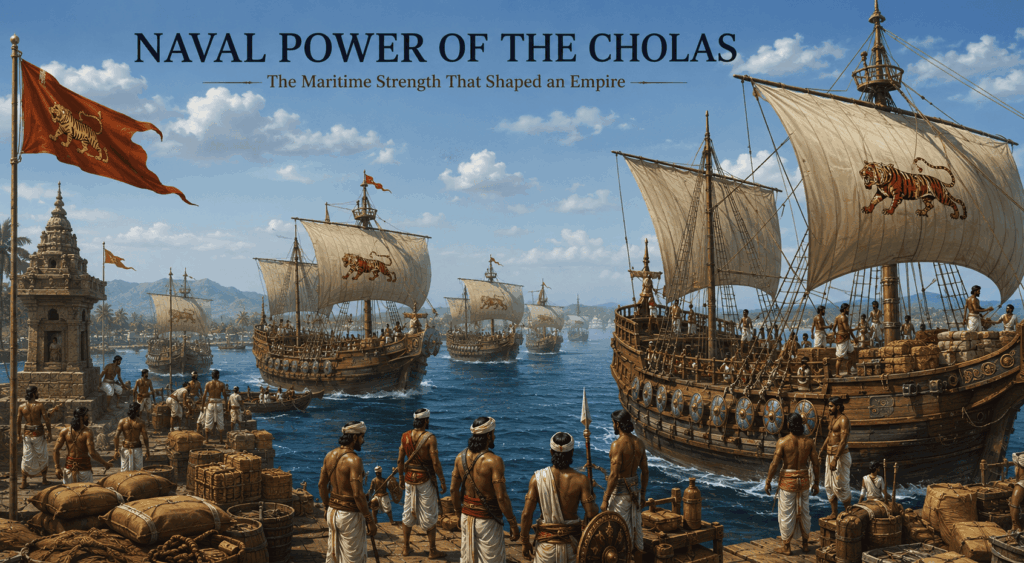
The Chola Empire is widely regarded as one of the greatest maritime powers in Indian history. Between the 9th and 13th centuries CE, the Cholas transformed South India into a dominant force across the Indian Ocean through their powerful navy, advanced shipbuilding techniques, and strategic maritime campaigns. Unlike many medieval kingdoms that focused mainly on land warfare, the Cholas recognized the importance of controlling sea routes for trade, diplomacy, and military expansion.
Under visionary rulers such as Rajaraja Chola I and Rajendra Chola I, the Chola navy reached unprecedented heights. It protected merchant ships, secured vital trade routes, expanded the empire’s influence across Sri Lanka and Southeast Asia, and projected Indian power far beyond the subcontinent. Their naval expeditions to regions such as Sri Lanka, the Maldives, and the Srivijaya Empire are among the earliest examples of long-distance overseas military operations by an Indian kingdom.
The success of the Chola navy was not built on military strength alone. It relied on thriving ports, efficient administration, skilled shipbuilders, experienced sailors, and flourishing international trade. These achievements helped establish the Cholas as one of the most influential maritime empires of the medieval world.
This article explores the origins, organization, achievements, and lasting legacy of the Chola navy, highlighting why it remains a remarkable chapter in India’s naval history.
Why the Cholas Needed a Strong Navy
The Chola Kingdom was located along the southeastern coast of India, bordering the Bay of Bengal. This strategic location offered direct access to important maritime trade routes connecting India with:
- Sri Lanka
- Maldives
- Southeast Asia
- China
- Arabia
As trade expanded, protecting merchant vessels became increasingly important.
A powerful navy enabled the Cholas to:
- Secure sea routes
- Defend coastal territories
- Protect commercial interests
- Expand overseas influence
- Support military campaigns
- Strengthen diplomatic relations
The sea became as important to the Cholas as the land.
Rise of the Chola Navy
The foundations of Chola naval power were laid during the revival of the dynasty under Vijayalaya Chola in the 9th century.
However, it was under Rajaraja Chola I (985–1014 CE) that the navy became a well-organized military force.
His successor, Rajendra Chola I (1014–1044 CE), further expanded its capabilities and transformed it into one of Asia’s most formidable naval forces.
Together, these rulers demonstrated that maritime dominance could enhance both economic prosperity and political influence.
Shipbuilding Excellence
The Cholas developed advanced shipbuilding traditions suited for long-distance voyages across the Indian Ocean.
Their vessels were designed to carry:
- Soldiers
- Horses
- Trade goods
- Food supplies
- Weapons
Historical evidence suggests that Chola ships were built using strong hardwoods from South India’s forests and were capable of withstanding long sea journeys.
Although no complete Chola ships survive today, inscriptions, literary references, sculptures, and foreign accounts indicate that they possessed impressive maritime engineering skills.
Major Ports of the Chola Empire
The success of the Chola navy depended heavily on well-developed ports.
Among the most important were:
Nagapattinam
Nagapattinam became one of the empire’s busiest ports.
It served as:
- A naval base
- A commercial centre
- A gateway for international trade
- A diplomatic contact point with Southeast Asia
Merchants from many countries visited this thriving port.
Kaveripoompattinam (Poompuhar)
Known from Sangam literature, Poompuhar was one of ancient Tamilakam’s greatest port cities.
It handled large volumes of:
- Spices
- Textiles
- Pearls
- Precious stones
- Ivory
The city reflected the Cholas’ long maritime tradition.
Other Coastal Centres
Several smaller ports along the Coromandel Coast supported:
- Shipbuilding
- Naval logistics
- Trade
- Fishing
- Customs administration
Together, these ports formed an extensive maritime network.
Naval Organization
Although historians do not possess complete military manuals from the Chola period, inscriptions indicate a highly organized naval structure.
The navy likely included:
Fleet Commanders
Senior officers responsible for planning naval expeditions.
Sailors
Experienced seafarers capable of navigating long ocean voyages.
Soldiers
Specially trained troops transported aboard ships for overseas campaigns.
Logistics Personnel
Officials responsible for supplying food, water, weapons, and equipment during long journeys.
Effective coordination between these groups enabled successful military operations.
Rajaraja Chola I and Naval Expansion
Rajaraja Chola I recognized that maritime power could strengthen the empire’s economy and security.
His naval achievements included:
- Conquest of northern Sri Lanka
- Control of important ports
- Expansion of overseas trade
- Strengthening coastal defenses
These successes increased the wealth of the empire and prepared the foundation for even greater naval expeditions under his son.
Rajendra Chola I: India’s Greatest Naval Commander?
Many historians regard Rajendra Chola I as the greatest naval ruler in Indian history.
During his reign, the Chola navy conducted one of the most remarkable overseas military campaigns of the medieval period.
His fleet sailed across the Bay of Bengal and attacked the powerful Srivijaya Empire, which controlled important maritime trade routes in Southeast Asia.
The expedition demonstrated:
- Excellent navigation
- Strong logistics
- Strategic planning
- Military coordination
Rather than permanent conquest, the campaign aimed to secure commercial interests and ensure uninterrupted trade.
Conquest of Sri Lanka
The Cholas launched several naval expeditions against Sri Lanka.
Their fleet successfully transported troops across the sea and supported military campaigns that resulted in the occupation of large parts of the island.
Control over Sri Lanka provided:
- Strategic ports
- Maritime security
- Commercial advantages
- Political influence
The island remained an important part of Chola strategy for many years.
Trade Protected by Naval Power
One of the primary responsibilities of the Chola navy was protecting merchant ships.
Tamil merchants traded extensively with:
- China
- Cambodia
- Indonesia
- Thailand
- Malaysia
- Sri Lanka
- Arabia
Exports included:
- Pepper
- Cotton textiles
- Pearls
- Ivory
- Precious stones
- Sandalwood
Imports included:
- Horses
- Gold
- Silk
- Ceramics
- Luxury goods
Safe sea routes encouraged economic growth and strengthened the empire’s prosperity.