
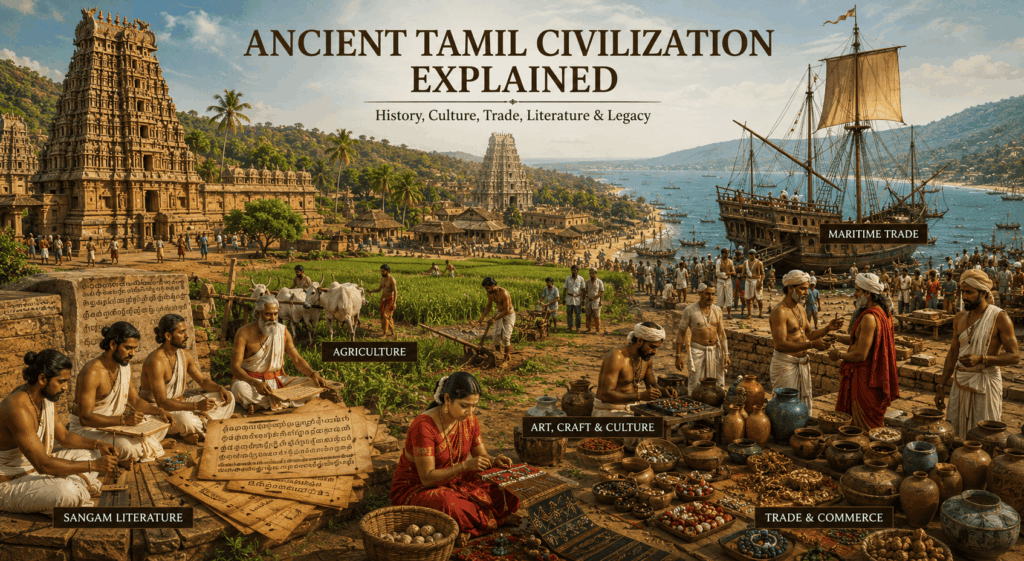
The Ancient Tamil Civilization is one of the world’s oldest continuous civilizations, with a history that stretches back more than two thousand years. Long before the rise of many medieval kingdoms, the Tamil-speaking regions of South India had developed advanced systems of governance, agriculture, maritime trade, literature, architecture, and social organization. The civilization flourished across present-day Tamil Nadu, parts of Kerala, southern Andhra Pradesh, and northern Sri Lanka, becoming a vibrant centre of culture and commerce.
The foundations of this civilization were built during the Sangam Age (approximately 300 BCE–300 CE), a period often referred to as the golden age of classical Tamil literature. During this era, the Cholas, Cheras, and Pandyas—collectively known as the Three Crowned Kings of Tamilakam—ruled prosperous kingdoms that encouraged education, poetry, trade, and public welfare.
Ancient Tamil society was deeply connected to nature, agriculture, and the sea. Farmers cultivated fertile river valleys, merchants traded with Rome, Arabia, and Southeast Asia, poets composed timeless literary works, and artisans created beautiful sculptures, jewellery, and textiles. These achievements helped establish Tamil civilization as one of the most influential cultural traditions in Asia.
Today, archaeological discoveries, inscriptions, classical literature, and ancient monuments continue to reveal the remarkable achievements of this civilization. Understanding its history offers valuable insights into India’s cultural heritage and remains important for students, researchers, tourists, and competitive examination aspirants.
What Is Ancient Tamil Civilization?
Ancient Tamil Civilization refers to the early societies that developed in the Tamil-speaking regions of South India before and during the Sangam Age.
These societies established organized settlements, practiced agriculture, built thriving towns, developed trade networks, and created one of the oldest literary traditions in the Indian subcontinent.
Unlike many ancient civilizations known mainly through archaeological discoveries, the Tamil civilization is documented through both material evidence and an extensive body of classical literature.
Geographic Setting of Tamilakam
The ancient Tamil region was known as Tamilakam.
It included:
- Present-day Tamil Nadu
- Kerala
- Parts of Karnataka
- Southern Andhra Pradesh
- Northern Sri Lanka
The region enjoyed diverse landscapes, including mountains, forests, fertile plains, coastal areas, and dry zones. These varied environments shaped the livelihoods, customs, and literature of the people.
Major rivers such as the Kaveri, Vaigai, and Tamiraparani supported agriculture and the growth of prosperous settlements.
The political landscape of ancient Tamilakam was dominated by three powerful dynasties.
The Cholas
The Cholas ruled the fertile Kaveri Delta and became famous for agriculture, irrigation, maritime trade, and later for building magnificent temples.
Their ports connected South India with distant markets across the Indian Ocean.
The Pandyas
The Pandyas ruled from Madurai, which emerged as a major centre of learning, literature, religion, and commerce.
They gained wealth through agriculture, pearl fishing, and overseas trade.
The Cheras
The Cheras controlled the western coastal regions and the spice-rich hills of present-day Kerala.
Their kingdom prospered through the export of pepper, cardamom, cinnamon, and other valuable products to foreign merchants.
Together, these kingdoms shaped the political and cultural identity of ancient Tamil civilization.
The Sangam Age: A Golden Era
The Sangam Age is one of the defining periods of ancient Tamil history.
The term “Sangam” refers to gatherings of poets and scholars who composed and preserved classical Tamil literature.
These literary works describe nearly every aspect of life, including:
- Governance
- Agriculture
- Trade
- Warfare
- Family life
- Ethics
- Nature
- Love
- Heroism
Because of these writings, historians have an unusually detailed understanding of early Tamil society compared with many other ancient civilizations.
Sources of Ancient Tamil History
Our knowledge of ancient Tamil civilization comes from several reliable sources.
Sangam Literature
Works such as the Ettuthokai (Eight Anthologies) and Pattuppattu (Ten Idylls) provide detailed descriptions of society, economy, and politics.
These texts remain among the oldest surviving literary works in any Indian language.
Archaeological Discoveries
Excavations at sites such as:
- Keeladi
- Adichanallur
- Kodumanal
- Poompuhar
have uncovered pottery, tools, ornaments, inscriptions, and urban settlements that demonstrate the sophistication of ancient Tamil society.
Foreign Accounts
Greek and Roman writers recorded their trade with South India.
Their writings describe Tamil ports exporting:
- Pepper
- Pearls
- Ivory
- Fine cotton textiles
- Precious stones
Roman gold coins discovered in Tamil Nadu further confirm these commercial links.
Inscriptions
Tamil-Brahmi inscriptions found on caves, pottery, and monuments provide valuable evidence of literacy, administration, and trade during the early historic period.
Society and Daily Life
Ancient Tamil society was highly organized and closely connected to nature.
Most people worked as:
- Farmers
- Fishermen
- Traders
- Weavers
- Blacksmiths
- Potters
- Sailors
- Poets
Communities often specialized according to the natural environment in which they lived.
Family values, hospitality, courage, and generosity were highly respected qualities.
The Five Landscapes (Tinai)
One of the unique features of ancient Tamil culture was the classification of life according to five ecological regions, known as Tinai.
Kurinji (Mountains)
People engaged in hunting and gathering.
Poetry associated this landscape with youthful love and adventure.
Mullai (Forests)
Communities practiced cattle grazing and pastoral life.
It symbolized patience and peaceful living.
Marutham (Fertile Plains)
The centre of agriculture.
Rice cultivation flourished here.
Neithal (Coastal Areas)
Fishing, shipbuilding, and overseas trade dominated daily life.
Ports became gateways for international commerce.
Palai (Dry Regions)
Associated with long journeys, warriors, and survival under difficult conditions.
The Tinai system reflects the deep relationship between geography, economy, and literature in ancient Tamil society.
Economy of Ancient Tamil Civilization
The Tamil economy was prosperous and diversified.
Agriculture
The fertile river valleys produced:
- Rice
- Millets
- Sugarcane
- Cotton
- Pulses
- Fruits
Advanced irrigation methods increased productivity and ensured food security.
Maritime Trade
Tamil merchants sailed across the Indian Ocean and established commercial links with:
- Rome
- Egypt
- Arabia
- Sri Lanka
- Southeast Asia
Exports included spices, pearls, ivory, textiles, and gemstones.
Imports included gold, wine, horses, glassware, and luxury goods.
Trade generated enormous wealth for the Tamil kingdoms.
Literature: A Timeless Legacy
Perhaps the greatest contribution of ancient Tamil civilization is its literature.
The Sangam poems discuss universal themes such as:
- Love
- Friendship
- War
- Justice
- Honour
- Nature
- Family
Their emotional depth and realistic descriptions continue to inspire readers even today.
These literary works preserve the voices, values, and experiences of people who lived more than two thousand years ago.