
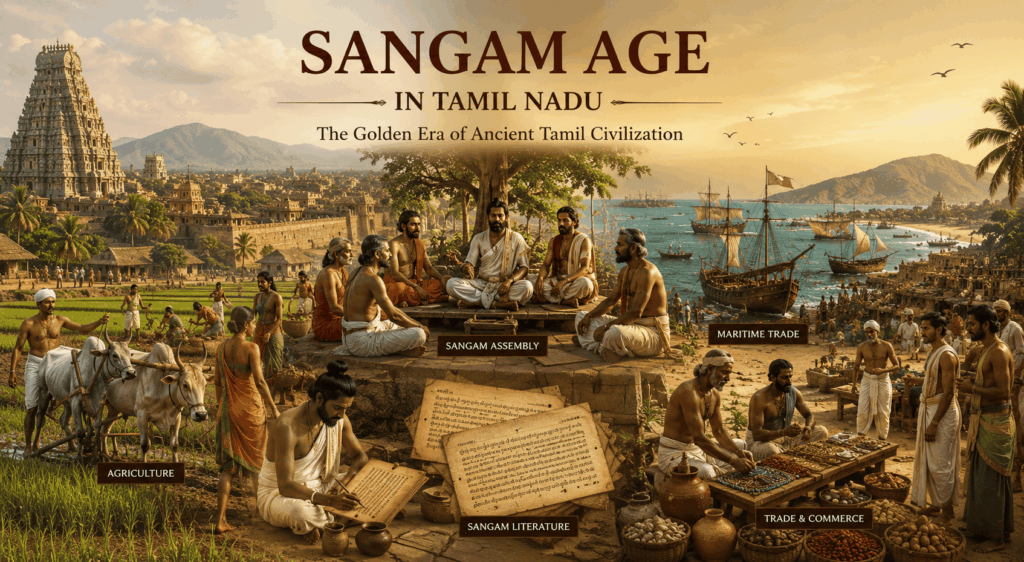
The Sangam Age is regarded as one of the most remarkable periods in the history of Tamil Nadu. Often called the Golden Age of Ancient Tamil Civilization, it witnessed extraordinary developments in literature, trade, governance, agriculture, art, and culture. The period produced some of the oldest surviving works of Tamil literature and laid the foundation for the cultural identity of Tamil society.
From approximately 300 BCE to 300 CE, Tamil Nadu flourished under the rule of the Three Crowned Kingdoms—the Cholas, Pandyas, and Cheras. These powerful dynasties encouraged trade, promoted poets and scholars, strengthened agriculture, and built prosperous cities that attracted merchants from distant lands, including the Roman Empire.
The Sangam Age was not merely a political era; it was a time when literature, ethics, heroism, love, and everyday life were carefully documented by poets. The literary works produced during this period continue to provide historians with valuable insights into ancient Tamil society.
Today, the Sangam Age remains an important subject for students, researchers, competitive exam aspirants, and anyone interested in India’s rich historical heritage. This article explores the origins, society, economy, literature, and lasting legacy of one of the greatest periods in South Indian history.
What Is the Sangam Age?
The word “Sangam” means assembly or gathering. According to Tamil tradition, learned poets, scholars, philosophers, and kings gathered in literary academies known as Sangams to compose, discuss, and preserve Tamil literature.
Although historians continue to debate certain traditional accounts, there is broad agreement that the surviving Sangam literature reflects the social, political, and cultural life of ancient Tamil Nadu between approximately 300 BCE and 300 CE.
The Sangam Age represents the earliest well-documented phase of Tamil history.
The Three Sangams
Tamil tradition speaks of three Sangams.
First Sangam
Believed to have been held in a legendary city that was later submerged by the sea. No literary works from this period have survived.
Second Sangam
Also associated with ancient traditions, but only limited references remain.
Third Sangam
The Third Sangam is considered historically significant because many surviving Tamil literary works belong to this period.
Most of the classical Tamil poems studied today are associated with this literary tradition.
Sources of Information About the Sangam Age
Our understanding of the Sangam Age comes from several important historical sources.
Sangam Literature
The most valuable source is Sangam literature itself.
Collections such as the Ettuthokai (Eight Anthologies) and the Pattuppattu (Ten Idylls) describe:
- Kings
- Society
- Agriculture
- Trade
- Warfare
- Religion
- Family life
- Nature
- Love and heroism
These works provide one of the earliest literary records in any Indian language.
Archaeological Discoveries
Excavations across Tamil Nadu have revealed:
- Pottery
- Roman coins
- Iron tools
- Beads
- Burial sites
- Inscriptions
Sites such as Keeladi, Adichanallur, Kodumanal, and Poompuhar have provided significant evidence of advanced urban settlements and trade during the Sangam period.
Foreign Accounts
Greek and Roman writers described the wealth of southern India.
Ancient texts mention Tamil ports exporting:
- Pepper
- Pearls
- Ivory
- Cotton textiles
- Precious stones
Roman gold coins discovered in Tamil Nadu confirm extensive overseas trade.
Ashoka’s Edicts
The inscriptions of Emperor Ashoka mention the southern kingdoms, including the Cholas, Pandyas, and Cheras, indicating that these kingdoms were already established during the 3rd century BCE.
Political Landscape of the Sangam Age
The Sangam Age was dominated by the Three Crowned Kings of Tamilakam.
The Cholas
The Cholas ruled the fertile Kaveri River basin.
Important centres included:
- Uraiyur
- Kaveripoompattinam (Poompuhar)
They became famous for agriculture, irrigation, and maritime trade.
The Pandyas
The Pandyas ruled from Madurai, one of the oldest continuously inhabited cities in India.
Their kingdom prospered through:
- Pearl fishing
- Agriculture
- Literature
- Overseas trade
Madurai also became an important literary centre.
The Cheras
The Cheras ruled the western regions of present-day Kerala and western Tamil Nadu.
Their wealth came largely from:
- Spice cultivation
- Maritime commerce
- Roman trade
- Pepper exports
The famous port of Muziris connected the Chera Kingdom with international markets.
Society During the Sangam Age
Sangam society was dynamic and well organized.
People earned their livelihoods through:
- Agriculture
- Fishing
- Cattle rearing
- Trade
- Handicrafts
- Metalworking
- Weaving
Communities often lived according to the geographical environment surrounding them.
The Five Landscapes
One of the most unique contributions of Sangam literature is the classification of life according to five natural landscapes, known as Tinai.
Kurinji (Mountains)
Associated with:
- Hill tribes
- Hunting
- Heroic love
Mullai (Forests)
Associated with:
- Cattle herding
- Patience
- Peaceful life
Marutham (Agricultural Plains)
Associated with:
- Farming
- Prosperity
- Village lifeNeithal (Coastal Region)
Associated with:
- Fishing
- Maritime trade
- Sailors
- Ports
Palai (Dry Lands)
Associated with:
- Desert-like regions
- Warriors
- Long journeys
This classification demonstrates the close relationship between geography, economy, literature, and daily life.
Economy of the Sangam Age
The Sangam economy was diverse and prosperous.
Agriculture
Rice remained the principal crop.
Other crops included:
- Sugarcane
- Millets
- Cotton
- Pulses
- Fruits
Advanced irrigation methods increased agricultural productivity.
Trade
Both inland and overseas trade flourished.
Merchants exchanged goods using roads, rivers, and sea routes.
Exports included:
- Pepper
- Pearls
- Ivory
- Cotton cloth
- Sandalwood
- Precious stones
Imports included:
- Gold
- Wine
- Horses
- Glassware
- Luxury goods
Trade generated enormous wealth for the Tamil kingdoms.
Literature: The Greatest Achievement
Perhaps the most enduring contribution of the Sangam Age is its literature.
These poems discuss:
- Love
- War
- Friendship
- Justice
- Nature
- Family
- Ethics
- Governance
Unlike many ancient literary traditions that focus primarily on kings, Sangam literature also portrays ordinary people’s lives with remarkable realism.
This makes it an invaluable historical source.
The Sangam Age represents the foundation of Tamil civilization. It was an era of flourishing literature, prosperous trade, efficient governance, vibrant cities, and rich cultural traditions. The achievements of the Cholas, Pandyas, and Cheras during this period shaped the history of South India and influenced later dynasties for centuries.