
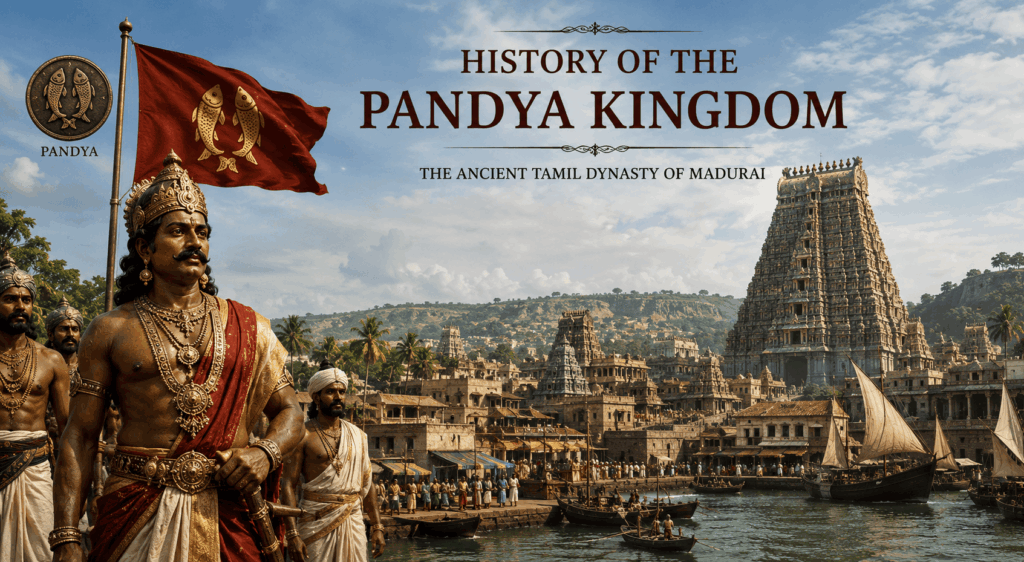
The Pandya Kingdom is one of the oldest and most influential dynasties in Indian history. Along with the Cholas and the Cheras, the Pandyas formed the famous Three Crowned Kings of Tamilakam , ruling large parts of southern India for centuries. Their remarkable achievements in governance, trade, literature, temple architecture, and maritime commerce helped shape the cultural identity of Tamil Nadu and left an enduring mark on Indian civilization.
The Pandya rulers were renowned for their prosperous ports, thriving pearl fisheries, diplomatic relations with foreign kingdoms, and patronage of Tamil literature. Their capital, Madurai became a celebrated centre of learning, religion, and commerce. From the Sangam Age to the medieval period, the Pandyas played a significant role in South India’s political and cultural development.
Although they experienced periods of decline due to conflicts with rival dynasties such as the Cholas and Pallavas, the Pandyas repeatedly regained their strength and eventually built one of the most powerful kingdoms in medieval South India.
This article explores the fascinating history of the Pandya Kingdom—from its ancient origins and rise to power to its cultural achievements and historical significance.
Who Were the Pandyas?
The Pandyas were an ancient Tamil dynasty that ruled primarily from **Madurai**, located in present-day Tamil Nadu. Their kingdom extended across the fertile plains of southern Tamil Nadu and the coastal regions bordering the Gulf of Mannar.
Ancient literary works, inscriptions, and foreign accounts describe the Pandyas as capable rulers who encouraged agriculture, trade, education, and religion. They maintained strong maritime links with Sri Lanka, Southeast Asia, the Roman Empire, and the Middle East.
The Pandya emblem, **the twin fish**, remains one of the most recognizable royal symbols in South Indian history and continues to represent the dynasty’s rich heritage.
Origins of the Pandya Dynasty
The exact origin of the Pandya dynasty is still debated among historians. However, there is broad agreement that the Pandyas are among the oldest continuously mentioned ruling families in the Indian subcontinent.
References to the Pandyas appear in:
Sangam literature
Ancient Tamil poems
Ashoka’s rock edicts (3rd century BCE)
Greek and Roman writings
Sri Lankan chronicles
Archaeological inscriptions
These sources indicate that the Pandyas were already an established kingdom more than two thousand years ago.
Madurai – The Heart of the Pandya Kingdom
Madurai served as the political, economic, and cultural capital of the Pandya Kingdom for centuries.
Located on the banks of the Vaigai River, the city enjoyed several natural advantages:
Fertile agricultural lands
Reliable water resources
Strategic trade routes
Religious importance
Flourishing marketplaces
Madurai became famous not only for governance but also as the centre of the **Tamil Sangam**, where poets, scholars, and philosophers gathered to develop classical Tamil literature.
Its reputation as a city of temples, learning, and commerce attracted merchants and travellers from across India and overseas.
The Sangam Age and the Pandyas
The Sangam Age (approximately 300 BCE–300 CE) represents one of the golden periods of Tamil history.
During this era, the Pandya rulers actively supported poets and scholars. Hundreds of literary works composed during this period provide valuable insights into:
Society
Agriculture
Warfare
Trade
Religion
Daily life
Governance
The Sangam poems portray Pandya kings as brave warriors, generous patrons of learning, and protectors of their people.
Because of this literary heritage, historians possess a richer understanding of the Pandyas than many other early Indian dynasties.
Economy of the Early Pandya Kingdom
The prosperity of the Pandya Kingdom rested on multiple economic activities.
Agriculture
The fertile plains surrounding the Vaigai River produced:
Rice
Sugarcane
Cotton
Millets
Pulses
Irrigation tanks and canals ensured stable agricultural production even during periods of low rainfall.
Pearl Fishing
One of the greatest sources of Pandya wealth came from the pearl fisheries of the **Gulf of Mannar**.
For centuries, divers harvested natural pearls that were exported to distant markets, including Rome, Arabia, and Southeast Asia.
Pandya pearls became famous for their exceptional quality and generated significant revenue for the kingdom.
Maritime Trade
The Pandyas controlled several important ports that connected India with international trade networks.
Exports included:
Pearls
Spices
Cotton textiles
Precious stones
Ivory
Sandalwood
Imports included:
Gold coins
Fine wine
Glassware
Horses
Luxury goods
Trade brought prosperity to the kingdom and strengthened diplomatic ties with foreign powers.
Foreign References to the Pandyas
The fame of the Pandya Kingdom spread far beyond India.
Greek and Roman writers described the wealth of southern India, especially its pearls and thriving ports.
Roman gold coins discovered in Tamil Nadu provide strong archaeological evidence of active trade between the Pandya Kingdom and the Roman Empire.
Similarly, Sri Lankan chronicles mention diplomatic and military interactions between the Pandyas and the rulers of Sri Lanka, highlighting the kingdom’s regional influence.
Religion and Society
The Pandya rulers primarily supported Hinduism, particularly the worship of Lord Shiva and Goddess Meenakshi. However, they also extended patronage to Jainism and Buddhism at different times.
Temples served as more than places of worship. They functioned as centres for:
Education
Music
Dance
Literature
Charity
Local administration
Society was largely agrarian, but merchants, artisans, scholars, and seafaring communities also played an important role in the kingdom’s prosperity.
Women contributed to religious life, literature, and charitable activities, and inscriptions record donations made by queens and noblewomen.
Rise of the Medieval Pandyas
Although the Pandya Kingdom experienced periods of decline due to conflicts with neighbouring powers, it revived strongly during the medieval period.
Capable rulers reorganized the administration, expanded the army, strengthened trade, and reclaimed territories that had previously been lost.
This revival transformed the Pandyas into one of the strongest kingdoms in South India, setting the stage for a period of remarkable political and cultural achievement.