
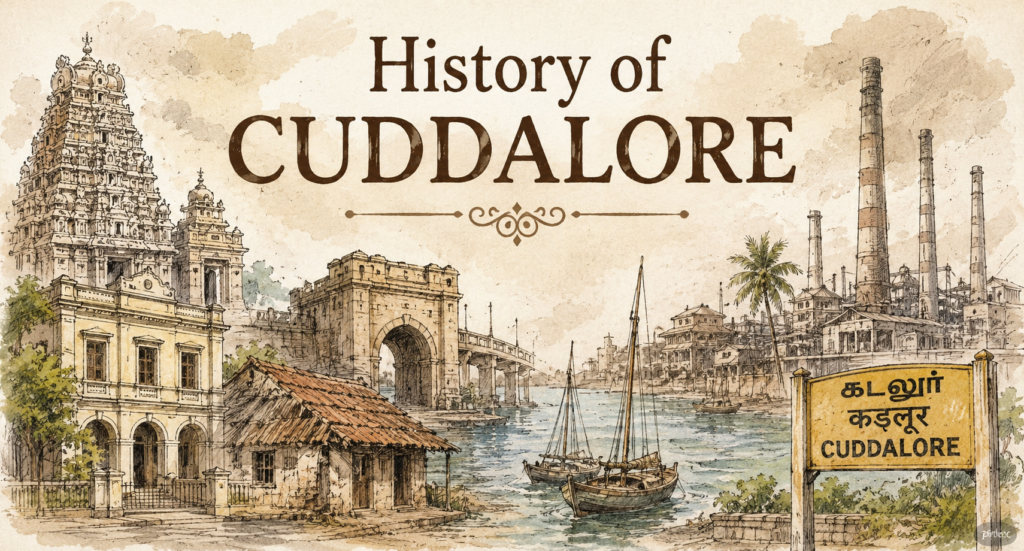
Cuddalore, located along the southeastern coast of Tamil Nadu on the Bay of Bengal, is one of South India’s oldest coastal settlements. While many international travelers recognize nearby destinations such as Chennai, Puducherry (Pondicherry), and Mahabalipuram, Cuddalore possesses a remarkable history that spans more than two thousand years. It has served as an ancient port, a thriving commercial center, a battlefield for European colonial powers, and an important contributor to Tamil Nadu’s cultural and economic development.
For readers in the United States and around the world, Cuddalore offers a fascinating example of how geography can shape history. Positioned where several rivers meet the sea, the city became an important gateway for maritime trade connecting South India with Southeast Asia, the Middle East, and Europe. Over the centuries, Cuddalore came under the influence of the Early Cholas, Pallavas, Later Cholas, Pandyas, Vijayanagara Empire, Carnatic Nawabs, the British East India Company, and the French, each leaving a lasting mark on the region’s architecture, administration, and culture.
Today, Cuddalore is known for its industries, educational institutions, agriculture, fisheries, and beautiful coastline. Yet beneath its modern identity lies a story of ancient kingdoms, maritime commerce, colonial rivalry, and remarkable resilience.
This article explores the early history of Cuddalore, tracing its journey from prehistoric settlements to one of the most strategically important ports on India’s Coromandel Coast.
Where is Cuddalore?
Cuddalore is situated approximately 180 kilometres south of Chennai and about 25 kilometres south of Puducherry, on the eastern coast of Tamil Nadu.
The city lies where several important rivers—including the Gadilam (Kedilam), Pennaiyar (South Pennar), and Paravanar—flow into the Bay of Bengal.
Its coastal location made Cuddalore a natural centre for:
- Maritime trade
- Fishing
- Agriculture
- Ship movement
- Cultural exchange
The city continues to be an important gateway connecting inland Tamil Nadu with the eastern coastline.
Origin of the Name “Cuddalore”
The name Cuddalore is generally believed to have evolved from the Tamil expression “Koodalur,” meaning “the place where rivers meet.”
This name accurately reflects the geography of the region, where multiple rivers converge before entering the Bay of Bengal.
European traders later adapted the pronunciation to “Cuddalore,” which eventually became the official English name during the colonial period.
Ancient Human Settlement
Archaeological evidence indicates that people have lived in the Cuddalore region for thousands of years.
Excavations across the district have revealed:
- Megalithic burial sites
- Iron Age tools
- Ancient pottery
- Stone implements
- Early farming settlements
These discoveries suggest that communities settled here because of:
- Fertile river plains
- Coastal fishing opportunities
- Freshwater availability
- Easy access to maritime trade routes
The combination of rivers and the sea created favorable conditions for permanent habitation long before written records.
Early Tamil Kingdoms
During ancient times, the region around Cuddalore formed part of the territories governed by several major Tamil dynasties.
Among them were:
- Early Cholas
- Pallavas
- Later Cholas
- Pandyas
Its coastal location made the area particularly valuable for rulers seeking to expand trade and naval power.
Unlike inland settlements that relied primarily on agriculture, Cuddalore developed through a combination of farming, fishing, and overseas commerce.
Cuddalore During the Sangam Age
The Sangam Age (approximately 300 BCE–300 CE) marks one of the earliest recorded periods of Tamil civilization.
During this era, the eastern coast of Tamil Nadu became an active participant in international trade.
Although nearby ports such as Kaveripoompattinam (Poompuhar) gained greater literary prominence, settlements around present-day Cuddalore also benefited from expanding maritime commerce.
Merchants traded goods including:
- Pepper
- Rice
- Cotton textiles
- Pearls
- Spices
- Precious stones
- Forest products
Roman coins and imported ceramics discovered throughout Tamil Nadu demonstrate the region’s participation in long-distance trade with the Mediterranean world.
The Chola Empire and Maritime Prosperity
One of the most significant chapters in Cuddalore’s history began under the Chola Empire.
Between the 9th and 13th centuries, the Cholas transformed South India into one of Asia’s leading maritime powers.
Their achievements included:
- Strong naval forces
- Overseas trade
- Efficient administration
- Temple construction
- Irrigation development
The Coromandel Coast, including Cuddalore, became an important link in the Chola trading network.
Ships sailed from Tamil ports to:
- Sri Lanka
- Southeast Asia
- China
- Arabia
This trade brought prosperity to coastal communities throughout the region.
Agriculture Along the River Plains
Although Cuddalore is primarily known as a coastal city, agriculture has always been an important part of its economy.
The fertile river basins supported cultivation of:
- Rice
- Sugarcane
- Groundnuts
- Coconut
- Pulses
- Cashew
The combination of river irrigation and seasonal monsoon rains enabled farming communities to flourish.
Agricultural products supplied both inland markets and coastal traders.
Pallava Influence
Before the rise of the Cholas, the Pallava Dynasty exercised considerable influence over northern Tamil Nadu.
Their capital at Kanchipuram became one of South India’s greatest centres of learning and religion.
The Pallavas contributed to regional development by:
- Expanding agriculture
- Encouraging trade
- Supporting temple architecture
- Improving administration
The coastal settlements of Cuddalore benefited from the relative political stability established during this period.
Religious and Cultural Development
Over many centuries, Cuddalore became home to diverse religious traditions.
The region contains numerous temples dedicated to:
- Lord Shiva
- Lord Vishnu
- Murugan
- Village deities
Later, Islamic traders established communities along the coast, followed by Christian missionaries during the European colonial period.
This cultural diversity remains one of Cuddalore’s defining characteristics today.
Vijayanagara Empire
Following the decline of the Cholas and Pandyas, Cuddalore came under the control of the Vijayanagara Empire during the 14th century.
The empire strengthened administration throughout South India by appointing regional governors known as Nayaks.
Under Vijayanagara rule:
- Agriculture expanded.
- Coastal trade continued.
- Temples received royal patronage.
- Roads and commercial routes improved.
These developments helped maintain Cuddalore’s importance as a regional trading centre.
Arrival of European Traders
The 16th century marked the beginning of a new era in Cuddalore’s history.
European maritime powers arrived on India’s eastern coast seeking control of the lucrative spice and textile trade.
Among them were:
- Portuguese
- Dutch
- French
- British
Cuddalore’s excellent coastal location quickly attracted European commercial interests.
Trading factories, warehouses, and fortified settlements gradually appeared along the Coromandel Coast.
Fort St. David
One of Cuddalore’s most important historical landmarks is Fort St. David.
Originally acquired by the British East India Company in the late 17th century, the fort became one of Britain’s strongest military and commercial bases on India’s eastern coast.
Before the rise of Madras (Chennai) as Britain’s dominant regional centre, Fort St. David served as an important administrative headquarters.
The fort witnessed numerous military conflicts between the British and French during the Carnatic Wars, making Cuddalore one of South India’s most contested colonial cities.
Anglo-French Rivalry
During the 18th century, Britain and France competed intensely for influence in India.
Because of its strategic coastal location, Cuddalore became a major battleground.
Several military campaigns took place in and around the city, including sieges and naval engagements.
Control of Cuddalore changed hands multiple times before Britain eventually established lasting authority.
These conflicts played a significant role in determining the future political landscape of South India.
Legacy of Ancient and Medieval Cuddalore
By the close of the medieval period, Cuddalore had established itself as:
- A thriving coastal settlement
- An important trading centre
- A strategic military location
- A meeting point of multiple cultures
- A prosperous agricultural region
- A gateway for maritime commerce
These foundations prepared the city for its later development under British administration and modern India.