
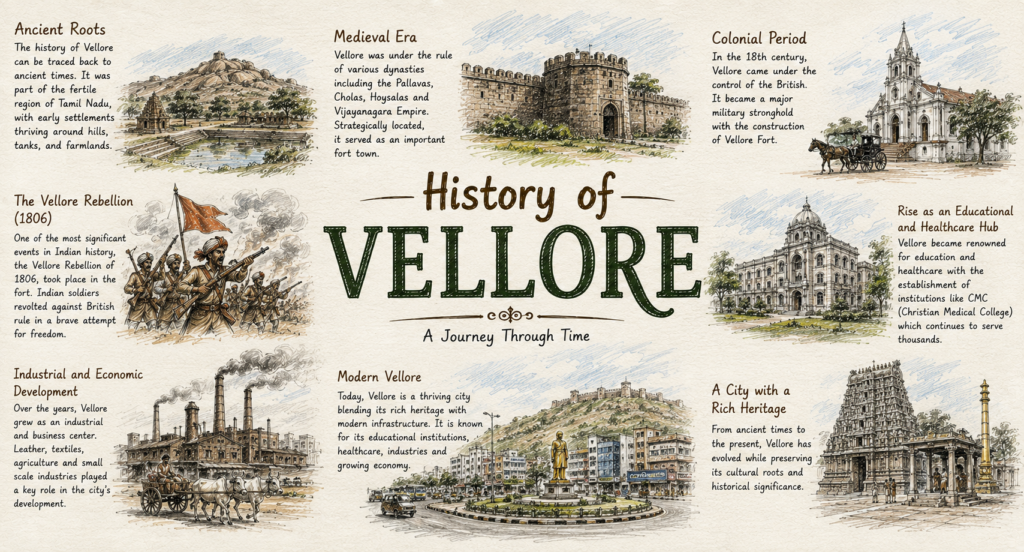
Vellore is one of the most historically significant cities in the Indian state of Tamil Nadu. Known around the world for its magnificent Vellore Fort, prestigious educational institutions such as Christian Medical College (CMC) and VIT University, and its role in India’s struggle against British rule, Vellore has a history spanning over a thousand years.
Located on the banks of the Palar River, Vellore has served as a military stronghold, royal capital, commercial centre, and cultural crossroads for numerous South Indian kingdoms. From the powerful Pallavas, Cholas, and Vijayanagara Empire to the Marathas, Mughals, Carnatic Nawabs, and the British East India Company, each ruling power left a lasting mark on the city’s architecture, traditions, and identity.
For readers in the United States and around the world, Vellore offers a fascinating glimpse into South India’s political history and architectural brilliance. While cities like Delhi, Agra, and Jaipur often dominate discussions about Indian history, Vellore played an equally important role in shaping southern India’s political landscape and even witnessed one of the earliest organized military uprisings against British colonial rule—the famous Vellore Mutiny of 1806.
Today, Vellore successfully blends its rich historical heritage with modern education, healthcare, manufacturing, and tourism, making it one of Tamil Nadu’s most dynamic cities.
Where is Vellore?
Vellore is situated in northern Tamil Nadu, approximately 140 kilometers west of Chennai, along the Chennai–Bengaluru highway.
Its strategic location has made it an important gateway between:
- Tamil Nadu
- Karnataka
- Andhra Pradesh
The city lies near the Palar River, which historically supported agriculture and settlements throughout the region.
Today, Vellore serves as a major transportation, educational, healthcare, and industrial hub.
Origin of the Name “Vellore”
Several theories explain the origin of the name Vellore.
One traditional explanation suggests that the area was once surrounded by dense forests filled with the Vellerukku plant (Calotropis gigantea), giving rise to the name “Vellore.”
Another theory associates the name with the Tamil word “Vel,” meaning spear, symbolizing military strength and defense.
Although historians continue to debate its precise origin, both interpretations reflect the city’s close association with nature and warfare.
Ancient Human Settlement
The region surrounding Vellore has been inhabited since prehistoric times.
Archaeological evidence from northern Tamil Nadu reveals:
- Megalithic burial sites
- Iron Age artifacts
- Ancient pottery
- Stone tools
- Early agricultural settlements
These discoveries indicate that organized communities flourished here long before recorded history.
The fertile plains surrounding the Palar River supported farming, cattle rearing, and trade.
Vellore During the Pallava Period
Between the 4th and 9th centuries CE, the Pallava Dynasty dominated much of northern Tamil Nadu.
Their capital at Kanchipuram, located not far from present-day Vellore, transformed the surrounding region into an important political, religious, and cultural centre.
During Pallava rule:
- Agriculture expanded through improved irrigation.
- Temple construction flourished.
- Tamil and Sanskrit scholarship advanced.
- Trade routes became more organized.
Although Vellore itself had not yet become a major fortified city, the region benefited greatly from Pallava stability and economic growth.
Chola Rule and Agricultural Prosperity
During the 9th to 13th centuries, the powerful Chola Empire incorporated the Vellore region into its expanding kingdom.
The Cholas introduced:
- Efficient local administration
- Irrigation improvements
- Temple-centered communities
- Village self-governance
- Agricultural reforms
Farmers cultivated:
- Rice
- Millets
- Sugarcane
- Pulses
- Oilseeds
Agricultural prosperity encouraged population growth and increased regional trade.
The Rise of the Vijayanagara Empire
One of the most important turning points in Vellore’s history came with the rise of the Vijayanagara Empire during the 14th century.
The empire sought to strengthen South India’s defenses against repeated invasions and established strong military centres across the region.
Because of its strategic location, Vellore became one of the empire’s most important defensive positions.
Construction of the Famous Vellore For
The greatest symbol of Vellore’s history is undoubtedly the Vellore Fort, built during the 16th century by Chinna Bommi Nayaka and Thimma Reddy Nayaka, regional chieftains serving under the Vijayanagara Empire.
The fort is widely regarded as one of India’s finest examples of military architecture.
Its remarkable features include:
- Massive granite walls
- A broad water-filled moat
- Double defensive structures
- Watchtowers
- Secret passages
- Strong bastions
Unlike many medieval forts, Vellore Fort remains exceptionally well preserved.
Military historians continue to admire its engineering because it successfully resisted numerous attacks for centuries.
Jalakandeswarar Temple
Located within Vellore Fort is the magnificent Jalakandeswarar Temple, dedicated to Lord Shiva.
Constructed in the Dravidian architectural style, the temple is famous for:
- Intricately carved stone pillars
- Decorative sculptures
- Elegant gopuram (gateway tower)
- Rich religious traditions
The temple represents one of the finest surviving examples of Vijayanagara architecture in Tamil Nadu.
StratTagsegic Military Importance
Vellore’s geographical position made it one of South India’s most valuable military centres.
The fort controlled important routes connecting:
- Chennai (Madras)
- Bengaluru
- Andhra Pradesh
- Interior Tamil Nadu
Because of this strategic advantage, nearly every major South Indian power sought control of the city.
Maratha Rule
During the late 17th century, the Marathas briefly captured Vellore.
Their occupation formed part of broader struggles for control over southern India.
Although relatively short-lived, Maratha administration contributed to the city’s political history before Mughal expansion into the region.
Mughal Administration
In the late 17th century, Mughal forces under Zulfiqar Khan captured Vellore.
The city became part of the Mughal Empire’s southern territories.
Under Mughal influence:
- Administrative reforms were introduced.
- Revenue collection became more organized.
- Military garrisons were strengthened.
However, Mughal control gradually weakened as regional powers gained independence.
Carnatic Nawabs
Following Mughal decline, Vellore came under the authority of the Carnatic Nawabs, who governed much of southeastern India.
The nearby city of Arcot became the capital of the Carnatic.
Vellore continued serving as an important military and administrative centre during this period.
Trade expanded, and the city’s strategic value remained high because of ongoing regional conflicts.
British East India Company
During the late 18th century, the British East India Company gradually gained control over Vellore following the Carnatic Wars and the decline of regional kingdoms.
The British recognized the fort’s military significance and converted it into a major garrison.
Several members of Tipu Sultan’s family were imprisoned inside Vellore Fort after his defeat in 1799.
This decision would later contribute to one of the most significant events in Indian colonial history.
The Vellore Mutiny of 1806
One of the most important chapters in Indian history occurred on 10 July 1806.
Known as the Vellore Mutiny, Indian soldiers serving under the British East India Company rebelled against colonial authority.
The uprising was triggered by several grievances, including new military dress regulations that many soldiers believed interfered with their religious traditions.
The mutiny resulted in:
- The temporary capture of the fort by Indian soldiers
- Heavy casualties
- A swift British military response
- Significant changes in British military policies
Although the revolt was suppressed within hours, many historians consider it the first major armed rebellion by Indian soldiers against British rule, occurring more than fifty years before the Revolt of 1857.
The Vellore Mutiny occupies an honored place in India’s freedom movement and is remembered as a symbol of resistance against colonial rule.