
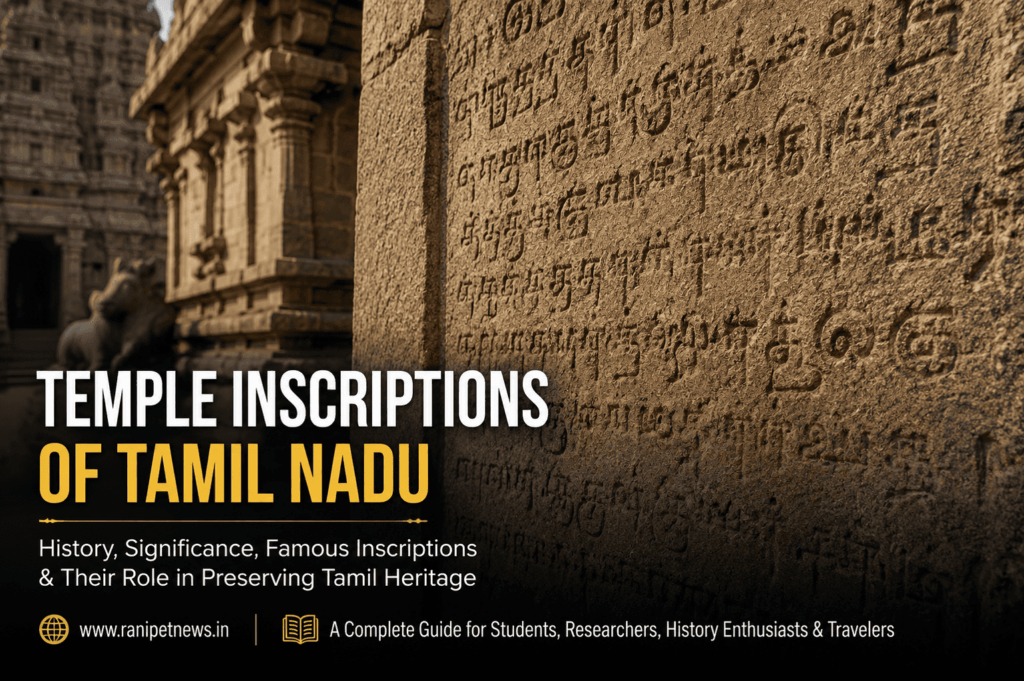
Tamil Nadu is often called the **”Land of Temples,”** and for good reason. The state is home to thousands of ancient temples built over nearly two millennia by powerful dynasties such as the Pallavas, Cholas, Pandyas, Vijayanagara rulers, and Nayaks. While their towering gopurams, intricate sculptures, and sacred traditions attract millions of devotees and tourists every year, another treasure often goes unnoticed—the temple inscriptions carved on stone walls, pillars, sanctums, and mandapas.
These inscriptions are much more than decorative carvings. They are authentic historical records that preserve details about kings, queens, village administration, land donations, taxation, irrigation systems, festivals, education, trade, and everyday life. Unlike myths or oral traditions, these stone records provide direct evidence of historical events, making them invaluable to historians, archaeologists, researchers, and competitive exam aspirants.
Today, Tamil Nadu has one of the largest collections of stone inscriptions in India. Thousands have been documented by the Archaeological Survey of India (ASI) and the Tamil Nadu State Department of Archaeology, while many more remain preserved within temple complexes.
Whether you are a history enthusiast, a student preparing for UPSC or TNPSC, a tourist exploring Tamil Nadu’s heritage, or simply curious about India’s past, understanding temple inscriptions opens a fascinating window into the state’s rich cultural legacy.
What Are Temple Inscriptions?
Temple inscriptions are texts engraved on stone surfaces within temple premises. Ancient rulers and local communities used these inscriptions to permanently record important information.
Unlike manuscripts written on palm leaves, stone inscriptions were durable and could survive for centuries. Many inscriptions carved over 1,000 years ago remain readable today.
Most inscriptions were written in:
Tamil
Grantha script
Sanskrit
Tamil-Brahmi (in early periods)
Vatteluttu
These inscriptions serve as official records, documenting everything from royal victories to temple management and charitable donations.
Why Are Temple Inscriptions Important?
Temple inscriptions are considered one of the most reliable sources for reconstructing South Indian history. They provide information that is often unavailable in literary works.
Some of the key historical insights they offer include:
Names and titles of kings
Dates of important events
Temple construction and renovations
Donations of land, gold, livestock, and jewels
Tax collection systems
Village administration
Irrigation and water management
Religious practices and festivals
Social customs and occupations
Trade guilds and merchant activities
Because they were carved in stone, inscriptions were difficult to alter, making them trustworthy historical evidence.
Evolution of Temple Inscriptions in Tamil Nadu
Sangam Period
Although the Sangam Age is known mainly through literature, a few early Tamil-Brahmi inscriptions found in caves provide valuable evidence about ancient society and religion.
These inscriptions are generally brief and mention donors, monks, or local chieftains.
Pallava Period (6th–9th Century CE)
The Pallavas expanded the use of temple inscriptions significantly.
Their inscriptions recorded:
Temple construction
Land grants
Royal genealogy
Religious endowments
Administrative orders
Temples at Kanchipuram and Mahabalipuram contain several important Pallava inscriptions.
Chola Period (9th–13th Century CE)
The Chola Empire produced the largest number of temple inscriptions in Tamil Nadu.
Chola inscriptions are highly detailed and often describe:
Village assemblies (Sabha and Ur)
Agricultural taxes
Irrigation tanks
Temple finances
Salaries of temple staff
Educational institutions
Dance and music traditions
Land measurements
Many historians consider the Chola inscriptions among the finest administrative records in medieval India.
Pandya Period
Pandya inscriptions continue the tradition of documenting royal grants, temple maintenance, and local governance.
They also reveal information about maritime trade and pearl fisheries.
Vijayanagara and Nayak Periods
Later rulers documented:
Temple renovations
Construction of mandapas
Festival arrangements
Donations from merchants
Expansion of temple complexes
Languages and Scripts Used
Tamil Nadu’s inscriptions reflect the linguistic diversity of different historical periods.
Tamil
The majority of inscriptions are written in Tamil, especially during the Chola and later periods.
Grantha
Grantha script was commonly used for writing Sanskrit words and royal titles.
Sanskrit
Royal praises and religious verses were often composed in Sanskrit.
Tamil-Brahmi
Among the oldest scripts used in Tamil Nadu, dating back over 2,000 years.
Vatteluttu
Widely used in southern Tamil Nadu before the dominance of the modern Tamil script.
Famous Temple Inscriptions in Tamil Nadu
Brihadisvara Temple, Thanjavur
Built by Rajaraja Chola I, this UNESCO World Heritage monument contains hundreds of inscriptions.
These records mention:
Temple administration
Donations of gold and land
Names of dancers attached to the temple
Salaries of musicians
Temple servants
Agricultural income
The inscriptions provide a remarkably detailed picture of the Chola administrative system.
Kailasanatha Temple, Kanchipuram
One of the finest Pallava temples, it preserves inscriptions relating to King Narasimhavarman II (Rajasimha).
These inscriptions help historians understand early Dravidian temple architecture and Pallava genealogy.
Airavatesvara Temple, Darasuram
Built during the later Chola period, its inscriptions describe temple rituals, donations, and administrative practices.
Meenakshi Amman Temple, Madurai
Although rebuilt and expanded over centuries, the temple contains inscriptions from Pandya, Vijayanagara, and Nayak rulers.
These records reveal information about festivals, endowments, and renovations.
Srirangam Ranganathaswamy Temple
One of India’s largest temple complexes, Srirangam preserves inscriptions spanning several dynasties.
They document:
Land grants
Temple festivals
Tax exemptions
Religious services
Administrative arrangements
What Do Temple Inscriptions Tell Us?
Political History
They mention kings, royal titles, military victories, and succession, helping historians establish accurate timelines.
Economic Life
Inscriptions record:
Land taxes
Agricultural income
Trade activities
Merchant guilds
Donations
Temple finances
This shows temples were important economic institutions.
Social Structure
Stone records mention:
Farmers
Priests
Merchants
Artisans
Dancers
Musicians
Teachers
Accountants
They demonstrate how diverse groups contributed to temple life.
Education
Some inscriptions refer to schools attached to temples where subjects such as the Vedas, grammar, philosophy, and mathematics were taught.
Water Management
Many inscriptions describe the construction and maintenance of tanks, canals, wells, and irrigation systems, highlighting the importance of water conservation in ancient Tamil society.
Temples as Centers of Administration
Ancient temples were not merely places of worship. They functioned as community centers where:
Land transactions were recorded.
Taxes were collected.
Public meetings were held.
Village assemblies made decisions.
Charity was organized.
Education was supported.
Temple inscriptions preserve these activities with remarkable detail.
The Art of Epigraphy
The study of inscriptions is known as **epigraphy**.
Epigraphists carefully:
Locate inscriptions.
Clean stone surfaces without causing damage.
Read ancient scripts.
Translate the text.
Compare historical records.
Publish findings for researchers.
This field combines history, archaeology, linguistics, and art history.
Preservation Challenges
Despite their importance, many inscriptions face threats from:
Weathering
Pollution
Urban development
Poor restoration practices
Moss and vegetation growth
Human vandalism
Conservation efforts by government agencies and heritage organizations are essential to protect these irreplaceable records.
Importance for Tourists
Visitors to Tamil Nadu’s temples can gain a deeper appreciation of history by paying attention to inscriptions.
Many temples now feature information boards or guided tours explaining notable inscriptions, allowing tourists to connect architecture with the stories of the people who built and maintained these sacred spaces.