
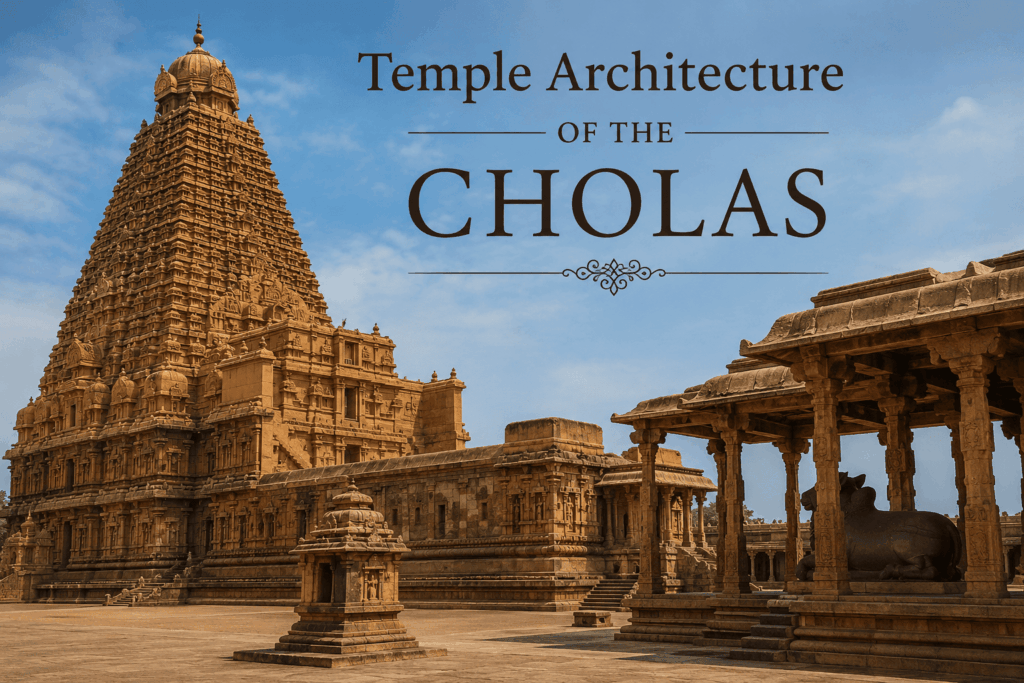
The Chola dynasty occupies a unique place in Indian history for its extraordinary contributions to art, architecture, administration, literature, maritime trade, and religion. Among its many achievements, **Chola temple architecture** stands as one of the greatest architectural traditions in the world. Even after nearly a thousand years, Chola temples continue to inspire historians, architects, engineers, artists, pilgrims, and travelers with their scale, precision, and artistic brilliance.
The temples built during the Chola period were not merely religious structures. They were vibrant centers of education, culture, administration, music, dance, and economic activity. Every temple reflected the empire’s prosperity, engineering excellence, and deep spiritual beliefs.
From the majestic Brihadeeswarar Temple in Thanjavur to the elegant Airavatesvara Temple in Darasuram, Chola architecture represents the finest expression of the Dravidian style. These monuments continue to function as active places of worship while serving as priceless historical records of medieval South India.
In this article, we explore the history, evolution, architectural features, engineering achievements, and enduring legacy of Chola temple architecture.
The Rise of the Chola Empire
The Cholas were one of the longest-ruling dynasties in South India. Although their origins can be traced to the Sangam Age, the imperial Cholas rose to prominence during the 9th century CE under Vijayalaya Chola, who established Thanjavur as the capital.
Over the next four centuries, powerful rulers such as Aditya I, Parantaka IRajaraja Chola I and Rajendra Chola expanded the empire across much of South India, Sri Lanka, and Southeast Asia.
The Chola Empire became renowned for:
Strong administration
Naval supremacy
International maritime trade
Agricultural prosperity
Tamil literature
Bronze sculpture
Temple construction
Temple building became one of the defining characteristics of Chola rule.
Evolution of Chola Temple Architecture
The Cholas inherited architectural traditions from earlier dynasties, especially the Pallavas. While the Pallavas pioneered structural stone temples, the Cholas refined and expanded these ideas on a monumental scale.
Early Chola temples were relatively modest in size, but over time they evolved into grand temple complexes featuring towering vimanas, expansive courtyards, elaborate mandapas, and intricate sculptures.
This evolution can be divided into three broad phases:
Early Chola Period (9th–10th Century)
Smaller stone temples
Simple vimanas
Limited ornamentation
Strong Pallava influence
Imperial Chola Period (10th–11th Century)
Monumental temples
Massive granite construction
Advanced engineering
Rich sculptures
Detailed inscriptions
Later Chola Period (12th–13th Century)
Greater decorative detail
More elaborate carvings
Elegant proportions
Sophisticated mandapas
Refined artistic style
What Makes Chola Temple Architecture Unique?
Several characteristics distinguish Chola temples from earlier and later architectural traditions.
Monumental Scale
Chola rulers built temples that symbolized royal power and divine authority. These temples were larger and more ambitious than anything previously constructed in South India.
Their towering vimanas dominated the landscape and became visible from great distances.—
Granite Construction
Unlike many earlier temples built with sandstone or brick, Chola temples extensively used granite.
Granite is among the hardest stones to quarry and carve, making the precision achieved by Chola artisans particularly remarkable.
The durability of granite explains why many Chola temples remain in excellent condition today.
Towering Vimana
One of the defining features of Chola architecture is the impressive **vimana**, the pyramidal tower rising directly above the sanctum.
Unlike later South Indian temples, where entrance gopurams became taller than the central shrine, Chola temples emphasized the vimana as the focal point of the complex.
Symmetrical Planning
Chola architects followed strict geometric principles.
Temple layouts exhibit:
Perfect symmetry
Balanced proportions
Axial alignment
Harmonious spatial planning
These principles contributed to both structural stability and aesthetic beauty.
Intricate Sculptures
Every surface of a Chola temple served as a canvas for artistic expression.
Visitors encounter sculptures depicting:
Shiva in various forms
Vishnu avatars
Goddess Durga
Ganesha
Murugan
Celestial dancers
Mythological creatures
Episodes from the Ramayana
Scenes from the Mahabharata
These carvings transformed temple walls into visual scriptures.
The Engineering Genius of Chola Builders
Modern engineers continue to admire the technical sophistication of Chola temples.
Builders successfully solved complex challenges involving:
Heavy stone transportation
Load distribution
Foundation stability
Structural balance
Earthquake resistance
Rainwater drainage
Without modern machinery, cranes, or computers, thousands of skilled workers completed some of India’s greatest architectural masterpieces.
Brihadeeswarar Temple, Thanjavur
The finest example of Chola architecture is the **Brihadeeswarar Temple**, built by **Rajaraja Chola I** around 1010 CE.
Dedicated to Lord Shiva, this UNESCO World Heritage monument represents the pinnacle of Chola engineering and artistic achievement.
Architectural Highlights
Towering Vimana
The temple’s vimana rises approximately **66 meters (216 feet)** above the sanctum.
For over a thousand years, it has remained one of the tallest masonry temple towers in the world.
Monolithic Capstone
The crowning feature is a massive granite block weighing nearly **80 tons**.
Historians believe it was raised to the summit using a long earthen ramp extending several kilometers.
This remains one of medieval India’s greatest en
Facing the sanctum is a colossal Nandi carved from a single block of granite.
Its polished finish reflects the extraordinary craftsmanship of Chola sculptors.
Massive Courtyard
Unlike many crowded temple complexes, Brihadeeswarar features an expansive open courtyard that emphasizes the grandeur of the central shrine.
Gangaikonda Cholapuram Temple
After conquering territories up to the Ganges River Rajendra Chola I established a new capital called Gangaikonda Cholapuram
To commemorate his victories, he built another magnificent Shiva temple.
Architectural Refinement
Although inspired by Brihadeeswarar, this temple introduces several innovations.
Compared to Thanjavur, it features:
Softer architectural lines
Graceful proportions
More detailed sculptures
Elegant tower profile
Many art historians regard it as the most aesthetically refined Chola temple.
Rich Sculptural Program
Visitors can admire exquisitely carved images of:
Shiva
Vishnu
Durga
Saraswati
Ganesha
Chandikeswara
Nataraja
The sculptural quality demonstrates the maturity of Chola craftsmanship.
Airavatesvara Temple, Darasuram
Built during the reign of **Rajaraja Chola II**, the Airavatesvara Temple represents the artistic peak of later Chola architecture.
Although smaller than the previous two monuments, it is celebrated for its extraordinary decorative richness.
Chariot-Shaped Mandapa
The temple’s front hall resembles a ceremonial stone chariot complete with carved wheels.
This imaginative design remains one of the finest achievements of medieval Indian architecture.
Musical Steps
One of the temple’s unique features is a staircase believed to produce different musical notes when gently struck.
This remarkable innovation reflects the advanced scientific understanding of Chola artisans.
Miniature Sculptures
Almost every inch of the temple contains delicate carvings depicting:
Gods and goddesses
Dancers
Musicians
Animals
Floral motifs
Mythological scenes
The precision of these carvings continues to astonish visitors.
Temple Inscriptions: Stone Records of History
One of the greatest contributions of Chola temples lies in their inscriptions.
Thousands of Tamil inscriptions carved into temple walls document:
Royal grants
Tax systems
Agricultural administration
Temple finances
Festivals
Donations
Employment records
Music and dance traditions
Educational activities
These inscriptions provide historians with invaluable information about medieval South Indian society.
Temples as Centers of Society
Chola temples were far more than religious institutions.
They functioned as:
Universities
Hospitals
Libraries
Art schools
Music academies
Dance centers
Employment hubs
Land administration offices
Entire communities depended upon temples for economic and social stability.
Influence Beyond India
The influence of Chola architecture extended beyond the Indian subcontinent.
Through maritime trade and naval expeditions, the Cholas established cultural connections with:
Sri Lanka
Indonesia
Malaysia
Thailand
Cambodia
Architectural ideas, artistic styles, and religious traditions spread throughout Southeast Asia, leaving a lasting cultural legacy.