
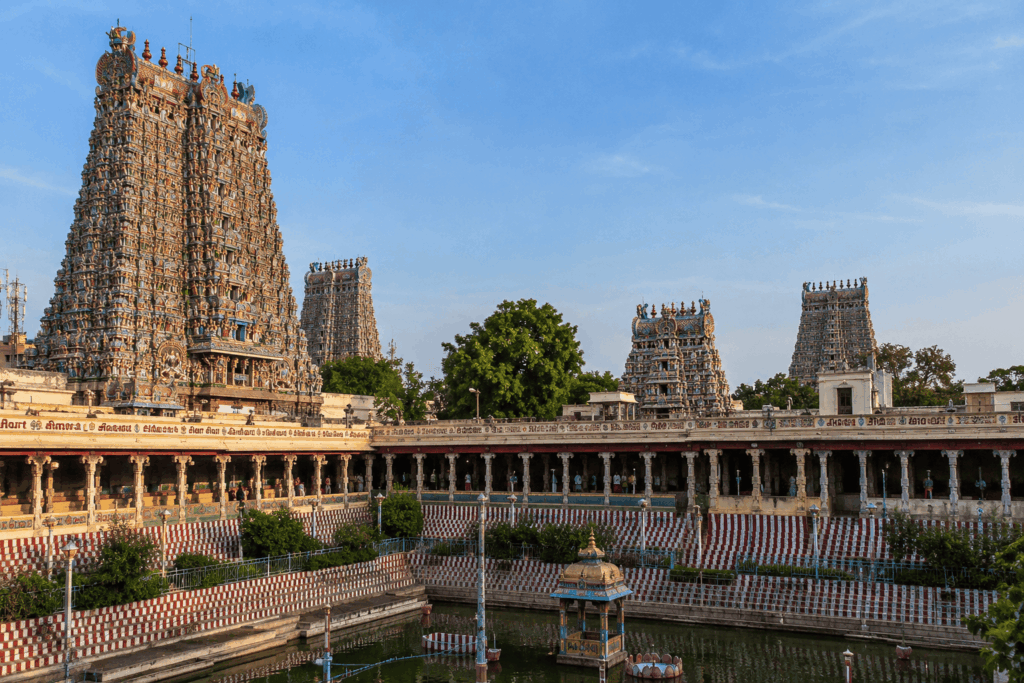
The Meenakshi Amman Temple in Madurai is one of India’s most celebrated temples and a remarkable symbol of Tamil culture, spirituality, and architectural excellence. Dedicated to Goddess Meenakshi, an incarnation of Goddess Parvati, and her divine consort Lord Sundareswarar (Lord Shiva), this temple has stood as a beacon of faith for centuries. Every year, millions of devotees and tourists from across India and around the world visit this magnificent temple to seek blessings and admire its breathtaking architecture.
Located in the heart of Madurai, one of the oldest continuously inhabited cities in the world, the temple is much more than a place of worship. It is a living monument that reflects the rich history of Tamil Nadu, the glory of the Pandya and Nayak dynasties, and the artistic brilliance of South Indian temple architecture.
Known for its towering gopurams, thousands of colorful sculptures, intricate carvings, sacred ponds, and grand festivals, the Meenakshi Amman Temple continues to inspire historians, architects, researchers, students, and pilgrims alike.
This article explores the fascinating history of Meenakshi Amman Temple, from its legendary origins and historical development to its architectural wonders and cultural significance.
Madurai: The Temple City of Tamil Nadu
Madurai is often called the “Temple City” and the “Athens of the East.” Situated on the banks of the Vaigai River, it has been an important center of Tamil civilization for more than two thousand years.
During the Sangam Age, Madurai served as the capital of the ancient Pandya Kingdom and became a renowned center of literature, trade, education, and religion. Tamil poets, scholars, merchants, and travelers gathered here, making the city one of the most influential cultural capitals in South India.
At the heart of this historic city stands the magnificent Meenakshi Amman Temple, which has shaped the identity and development of Madurai for centuries.
The Legend Behind Meenakshi Amman Temple
The origins of the temple are deeply rooted in Hindu mythology and Tamil tradition.
According to legend, King Malayadhwaja Pandya and Queen Kanchanamalai ruled the Pandya Kingdom but had no children. They performed a sacred yagna (fire ritual) seeking divine blessings for an heir.
From the sacred fire emerged a young girl with three breasts. A divine voice proclaimed that the third breast would disappear when she met her future husband.
The princess was named Meenakshi, meaning “fish-eyed,” symbolizing compassion, beauty, and protection. She was raised as a warrior queen and eventually became the ruler of the Pandya Kingdom.
During one of her military expeditions, she encountered Lord Shiva in the form of Sundareswarar. At that moment, her third breast disappeared, fulfilling the divine prophecy. Their celestial marriage became one of the most celebrated events in Hindu tradition.
The divine wedding of Meenakshi and Sundareswarar remains the central theme of the temple and is commemorated annually through the grand Chithirai Festival.
Historical Origins of the Temple
Although mythology explains the spiritual significance of the temple, historians believe that an early shrine dedicated to Shiva existed in Madurai as early as the Sangam period.
Literary references from ancient Tamil texts suggest that Madurai was already an important religious center over two thousand years ago. Over time, successive rulers expanded the shrine into a grand temple complex.
The earliest known structural developments are generally attributed to the Pandya rulers, who supported temple construction as part of their patronage of religion, culture, and public life.
The temple gradually evolved into one of South India’s most significant pilgrimage destinations.
The Pandya Dynasty and the Temple
The Pandya Kingdom played a crucial role in establishing and developing the Meenakshi Amman Temple.
As rulers of southern Tamil Nadu, the Pandyas promoted Shaivism while encouraging literature, education, and temple architecture. They transformed Madurai into a thriving center of religion and commerce.
The temple became a focal point for festivals, royal ceremonies, and community gatherings. Donations from kings, merchants, and devotees helped expand the temple’s buildings and maintain daily rituals.
Many inscriptions from the Pandya period record land grants, tax exemptions, and gifts made to support temple activities, reflecting its importance in both spiritual and administrative life.
The Delhi Sultanate Invasion and Its Impact
One of the most challenging chapters in the temple’s history occurred in the early 14th century. During the military campaigns of the Delhi Sultanate in South India, forces led by Malik Kafur reached Madurai.
Historical accounts suggest that parts of the temple suffered damage during this period, and political instability affected the region for several decades. Despite these setbacks, the religious significance of the temple endured, and local communities continued to preserve their traditions.
The resilience of the people of Madurai ensured that the temple remained an enduring symbol of faith, paving the way for its later restoration and expansion.
The Nayak Dynasty and the Temple’s Revival
The modern appearance of the Meenakshi Amman Temple owes much to the Nayak rulers, particularly during the 16th and 17th centuries.
Among them, King Tirumalai Nayak is especially remembered for his generous patronage of art, architecture, and public works. Under the Nayaks, the temple underwent extensive reconstruction and expansion.
Magnificent gopurams (gateway towers), spacious halls, ornate mandapams, and elaborate corridors were added, transforming the temple into the architectural masterpiece seen today.
The Nayaks also encouraged skilled sculptors, painters, and craftsmen to create the vibrant artwork that continues to captivate visitors from around the world.
Why Is It Called Meenakshi Amman Temple?
Unlike many Hindu temples where Lord Shiva is the primary deity, this temple places Goddess Meenakshi at the center of worship. This reflects the unique tradition of honoring the divine feminine alongside Lord Sundareswarar.
The temple’s name highlights the importance of Goddess Meenakshi as the protector and patron deity of Madurai. Devotees believe she symbolizes wisdom, courage, prosperity, and compassion.
This emphasis on the goddess has made the temple one of the most significant Shakti pilgrimage sites in India.
The Temple as a Cultural Center
For centuries, the Meenakshi Amman Temple has served as far more than a place of worship. It has functioned as a vibrant center for education, music, dance, literature, and social life.
Classical musicians and Bharatanatyam dancers have performed during temple festivals, while scholars and poets have found inspiration within its sacred precincts. The temple has also supported artisans, sculptors, and craftsmen, helping preserve traditional skills across generations.
Its influence extends beyond religion, shaping the cultural identity of Madurai and contributing to the broader heritage of Tamil Nadu.
Festivals That Bring the Temple to Life
The temple hosts numerous festivals throughout the year, but the most famous is the Chithirai Festival, which celebrates the divine marriage of Goddess Meenakshi and Lord Sundareswarar.
This grand event attracts lakhs of devotees and visitors, filling the streets of Madurai with colorful processions, music, rituals, and cultural performances. The festival reflects centuries-old traditions that continue to unite communities and strengthen the city’s spiritual identity.
Other important celebrations include Navaratri, Maha Shivaratri, Aadi and Thai Fridays, and the Float Festival, each showcasing different aspects of the temple’s rich religious heritage.