
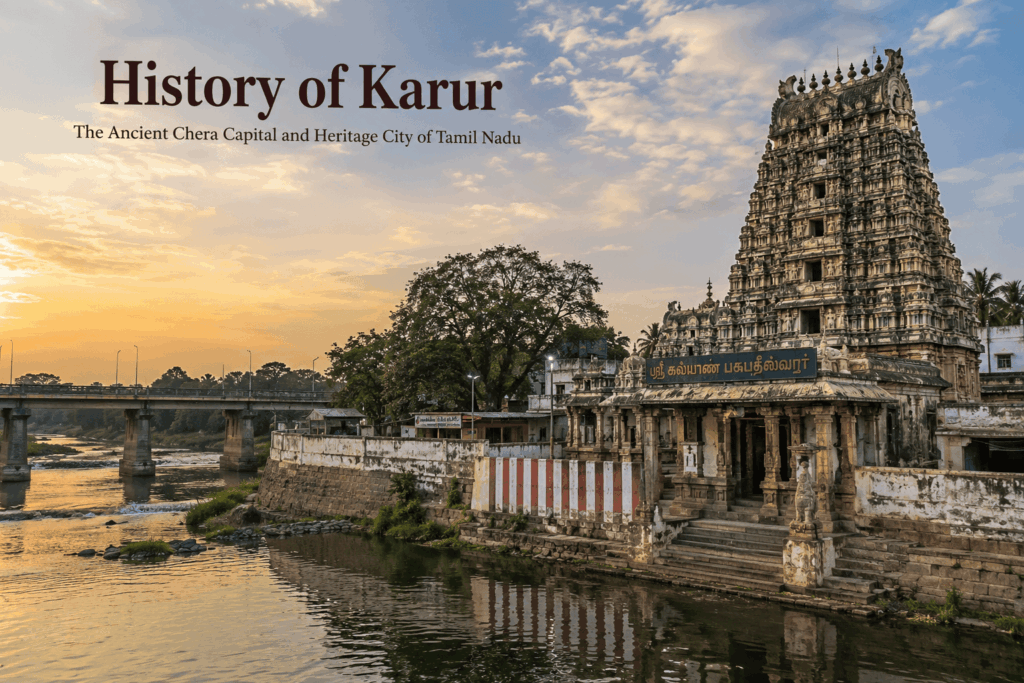
Karur is one of the oldest continuously inhabited cities in Tamil Nadu and holds a distinguished place in the history of South India. Located on the banks of the Amaravathi River, a tributary of the Kaveri, Karur was once the flourishing capital of the early Chera dynasty and an important center for trade, administration, culture, and religion. Its strategic location at the crossroads of inland trade routes made it a vibrant commercial city that connected the western coast of India with the fertile plains of the Kaveri basin.
For more than two thousand years, Karur has witnessed the rise and fall of powerful kingdoms, including the Cheras, Cholas, Pandyas, Vijayanagara Empire, Madurai Nayaks, Mysore rulers, and the British. The city’s rich archaeological discoveries, Sangam literature, ancient inscriptions, Roman coins, and temple architecture provide valuable insights into its remarkable past.
Karur is particularly famous for its role in the Sangam Age, when it emerged as one of South India’s most prosperous urban centers. Merchants from Rome, Greece, Egypt, Arabia, and Southeast Asia traded with the Chera kingdom through ports on the western coast, while Karur served as an important inland commercial hub. Goods such as spices, gemstones, ivory, textiles, iron products, and precious metals passed through the city, contributing significantly to the wealth of the Chera rulers.
Today, Karur is known for its thriving textile industry, bus body manufacturing, agriculture, and rich cultural heritage. Visitors come to explore its ancient temples, archaeological sites, and historical landmarks, while students and researchers continue to study its contributions to Tamil civilization.
This article explores the fascinating history of Karur, tracing its origins, political significance, archaeological discoveries, religious heritage, trade connections, and enduring legacy in Tamil Nadu.
Where Is Karur Located?
Karur is situated in central Tamil Nadu, approximately 75 kilometers west of Tiruchirappalli and around 130 kilometers east of Coimbatore.
The city lies on the banks of the Amaravathi River, close to its confluence with the Kaveri River.
This strategic location offered several advantages:
- Fertile agricultural land.
- Reliable water supply.
- Easy access to inland trade routes.
- Connections between eastern and western Tamil regions.
- Natural routes to the Western Ghats and Kerala.
These geographical benefits made Karur an ideal location for an ancient capital and commercial center.
Origin of the Name Karur
Historians have proposed several explanations for the origin of the name Karur.
Some scholars believe the name derives from ancient Tamil words associated with settlement, fortification, or habitation. Others connect it to the city’s role as a fortified administrative center during the Chera period.
Ancient literary sources and inscriptions mention Karur by names such as:
- Karuvur
- Vanchi (in certain historical traditions)
- Karapuram
Many historians identify Karur with Vanchi, the celebrated capital of the early Chera kingdom mentioned in Sangam literature, although scholarly discussions continue regarding this identification.
Karur During the Sangam Age
The Sangam Age (approximately 300 BCE–300 CE) represents the golden period of Karur’s early history.
During this time, Karur developed into:
- A royal capital.
- A thriving trading center.
- An important military headquarters.
- A cultural and literary hub.
Sangam poems describe prosperous towns ruled by the Chera kings, highlighting fertile lands, active markets, generous rulers, and successful military campaigns.
Karur benefited greatly from its position at the junction of important trade routes connecting the western coast, the Kaveri basin, and the Tamil interior.
Karur as the Capital of the Chera Kingdom
One of Karur’s greatest historical distinctions is its association with the early Chera dynasty, one of the three major Tamil kingdoms alongside the Cholas and Pandyas.
Many historians believe Karur served as the Chera capital during the Sangam period.
From this strategic city, the Chera rulers governed extensive territories stretching across parts of present-day Tamil Nadu and Kerala.
Karur functioned as:
- The administrative headquarters.
- A military base.
- A commercial center.
- A royal residence.
- A center for taxation and governance.
Its prosperity strengthened the Chera kingdom and enhanced its influence throughout South India.
Famous Chera Kings Associated with Karur
Several renowned Chera rulers are mentioned in Sangam literature.
Uthiyan Cheralathan
One of the earliest known Chera kings, Uthiyan Cheralathan is remembered for consolidating the Chera kingdom and encouraging trade.
Nedum Cheralathan
Nedum Cheralathan expanded Chera influence through military campaigns and maintained strong trade relations with foreign merchants.
His reign contributed significantly to Karur’s growing importance.
Senguttuvan Chera (Cheran Senguttuvan)
Perhaps the most celebrated Chera ruler, Senguttuvan is remembered for:
- Promoting Tamil culture.
- Encouraging trade.
- Supporting literature.
- Strengthening administration.
He is also associated with the famous Pattini (Kannagi) cult, which later spread to Sri Lanka and other regions.
Trade and Commerce in Ancient Karur
Karur became one of South India’s busiest inland trading centers.
Its merchants traded with ports on both the eastern and western coasts of India.
Goods transported through Karur included:
- Black pepper.
- Cardamom.
- Cotton textiles.
- Iron tools.
- Steel products.
- Precious stones.
- Gold ornaments.
- Ivory.
- Sandalwood.
Trade generated enormous wealth for the Chera kingdom.
Roman Trade Connections
One of the most fascinating aspects of Karur’s history is its connection with the Roman Empire.
Roman merchants reached India’s western coast through Arabian Sea trade routes.
Goods were transported inland to Karur using well-established commercial networks.
Archaeological excavations have uncovered:
- Roman gold coins.
- Silver coins.
- Amphora fragments.
- Glass beads.
- Imported ceramics.
- Luxury objects.
These discoveries confirm Karur’s participation in international commerce during the early centuries CE.
Archaeological Discoveries
Karur has yielded some of the richest archaeological evidence in Tamil Nadu.
Excavations have revealed:
- Black-and-red ware pottery.
- Rouletted ware.
- Roman coins.
- Chera coins.
- Gold ornaments.
- Copper objects.
- Iron weapons.
- Brick structures.
- Beads.
- Terracotta figurines.
- Ring wells.
These discoveries demonstrate that Karur was an advanced urban settlement with active trade and skilled craftsmanship.
Archaeologists continue to study these findings to better understand ancient South Indian civilization.
Karur in Sangam Literature
Karur is indirectly celebrated in several Sangam works that praise the Chera rulers and their prosperous capital.
The poems describe:
- Brave kings.
- Fertile agricultural lands.
- Prosperous merchants.
- Successful military campaigns.
- Lavish royal courts.
- Patronage of poets.
These literary references remain valuable historical sources for reconstructing Karur’s early history.
Religious Heritage of Karur
Religion has always been an important part of Karur’s identity.
The city became home to several significant Hindu temples.
Among the most famous is the Sri Kalyana Pasupatheeswarar Temple, dedicated to Lord Shiva.
The temple is known for:
- Ancient inscriptions.
- Dravidian architecture.
- Religious festivals.
- Historical significance.
Karur also has important Vishnu temples and shrines that reflect the city’s long-standing spiritual traditions.
Why Karur Continues to Be Historically Important
Karur occupies a unique place in Tamil Nadu’s history because it represents the political, commercial, and cultural achievements of the early Chera kingdom.
Its importance includes:
- Serving as the capital of the early Cheras.
- Acting as a major inland trading center.
- Maintaining international trade with Rome.
- Preserving valuable archaeological evidence.
- Encouraging Tamil literature and culture.
- Continuing its tradition as a center for textiles and commerce.
For students, competitive exam aspirants, researchers, and history enthusiasts, Karur offers an exceptional opportunity to understand the evolution of ancient South Indian civilization and the maritime and inland trade networks that connected India with the wider world.